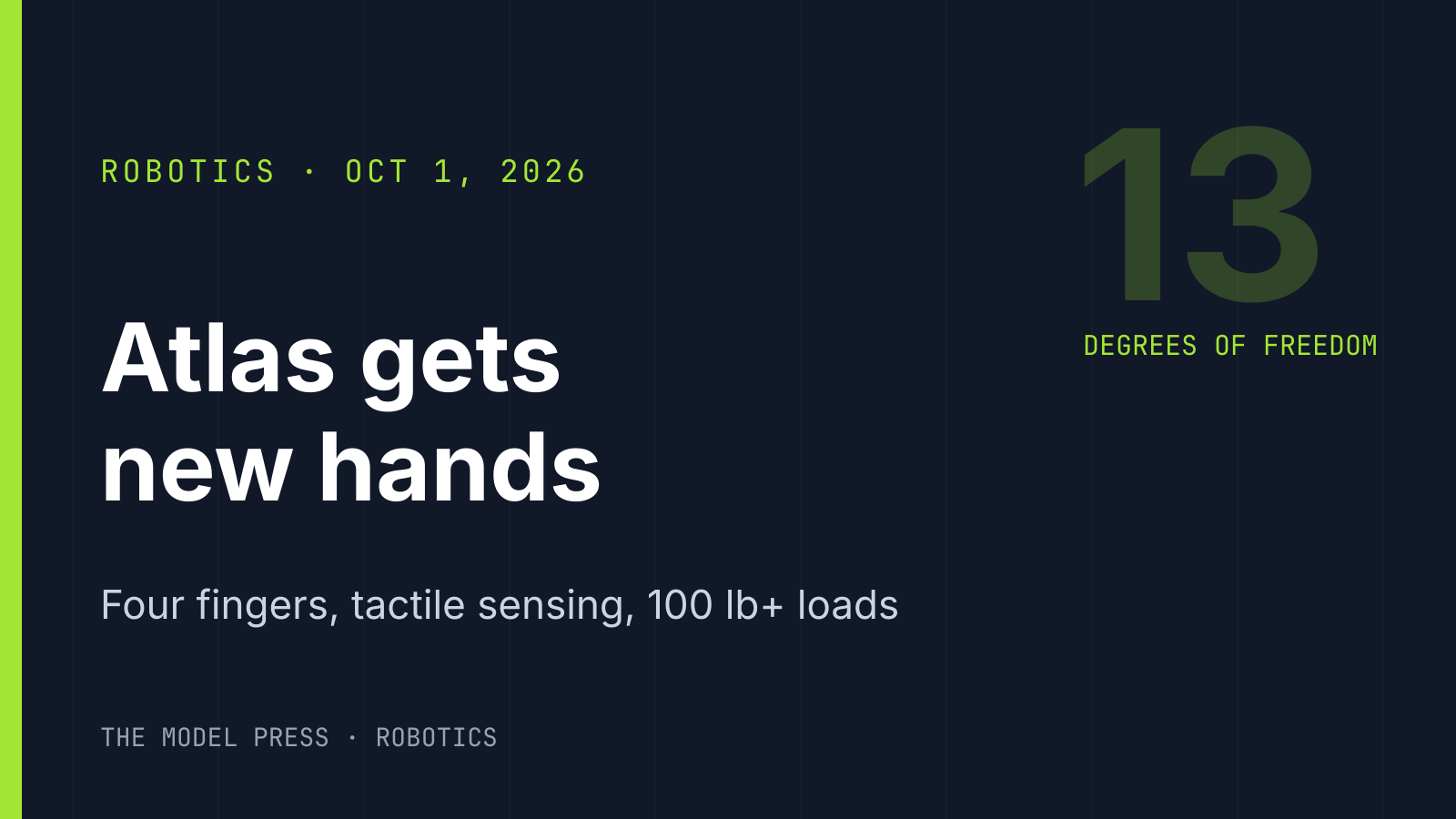
Boston Dynamics detailed a new hand for its Atlas humanoid robot on October 1, 2026. According to the company’s engineering post, the new Atlas robot hand has 13 degrees of freedom (DOF), up from 7 on the previous Atlas hand, with four fingers including an opposable thumb and dense pressure-sensing tactile sensors on the fingertips and palm.
Boston Dynamics describes the hand as “a little bit larger than an average human hand, but it’s also on average, a bit stronger,” and says it keeps the strength of the previous hand, remaining “capable of carrying a 100lb+ loaded minifridge.”
On this page
The new hand at a glance
| Item | As stated by Boston Dynamics |
|---|---|
| Degrees of freedom | 13 (previous Atlas hand: 7) |
| Digits | Four, including an opposable thumb |
| Sensing | Dense pressure tactile sensors on fingertips and palm |
| Actuation | Direct actuation, a single actuator type throughout |
| Cabling | Fully encapsulated, no cables crossing joints |
| Load | Can carry a 100 lb+ loaded minifridge |
With the extra joints, Boston Dynamics lists grasps the hand can make: pinch grasps between the thumb and other fingers, tripodal grasps with controlled strength, the thumb sliding along the other fingers, and “triggered tool grasps, like drills, power torque drivers, grinders, nail guns, and welding torches.”
Why four fingers
The company chose not to add a fifth finger, saying “four fingers and 13 DOFs already unlock in-hand reorientation, recovery from a slipping grasp, and handling tools.” The post recounts that team members taped fingers together for a day to judge whether a pinky was needed; the result was a four-finger design. Boston Dynamics ties this to manufacturing, describing “the fight to manufacture reliable hardware at large scale and low cost.”
Built for training in simulation
Much of the design targets how the hand will be trained. Boston Dynamics says the hand’s “rigid-drive actuation and backdrivable transmission” make it possible to simulate accurately, which matters for reinforcement learning with domain randomization, and reports “promising sim2real transfer in dynamic tasks.”
Backdrivability means the joints give way when pushed. The company says this serves two purposes: the hand can sense forces through its own joints for dexterous work, and on impact the joints move away instead of damaging the gearboxes.
The post’s stated goal is tool use: “The ultimate general-purpose dexterous manipulator will not be an over-complicated hand, but one that is reliable and is capable of using tools.”
More humanoid robot announcements are in Humanoid robots news, and model releases from the AI labs, dated from their own announcements, are listed in AI model updates.