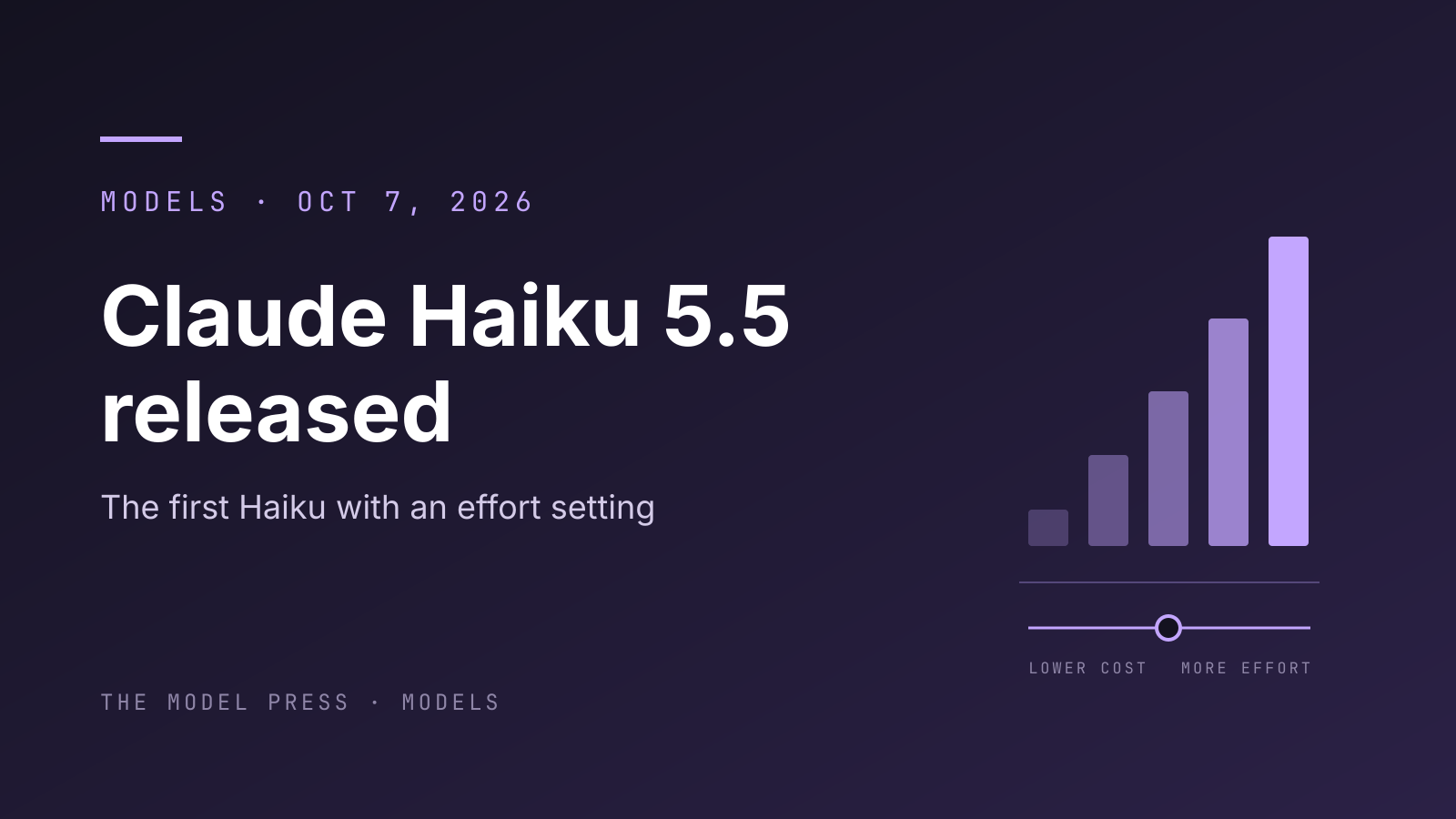
Anthropic released Claude Haiku 5.5 on October 7, 2026, the small, fast model of its Claude 5.5 family. The announcement calls it Anthropic’s fastest model to date and positions it for high-volume work: summaries, compaction, database queries, classification and request routing, as well as speed-sensitive jobs such as live customer support and browser use. It joins Claude Opus 5.5, released on September 22, and Claude Sonnet 5.5, released on September 28.
The release is available immediately under the API name claude-haiku-5-5.
On this page
The first Haiku with an effort setting
The main functional change is control over how hard the model works. Haiku 5.5 is the first Haiku-class model with an adjustable effort setting, as Anthropic’s other current models already have; developers can trade answer quality against cost and latency per task instead of choosing one setting for a whole workload. Anthropic’s announcement charts the model’s scores at each effort level on OSWorld, GDPval-AA and Humanity’s Last Exam.
Anthropic also describes Haiku 5.5 as a subagent: a larger model such as Opus 5.5 plans a coding task and hands narrow subtasks to Haiku, so many agents can run in parallel. Its Haiku product page adds simple coding, multi-step tool use and repetitive browser and desktop automation such as form filling and data entry. Alongside the launch, Anthropic updated its Python and TypeScript SDKs with beta support for computer use and browser use.
Anthropic is explicit about the limits. It says Sonnet 5.5 and Opus 5.5 remain the better choice for complex agentic coding of the kind measured by Terminal-Bench 4.0, and that Haiku 5.5 suits narrowly scoped tasks.
Benchmark results Anthropic published
The scores below are Anthropic’s own, from its launch table; the Haiku 5.5 system card describes how the evaluations were run.
| Benchmark (as reported by Anthropic) | Haiku 5.5 | Haiku 4.5 | Sonnet 5.5 |
|---|---|---|---|
| GDPval-AA v2.1 (score) | 1620 | 735 | 1840 |
| AA-Briefcase v1.1 (score) | 1578 | 614 | 1824 |
| OSWorld 2.1, offline subset | 72.4% | 15.7% | 83.9% |
| Humanity’s Last Exam, no tools | 45.9% | 10.2% | 56.9% |
| Humanity’s Last Exam, with tools | 57.4% | 18.7% | 64.5% |
| Terminal-Bench 4.0 | 39.2% | 0.0% | 70.6% |
| FrontierCode 1.1 (Main) | 46.4% | — | 52.1% (xhigh effort) |
| Chartography, no tools | 46.4% | 6.4% | 61.6% |
The same table compares Haiku 5.5 with OpenAI’s GPT-6 Luna, which scored 1437 on GDPval-AA, 48.9% on the OSWorld 2.1 offline subset, 16.4% on Terminal-Bench 4.0 and 42.4% on FrontierCode 1.1 in Anthropic’s runs. The system card says that in a few areas Haiku 5.5 rivalled or exceeded Sonnet 5.5. Scores from different benchmarks and effort settings are not one ranking; lab-reported results are collected with their sources on our LLM leaderboard.
Safeguards
Anthropic reports large improvements over Haiku 4.5 on its alignment evaluations, with fewer instances of misaligned behaviour and lower willingness to cooperate with misuse.
Its cybersecurity safeguards sit between those of earlier models: more restrictive than Haiku 4.5’s, less restrictive than those on other recent Claude models. Anthropic says they allow a wider range of defensive security work than Sonnet 5.5’s safeguards but still block penetration testing and other techniques more likely to be used by attackers. Biology safeguards match those of Sonnet 5, Sonnet 5.5 and Opus 5. Organisations that need wider access can apply to the Life Sciences Verification Program or the Cyber Verification Program, which Anthropic expanded to three tiers on October 6.
Where Haiku 5.5 runs
According to Anthropic, Haiku 5.5 is available:
- in the Claude apps on web, iOS and Android, selectable on Free, Pro, Max, Team and Enterprise plans;
- in Claude Code;
- on the Claude Platform API as
claude-haiku-5-5; - through Amazon Web Services, Google Cloud and Microsoft Foundry. AWS confirmed availability on Amazon Bedrock and Claude Platform on AWS the same day.
Every release since July 2026 is logged with its date in our AI model updates tracker.