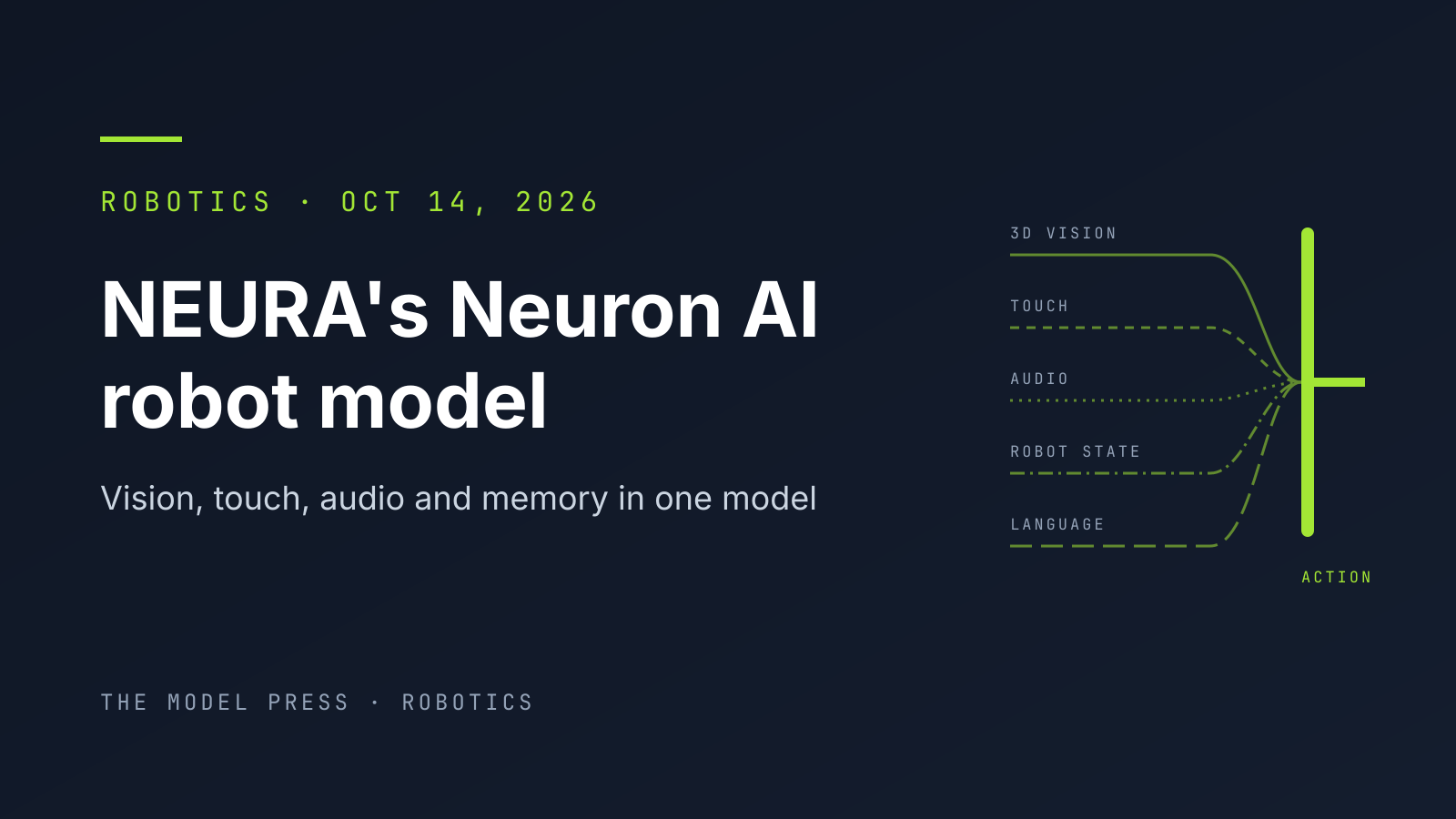
NEURA Robotics introduced Neuron AI, a foundation model for robots, on October 14, 2026. In its announcement, the German company says the model takes in 3D vision, touch and force data, audio, the robot’s own state and language, keeps a memory of what has happened, and turns all of it into a single stream of actions. NEURA calls the design a Perception-Language-Action (PLA) architecture.
The pitch is aimed at a gap in camera-first robot models. A camera reports geometry, colour and position, but not whether a screw has caught or a connector has clicked into place. NEURA’s examples are concrete: only sound and touch confirm that a lock has opened, touch lets a robot grasp an object it cannot see, and in welding the sound of the process says something about the quality of the seam.
On this page
What Neuron AI combines
According to NEURA, the model does not treat each sensor as a separate input. It encodes the five kinds of signal, aligns them in one shared space over time and outputs actions from that combined picture.
The second ingredient is memory. NEURA says it changed the model’s architecture so a robot can keep track of objects that have left its field of view and of the results of its own earlier actions, and that it trains the model on datasets built to exercise that ability. The company compares it to object permanence, which people learn in their first two years.
How it is trained and deployed
NEURA names three data sources for Neuron AI:
- Real robot data collected in the NEURA Gyms, its training sites, where robots of different shapes perform tasks and record synchronised vision, touch, force, audio and movement.
- Simulation-amplified data, in which NEURA’s Data Amplifier and simulation stack generate variations of tasks and environments.
- Human demonstrations recorded by people wearing sensor-equipped data suits.
One model serves five NEURA robot embodiments with different grippers and hands. Customers fine-tune it for their own tasks and push the resulting skills to fleets of robots through Neuraverse, NEURA’s platform; they can keep those skills private or share them. The company names “Time-to-Skill”, how quickly a robot learns a new task and performs it reliably, as the measure it is working to shorten.
NEURA says the model was developed and trained in-house in Metzingen, Germany, and that data partnerships with Schaeffler and Bosch add to what it collects in its own Gyms. The announcement gives no parameter count, benchmark scores or release date for outside developers.
The laundry demonstration at GTC Berlin
NEURA has scheduled a public demonstration at NVIDIA GTC Berlin 2026, from October 20 to 22 at Station-Berlin. There, the company says, its 4NE1 humanoid will run an eleven-minute laundry sequence with the current version of Neuron AI and no human intervention: sorting laundry, loading a washing machine, closing and reopening it, unloading it and moving the laundry to a dryer. The point of the demo, in NEURA’s words, is carrying context from one step to the next across a long task, not any single movement.
Neuron AI joins a crowded field of robot foundation models. Google DeepMind released Gemini Robotics 2 on July 30, 2026, and Figure reported Helix 2.5 running zero-shot in 30 homes on September 17. NEURA’s distinguishing claim is the sensor mix: touch, force and audio sit alongside vision and language in the same model. For what separates humanoids like 4NE1 from the industrial arms already in factories, see humanoid vs industrial robots; more announcements are in Humanoid robots news.