ARC-AGI is a family of reasoning benchmarks from ARC Prize, scored against what first-time human players manage. ARC-AGI-2 is a static set of tasks; ARC-AGI-3, the newest version and a track of ARC Prize 2026, drops an AI agent into game environments with no instructions and scores how efficiently it reaches each goal compared with people.
This explainer uses ARC Prize’s own competition pages, scoring methodology and leaderboard, checked November 18, 2026.
On this page
Three versions, static and interactive
The public leaderboard reports scores for three versions side by side. ARC Prize describes ARC-AGI-2 as “a static reasoning benchmark” in its 2026 competition overview, while ARC-AGI-3 is “the first interactive reasoning benchmark” (ARC-AGI-3 competition page).
The difference matters for how a result reads. On a static set, a system sees a task and produces an answer. On ARC-AGI-3, ARC Prize says agents “must efficiently explore, adapt, and act within dynamic environments”, which tests exploration, building a model of the environment, setting goals and carrying out a plan. ARC Prize also says the games used for evaluation sit in a hidden hold-out set, so “these games can’t be memorized” (Milestone #1 post, July 6, 2026).
The older versions are close to saturated at the top of the leaderboard. Several frontier systems listed there score 98.5% on ARC-AGI-1 and above 93% on ARC-AGI-2, against a human panel row of 98.0% and 100.0% (leaderboard, checked November 18, 2026). ARC-AGI-3 is where the scores still spread out.
How ARC-AGI-3 is scored
ARC-AGI-3 does not count correct answers. Its metric, which ARC Prize calls RHAE, “measures per-level action efficiency compared to a human baseline, normalized per game, across all games” (methodology). An action is an input that changes the game state; reasoning steps, tool calls and retries do not count.
The calculation, as ARC Prize documents it:
| Step | Rule |
|---|---|
| Level score | (human baseline actions ÷ AI actions)², so 20 actions against a 10-action baseline scores 0.25 |
| Cap | A level can score at most 1.15 times the human baseline |
| Game score | Weighted average of level scores, with later levels weighted more (by level number) |
| Unfinished games | Levels not completed cap the game score; ARC Prize’s example game with five levels tops out at 66.7% if only levels 1–4 are completed |
| Total | Average of all game scores, from 0% to 100% |
Squaring the ratio punishes waste hard. An agent that needs twice as many moves as the baseline keeps a quarter of the credit for that level, not half.
Where the human baseline comes from
The baseline for each level is “the upper median human (by fewest actions)” among people playing that game for the first time (methodology). ARC Prize changed this in April 2026: the baseline moved from the second-best player to the median player per level, and the per-level cap rose from 100% to 115%, a change it says moved scores by about half a percentage point for both humans and AI (human dataset post, April 14, 2026).
The same post describes the human testing behind it: 458 participants in 90-minute in-person sessions in San Francisco, 135 environments in ARC-AGI-3, and a public demo set covering 25 of them. ARC Prize says every environment was beaten by at least two independent participants.
ARC Prize 2026: tracks, money and dates
ARC Prize 2026 ran on Kaggle with three tracks: ARC-AGI-3, ARC-AGI-2 and a Paper Prize, with “$2M in prizes” in total (competition overview). Kaggle evaluation runs without internet access, so API-based systems such as hosted frontier models cannot enter, and leading entries must open-source their solutions to be eligible.
The ARC-AGI-3 track carried $850,000 (ARC-AGI-3 competition page):
| Prize | Amount | Condition |
|---|---|---|
| Grand Prize | $700,000 | First eligible agent to score 100% on the ARC-AGI-3 evaluation; rolls over to the next competition if not won |
| Top Score Awards | $75,000 | Guaranteed: $40K, $15K, $10K, $5K, $5K for places 1–5 |
| Milestone Prizes | $75,000 | Two milestones, June 30 and September 30, 2026 |
Key dates: the competition opened March 25, 2026; submissions closed November 2 and papers November 8; results are due December 4, 2026. The first milestone went to Tufa Labs for “The Duck”, an open-source setup in which a small model writes and runs Python in a live REPL, running Qwen 3.6 27B locally (Milestone #1 post).
Frontier model scores on ARC-AGI-3
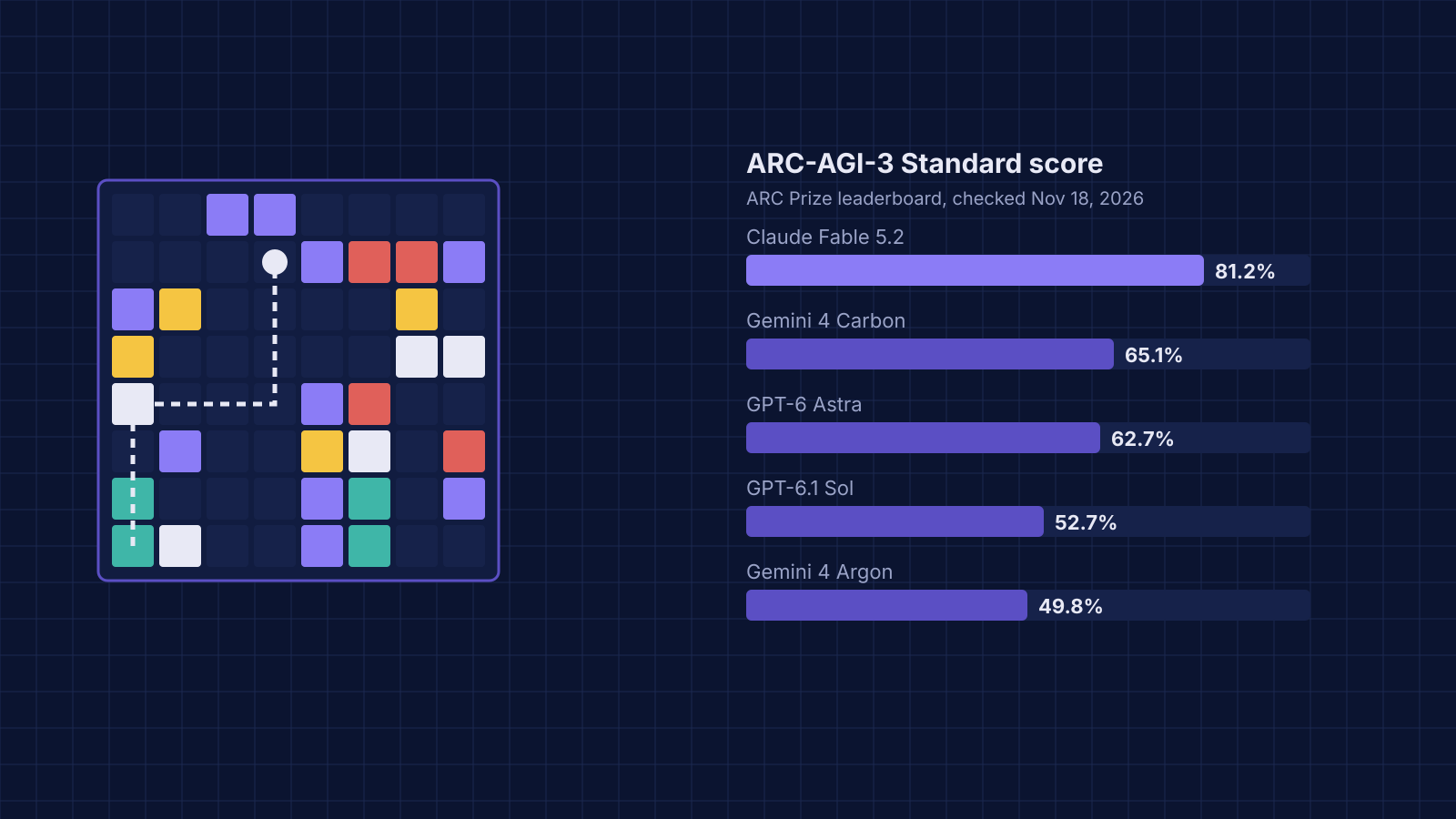
The leaderboard lists results for hosted frontier models separately from the Kaggle competition. Its ARC-AGI-3 “Standard” column, as listed on November 18, 2026 (leaderboard):
| Model | Date on leaderboard | ARC-AGI-3 Standard | ARC-AGI-2 |
|---|---|---|---|
| Claude Fable 5.2 | 2026-11-09 | 81.2% | 93.8% |
| Gemini 4 Carbon | 2026-11-10 | 65.1% | 94.2% |
| GPT-6 Astra | 2026-09-02 | 62.7% | 95.0% |
| GPT-6.1 Sol | 2026-09-29 | 52.7% | 94.2% |
| Gemini 4 Argon | 2026-10-13 | 49.8% | 91.3% |
| Claude Opus 5 | 2026-07-24 | 30.2% | 90.4% |
Two columns on the page are easy to mix up: next to “Standard” the leaderboard lists an “Adapter” score, which is much higher for the same models (99.9% for GPT-6 Astra, for example). Compare like with like. The leaderboard also lists a cost for each run, from a few hundred dollars for small models to $26.1K for GPT-6 Astra. Cost matters when comparing systems that reach similar scores.
The spread at the bottom is as telling as the top: several recent models, including Claude Haiku 5.5 and GPT-6 Luna, score under 1% on ARC-AGI-3 Standard while scoring around 60% on ARC-AGI-2.
How to read an ARC-AGI number
- Check the version. An ARC-AGI-1 score near 98% and an ARC-AGI-3 score near 50% describe different tests.
- Check the column. ARC-AGI-3 Standard and Adapter results differ sharply for the same model.
- Check who ran it. Kaggle competition entries run offline with open-source code; leaderboard entries for hosted models are a separate track. Lab-reported scores in announcements should be matched to the leaderboard where possible.
- Remember the metric. On ARC-AGI-3, a score below 100% can mean levels left unfinished or levels finished with more moves than people needed.