Anthropic’s Claude models, as of October 23, 2026, come in four generally available versions: Claude Fable 5.1, Claude Opus 5.5, Claude Sonnet 5.5 and Claude Haiku 5.5. A fifth, Claude Mythos 5.1, is the same model as Fable 5.1 with different safeguards and is open only to organisations in Anthropic’s trusted access programs. Below is the current line-up with its model IDs and limits, followed by every Claude model Anthropic has released since Claude 4 in May 2025, each dated from Anthropic’s own announcement or Claude Platform release notes.
On this page
The current Claude line-up
Anthropic’s models overview lists four current models. All four take text and image input, return text, support tool use and share the same context and output limits:
| Model | Claude API ID | Released | Context window | Max output | Knowledge cutoff | Earliest retirement |
|---|---|---|---|---|---|---|
| Claude Fable 5.1 | claude-fable-5-1 | September 1, 2026 | 1M tokens | 128K tokens | June 2026 | Not before September 1, 2027 |
| Claude Opus 5.5 | claude-opus-5-5 | September 22, 2026 | 1M tokens | 128K tokens | June 2026 | Not before September 22, 2027 |
| Claude Sonnet 5.5 | claude-sonnet-5-5 | September 28, 2026 | 1M tokens | 128K tokens | June 2026 | Not before September 28, 2027 |
| Claude Haiku 5.5 | claude-haiku-5-5 | October 7, 2026 | 1M tokens | 128K tokens | June 2026 | Not before October 7, 2027 |
Source: Anthropic models overview and model deprecations pages, checked October 23, 2026.
Anthropic describes the four by job. Fable 5.1 is “for demanding reasoning and long-horizon agentic work”, Opus 5.5 “for long-running agentic coding and knowledge work”, Sonnet 5.5 is “the best combination of speed and intelligence”, and Haiku 5.5 is for “high-volume, latency-sensitive tasks such as classification, extraction, and routing”. The docs rank their latency from slower (Fable 5.1) through moderate (Opus 5.5) and fast (Sonnet 5.5) to fastest (Haiku 5.5).
The docs’ own starting advice is to use Opus 5.5 for most workloads and to move up to Fable 5.1 when evaluations on Opus 5.5 at higher effort still fall short. Thinking is adaptive on all four and always on for Fable 5.1 and Opus 5.5. Default effort is high on Fable 5.1 and Sonnet 5.5 and medium on Opus 5.5 and Haiku 5.5. Haiku 5.5 is the first Haiku-class model with an adjustable effort setting, according to Anthropic’s launch post.
The same IDs work on the Claude API, Claude Platform on AWS, Microsoft Foundry and both Google Cloud routes; Amazon Bedrock prefixes them with anthropic., as in anthropic.claude-opus-5-5.
Four lines: Haiku, Sonnet, Opus and Fable
Claude model names carry a line and a version number. Haiku, Sonnet and Opus are the long-running small, mid-size and large lines. Fable and Mythos arrived in 2026 above Opus.
Mythos started as a restricted model. On April 7, 2026, Anthropic announced Claude Mythos Preview as a gated research preview for defensive cybersecurity work under Project Glasswing, with access by invitation only. Anthropic said Mythos Preview could find and exploit software vulnerabilities better than all but the most skilled humans, and that this was why it kept the release limited.
Fable is the general-availability version of that class. On June 9, 2026, Anthropic launched Claude Fable 5, calling it “a Mythos-class model that we’ve made safe for general use”, alongside Claude Mythos 5 for Project Glasswing participants. With Fable 5.1 and Mythos 5.1, Anthropic states it outright: “Claude Fable 5.1 and Claude Mythos 5.1 are the same model, but with different levels of safeguards.” Fable 5.1 is generally available; Mythos 5.1 goes through trusted access programs, with safeguards designed for work in cybersecurity and the life sciences.
So a newer version number does not always mean a stronger model across lines. Anthropic says Opus 5.5 “performs at the level of Claude Fable 5.1 on most work”, while still placing Fable 5.1 above it for the hardest reasoning and agentic tasks. Within a line, a higher number replaces the lower one. For programs that need to group models, the Models API now returns a line field for each model, and the docs advise reading it rather than inferring the line from the model ID.
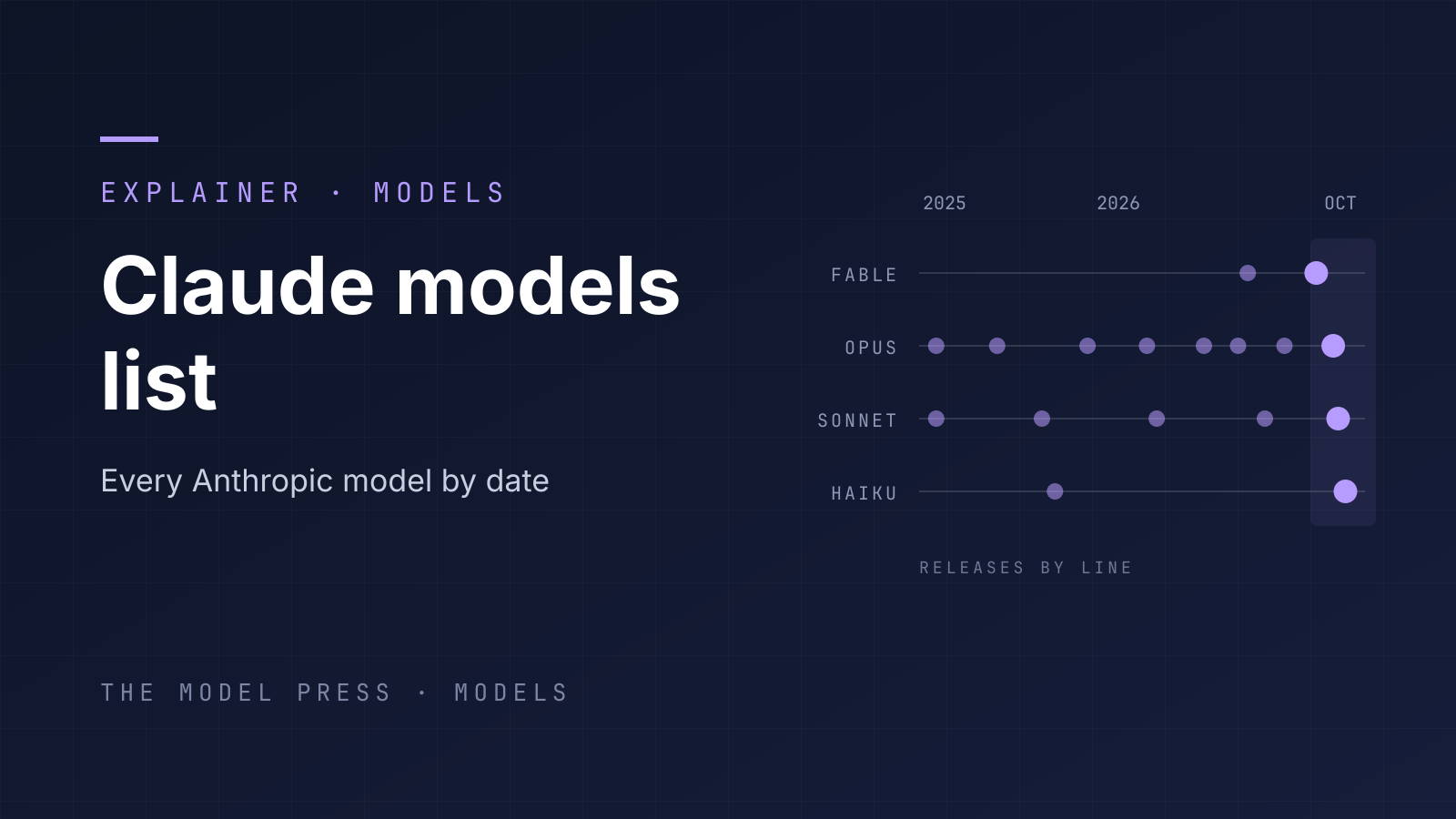
Every Claude model by date, since Claude 4
| Date | Model | API ID | What Anthropic said at launch | Status, October 23, 2026 |
|---|---|---|---|---|
| May 22, 2025 | Claude Opus 4 and Claude Sonnet 4 | claude-opus-4-20250514, claude-sonnet-4-20250514 | The next generation of Claude models, for coding, advanced reasoning and agents | Retired June 15, 2026 |
| August 5, 2025 | Claude Opus 4.1 | claude-opus-4-1-20250805 | An upgrade to Opus 4 on agentic tasks, real-world coding and reasoning | Retired August 5, 2026 |
| September 29, 2025 | Claude Sonnet 4.5 | claude-sonnet-4-5-20250929 | Released with the Claude Agent SDK and Claude Code checkpoints | Deprecated; retires November 30, 2026 |
| October 15, 2025 | Claude Haiku 4.5 | claude-haiku-4-5-20251001 | Coding performance similar to Sonnet 4 at more than twice the speed | Active |
| November 24, 2025 | Claude Opus 4.5 | claude-opus-4-5-20251101 | Aimed at coding, agents and computer use | Active |
| February 5, 2026 | Claude Opus 4.6 | claude-opus-4-6 | The first Opus-class model with a 1M-token context window, in beta | Active |
| February 17, 2026 | Claude Sonnet 4.6 | claude-sonnet-4-6 | Upgrades across coding, computer use and long-context reasoning; 1M context in beta | Active |
| April 7, 2026 | Claude Mythos Preview | claude-mythos-preview | Invitation-only research preview for defensive cybersecurity, Project Glasswing | Deprecated June 9, 2026; retirement date to be announced |
| April 16, 2026 | Claude Opus 4.7 | claude-opus-4-7 | Gains on the hardest coding tasks, higher-resolution vision, new cyber safeguards | Active |
| May 28, 2026 | Claude Opus 4.8 | claude-opus-4-8 | Builds on Opus 4.7; launched with user-set effort in claude.ai | Active |
| June 9, 2026 | Claude Fable 5 and Claude Mythos 5 | claude-fable-5, claude-mythos-5 | A Mythos-class model made safe for general use; Mythos 5 for Project Glasswing participants | Active (access suspended June 12, restored July 1, 2026) |
| June 30, 2026 | Claude Sonnet 5 | claude-sonnet-5 | Built to be the most agentic Sonnet model yet, close to Opus 4.8 | Active |
| July 24, 2026 | Claude Opus 5 | claude-opus-5 | Close to the frontier intelligence of Fable 5; our record | Active |
| September 1, 2026 | Claude Fable 5.1 and Claude Mythos 5.1 | claude-fable-5-1, claude-mythos-5-1 | One model with two levels of safeguards; our report | Active |
| September 22, 2026 | Claude Opus 5.5 | claude-opus-5-5 | The first model of the Claude 5.5 family; our report | Active |
| September 28, 2026 | Claude Sonnet 5.5 | claude-sonnet-5-5 | The second 5.5 model, more than 30% faster than Sonnet 5; our report | Active |
| October 7, 2026 | Claude Haiku 5.5 | claude-haiku-5-5 | Anthropic’s fastest model to date, for high-volume work; our report | Active |
Dates are Anthropic’s launch dates from its announcements and Claude Platform release notes. Status is from Anthropic’s model deprecations page for Anthropic-operated platforms.
Two patterns stand out. The gap between versions has shortened: Opus went from 4.5 to 5.5 in ten months, through 4.6, 4.7, 4.8 and 5. And older models stay available longer than the release pace suggests: on October 23, 2026, Anthropic still lists Opus 4.5, 4.6, 4.7 and 4.8 as active, next to Opus 5 and Opus 5.5.
Older Claude models, all retired
Anthropic’s deprecations page records the end of every model before Claude 4. Requests to a retired model fail.
| Model | Retired | Replacement Anthropic recommends |
|---|---|---|
| Claude 1 and Claude Instant models | November 6, 2024 | Claude Haiku 4.5 |
| Claude 2.0, Claude 2.1 and Claude Sonnet 3 | July 21, 2025 | Opus 4.8 (for Claude 2), Sonnet 5.5 (for Sonnet 3) |
| Claude Sonnet 3.5 (both versions) | October 28, 2025 | Claude Sonnet 5.5 |
| Claude Opus 3 | January 5, 2026 | Claude Opus 4.8 |
| Claude Sonnet 3.7 | February 19, 2026 | Claude Sonnet 5.5 |
| Claude Haiku 3.5 | February 19, 2026 | Claude Haiku 4.5 |
| Claude Haiku 3 | April 20, 2026 | Claude Haiku 4.5 |
The next scheduled retirement is Claude Sonnet 4.5 on November 30, 2026. Anthropic notified developers on September 30 and recommends Sonnet 5.5 as the replacement.
How Claude models are retired
Anthropic uses four lifecycle terms. An active model is fully supported. A legacy model no longer receives updates and might be deprecated later. A deprecated model still works but is no longer recommended, and has a replacement and a retirement date. A retired model is no longer available.
Anthropic says it gives at least 60 days’ notice before retiring a publicly released model, and every current model’s entry carries a “not sooner than” date, one year after its launch. Those dates apply to Anthropic-operated platforms; Amazon Bedrock and Google-managed Claude on Google Cloud set their own retirement schedules, so a model’s status there can differ. Anthropic has also committed to preserving the weights of retired models.
New Claude releases are logged as they happen in our AI model updates tracker, scores that Anthropic and benchmark maintainers publish are on the LLM leaderboard, and our research reviews of Claude Opus 5.5 and Claude Sonnet 5.5 collect independent evaluations. What labs disclose about each model is covered in our model cards explainer.