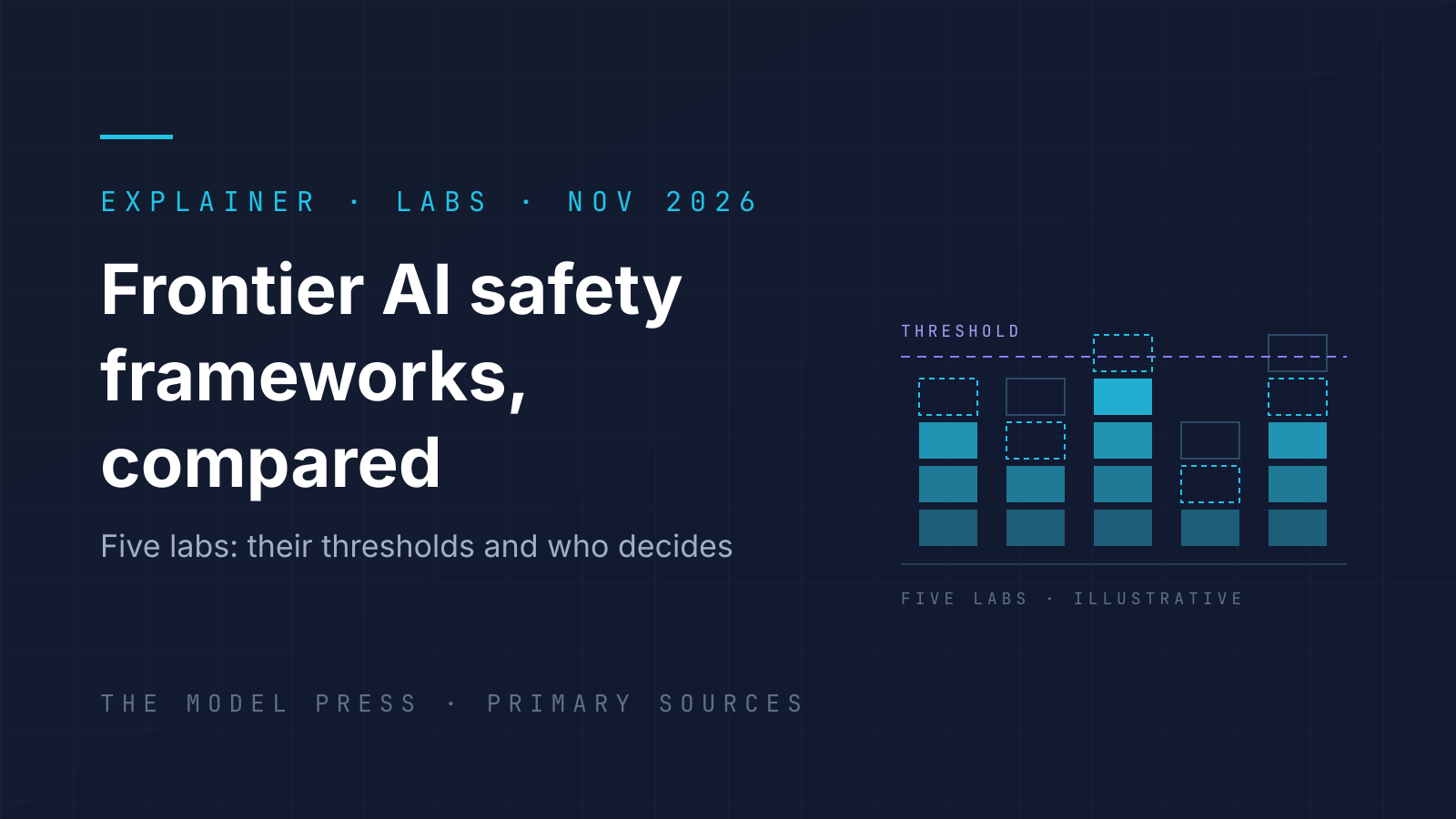
A frontier AI safety framework is a lab’s own published rulebook for its most capable models: which catastrophic risks it tests for, the capability level at which a model needs stronger safeguards, and who signs off before the model is trained further or released. Anthropic calls its version the Responsible Scaling Policy, OpenAI the Preparedness Framework, Google DeepMind the Frontier Safety Framework. Meta and xAI publish their own.
All five are voluntary documents written by the companies themselves, and they do not use the same words for the same things. “Critical” is the top of two levels at OpenAI, the main threshold at Google DeepMind and the highest of three tiers at Meta. This page compares the current versions as published on each lab’s site, checked on November 12, 2026, and then shows where the newest Anthropic, OpenAI and Google models actually landed under them.
On this page
The five frameworks side by side
| Anthropic | OpenAI | Google DeepMind | Meta | xAI | |
|---|---|---|---|---|---|
| Name | Responsible Scaling Policy (RSP) | Preparedness Framework | Frontier Safety Framework (FSF) | Meta Superintelligence Scaling Framework | Frontier Artificial Intelligence Framework (FAIF) |
| Current version | 3.4, effective July 8, 2026 | Version 2, last updated April 15, 2025 | 3.1, published April 17, 2026 | 2.1, October 2026 | Effective June 30, 2026 (no version number) |
| Risk areas | Chemical and biological weapons; misaligned AI in high-stakes settings; automated AI R&D | Tracked: biological and chemical, cybersecurity, AI self-improvement. Five more as research categories | CBRN, cyber, harmful manipulation; machine learning R&D and misalignment | Chemical and biological, cybersecurity, loss of control | CBRN, offensive cybersecurity, loss of control, harmful manipulation |
| Threshold levels | Four capability thresholds, each mapped to company mitigations and industry-wide recommendations | High and Critical | Critical Capability Levels (CCLs), with Tracked Capability Levels (TCLs) below them and alert thresholds as early warnings | Critical, High, Moderate or lower | Risk tiers and safety margins inside a “systemic risk acceptance determination” |
| What a threshold triggers | Mitigations set out in the policy; analysis published in Risk Reports | High: safeguards before deployment. Critical: safeguards during development too | Residual risk assessment; for a CCL, a safety case before external launch | Critical: develop with mitigations. High: deploy with mitigations. Moderate: deploy | Deployment only if risks are judged acceptable; options include limiting full functionality to trusted parties |
| Who decides | CEO and Responsible Scaling Officer; Board and Long-Term Benefit Trust notified, and must approve when marginal-risk arguments carry the case | Safety Advisory Group recommends; OpenAI Leadership decides | “The appropriate governance function” | Chief AI Officer or Director of Alignment and Risk | Not named in the framework |
| Public reporting | Risk Reports every 3 to 6 months, plus system cards | Capabilities and Safeguards Reports summarised in system cards | Model cards and safety and security reports | A preparedness report for each frontier release | Results “will be documented”; annual full assessment |
The sources for each cell are the framework documents linked in the sections below.
Anthropic: Responsible Scaling Policy 3.4
Anthropic published the first Responsible Scaling Policy on September 19, 2023 and lists nine versions since. Five of them took effect in 2026: version 3.0 on February 24, a rewrite, then 3.1 (April 2), 3.2 (April 29), 3.3 (May 26) and 3.4 (July 8).
The version 3.4 policy is built around a three-column table. The left column sets four capability thresholds: help with non-novel chemical or biological weapons, help with novel ones, misaligned AI systems relied on in high-stakes settings, and automated AI R&D. The middle column lists what Anthropic plans to do as a company. The right column lists what it thinks the whole industry should do at each threshold, which it says it “cannot commit to following unilaterally”.
That split is the main change from earlier versions. The policy argues that one developer pausing while others continue could leave the world less safe, so Anthropic separates its own plans from industry-wide recommendations and adds competitor-contingent commitments in an appendix. The old AI Safety Levels survive only as names for protections in place now: ASL-3 is still how Anthropic describes its current deployment and security standard.
The automated R&D threshold is the most precisely defined. It is met if Anthropic’s models could fully substitute for its entire set of research scientists and engineers at competitive cost (within a factor of five), or if AI progress runs at double its normal rate, “as much progress in one year as one would see in two years at baseline”, for reasons tied to automated research.
Findings go into Risk Reports, published every three to six months. The CEO and the Responsible Scaling Officer approve each report and share it with the Board and the Long-Term Benefit Trust. The most recent, the August 2026 Risk Report, was published on August 14 with a coverage date of July 15.
OpenAI: Preparedness Framework version 2
The newest Preparedness Framework on OpenAI’s site, checked November 12, 2026, is Version 2, “last updated: 15th April, 2025”. It tracks three categories: biological and chemical, cybersecurity, and AI self-improvement. Five more are research categories without thresholds yet: long-range autonomy, sandbagging, autonomous replication and adaptation, undermining safeguards, and nuclear and radiological. OpenAI’s announcement of version 2 says persuasion is handled outside the framework.
Each tracked category has two levels. A model at High needs safeguards that “sufficiently minimize” the risk before it is deployed. A model at Critical needs them during development as well. The Safety Advisory Group, a team of internal safety leaders, reviews capability and safeguard reports and recommends; OpenAI Leadership makes the final decision.
When version 2 was written, OpenAI said it did not have any model at Critical in any category. That changed in 2026. On August 7, 2026 OpenAI said it could not rule out Critical cyber capability for Astra, an upcoming model. It quoted the threshold: a model that can “identify and develop functional zero-day exploits of all severity levels in many hardened real-world critical systems without human intervention”, or plan and run novel end-to-end attacks against hardened targets from a high-level goal. On August 18 it described a two-week pause in reinforcement learning training on models intended for deployment and said: “We will evolve our Preparedness Framework to bring these safeguards together across training and deployment.”
OpenAI also published a separate Frontier Governance Framework on May 28, 2026. It is the document OpenAI uses to meet California’s Transparency in Frontier AI Act and the EU’s General-Purpose AI Code of Practice, and it covers cyber offense, CBRN, harmful manipulation and loss of control. OpenAI says the Preparedness Framework “remains the foundation” of its approach.
Google DeepMind: Frontier Safety Framework 3.1
Google DeepMind’s frontier safety page lists version 3.1, dated April 17, 2026, as current. Version 2.0 came out on February 4, 2025, and version 3.0 on September 22, 2025.
The version 3.1 document has three kinds of marker. Critical Capability Levels are the capability at which a model, without mitigations, may pose a risk of severe harm. Tracked Capability Levels, new in 3.1, sit lower and cover “significant” rather than severe harm; there is one for CBRN and one for stealth and situational awareness. Alert thresholds are early-warning signals that a CCL may be near.
When a model reaches a CCL, Google DeepMind writes a safety case and an “appropriate governance function” must judge the residual risk acceptable before external deployment. For the ML R&D levels the same applies to high-risk internal deployment. For misuse CCLs the framework recommends “Security Level 2+”, a baseline aligned with RAND’s Security Level 2 for model weights plus measures against insiders and well-resourced non-state attackers.
Meta: Superintelligence Scaling Framework 2.1
Meta’s framework has had three names. It began as the Frontier AI Framework on February 3, 2025, became the Advanced AI Scaling Framework (version 2.0) on April 7, 2026, and was renamed the Meta Superintelligence Scaling Framework, version 2.1, on October 2, 2026.
It covers chemical and biological, cybersecurity and loss-of-control risks, with three thresholds. Version 2.0 changed what each one means: Critical moved from “Stop” to “Develop with Mitigations”, High from “Do not release” to “Deploy with mitigations”, and Moderate or lower from “Release” to “Deploy”. Version 2.1 adds a new outcome, Loss of Control 3, for a model escaping containment during training or evaluation. Before a reinforcement learning run, Meta now checks whether the model could compromise its environment and, if so, requires vetted sandboxes, tamper-proof logging and monitors that can halt the run.
The Chief AI Officer and the Director of Alignment and Risk assign the risk threshold, and either can approve deployment. A model counts as frontier if it shows high capability in the framework’s risk areas or was trained with at least 10^26 operations. Meta commits to a preparedness report for each frontier release.
xAI: Frontier Artificial Intelligence Framework
xAI’s framework, effective June 30, 2026, names four risk domains: CBRN, offensive cybersecurity, loss of control and harmful manipulation. It sorts model behaviour into three buckets: abuse potential, such as vulnerability to jailbreaks; concerning propensities, such as deceiving the user; and dual-use capabilities, such as offensive cyber skill.
xAI commits to a full systemic risk assessment of its frontier models at least once a year, plus smaller evaluations at trigger points such as a model update or a serious incident. Before release it makes a “systemic risk acceptance determination” using risk tiers and safety margins, and it may limit a model’s full functionality to trusted parties, partners and government agencies. The document does not name who makes that determination.
Where the newest models landed
A framework describes thresholds; the lab’s model documentation says which ones a model reached. For the latest flagship from each of the three labs that publish model-level results under their framework:
| Model (release) | Framework | Lab’s determination |
|---|---|---|
| Claude Opus 5.5 (September 22, 2026) | RSP 3.4 | Deployed with ASL-3 protections, treated as having CB-1 capabilities. Does not cross CB-2 (novel chemical and biological weapons) or the automated AI R&D threshold |
| GPT-6.1 Sol (September 29, 2026) | Preparedness Framework v2 | Treated as Critical in cybersecurity and High in biological and chemical |
| Gemini 4 Argon (generally available October 13, 2026) | FSF 3.1 | Cannot rule out the biological CCL or the cyber CCL; safety cases written for both. Cannot rule out the stealth and situational awareness TCL. Harmful manipulation and ML R&D CCLs not reached |
Sources: Anthropic’s Transparency Hub and Claude Opus 5.5 system card; OpenAI’s GPT-6.1 Sol addendum; Google DeepMind’s Gemini 4 Argon model card.
Read the table row by row, not as a ranking. OpenAI’s Critical is its top level, while “cannot rule out” a CCL is Google DeepMind’s wording for treating a model as if it may have reached its main threshold. Anthropic’s statement that Opus 5.5 does not cross CB-2 rests on reported failures in its testing, such as DNA designs that did not encode the intended protein. Each determination is the lab’s judgment under its own definitions, run on its own evaluations.
Meta and xAI publish frameworks but are not in this table: we did not find a model-level determination from either company under its current framework.
How to read a framework
Check the version and date first. Anthropic changed its policy five times in 2026 and Meta renamed its framework twice in 18 months. A quote from an older version may describe a rule that no longer applies.
Find what the threshold triggers, not just where it sits. At Meta, crossing the top threshold now means “develop with mitigations” rather than stop. At OpenAI, Critical adds safeguards during development, not only at release.
Look for who decides. Anthropic, OpenAI and Meta name roles. Google DeepMind refers to a governance function. xAI does not say.
Keep the regulatory documents apart. OpenAI’s Frontier Governance Framework and Anthropic’s Frontier Compliance Framework exist to meet California and EU requirements. They overlap with the safety frameworks but are separate documents.
What labs disclose about each model is explained in our guide to AI model cards and system cards. OpenAI’s proposal for documented sign-off before frontier training runs is covered in OpenAI’s safety cases framework. Every model release we track is in AI model updates, and each lab’s ownership status is in AI companies.