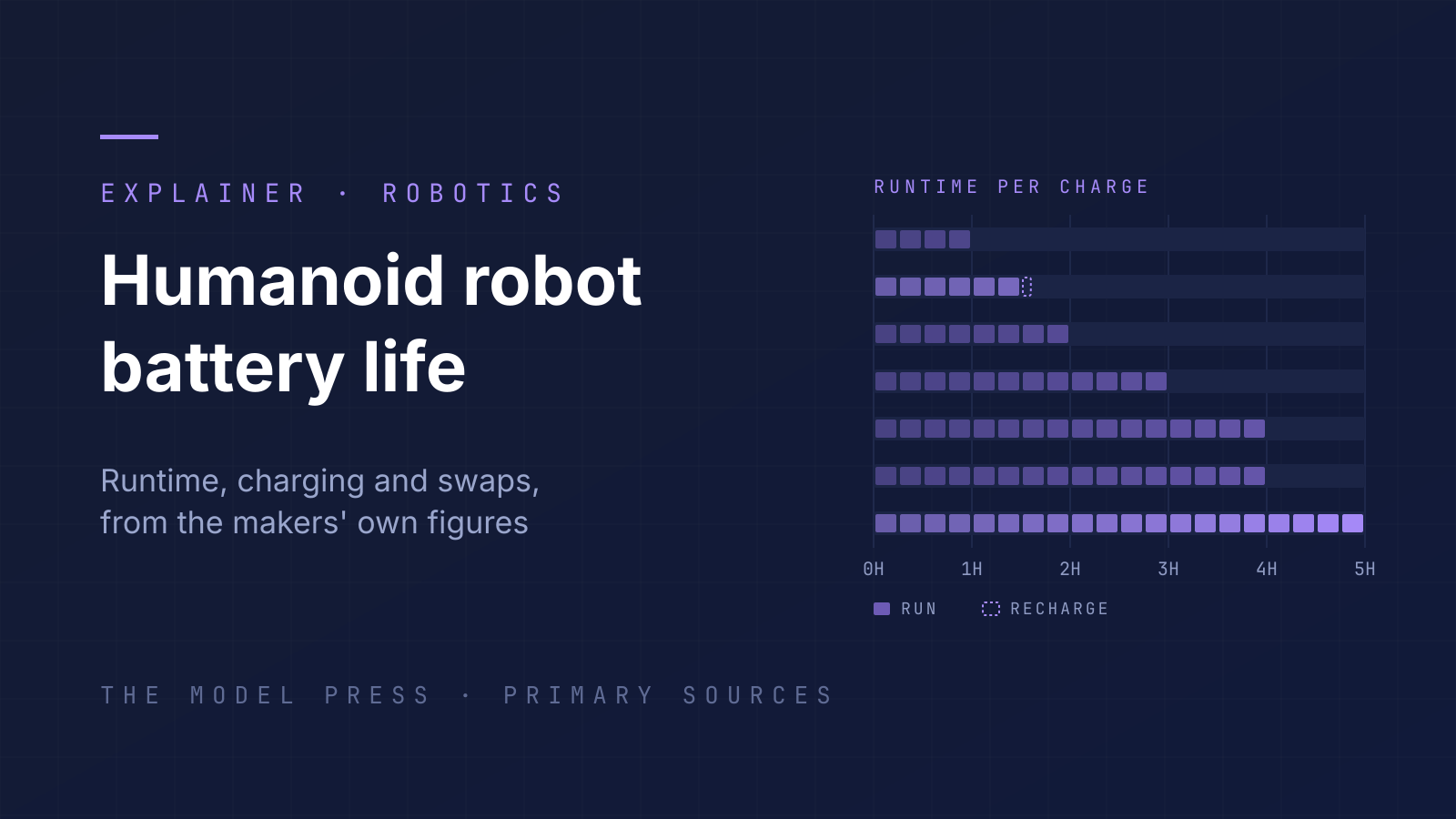
Humanoid robot battery life runs from about one hour to five hours on one charge, going by the figures makers publish. Unitree lists about 1 hour for the R1, about 2 hours for the G1 and about 3 hours for the H2. Boston Dynamics and 1X list 4 hours for Atlas and NEO, and Figure lists 5 hours for Figure 03.
Agility gives Digit 5 a shorter 90-minute runtime, but it recharges in 9 minutes. That points to the number that matters more for working robots: how long a robot is down between runs, not how long one charge lasts.
Last checked November 15, 2026, on each maker’s own product page or announcement.
On this page
Battery life by robot
| Robot | Maker | Runtime the maker lists | How it gets power back |
|---|---|---|---|
| R1 | Unitree | About 1 h | Quick-release smart battery and charger |
| Digit 5 | Agility Robotics | 90 min | Charges itself in 9 min (10:1 run-to-charge) |
| G1 | Unitree | About 2 h | Quick-release 9,000 mAh battery; 54 V, 5 A charger |
| H2 | Unitree | About 3 h | Quick-release 15 Ah (0.972 kWh) battery |
| Atlas | Boston Dynamics | 4 h | Walks to a station and swaps its own battery |
| NEO | 1X | 4 h | Plugs itself in; quick charge of 6 min per hour of runtime |
| Figure 03 | Figure | 5 h | Steps onto a wireless pad; inductive charging at 2 kW |
The runtimes are the makers’ own figures. None of them states the test conditions behind the number, such as the load carried, walking time or ambient temperature, and Unitree notes on its spec pages that its parameters “may vary in different scenarios and configurations”. Treat each runtime as the maker’s typical figure, not a guarantee for a given job.
Two other makers publish battery details without a runtime. Unitree lists an 864 Wh, quickly replaceable battery for its full-size H1. Apptronik says Apollo 2 uses swappable batteries for “7x22 operation”, with opportunity charging and tethering as options.
What the numbers imply about power draw
Only three robots come with both a battery size and a runtime, which is enough to work out the average power draw by dividing one by the other. These are our calculations from the makers’ figures:
| Robot | Battery | Runtime | Average draw over the runtime |
|---|---|---|---|
| Unitree H2 | 972 Wh | About 3 h | About 324 W |
| 1X NEO | 842 Wh | 4 h | About 210 W |
| Unitree G1 | About 420–435 Wh (our estimate) | About 2 h | About 210–220 W |
The G1 row needs an assumption. Unitree gives the battery as 9,000 mAh across 13 lithium cells in series but does not state watt-hours. At the 3.6 to 3.7 V nominal voltage typical of lithium-ion cells, that comes to roughly 420 to 435 Wh. Unitree’s 54 V, 5 A charger delivers at most 270 W, so refilling a flat G1 battery from that charger takes at least about 1.6 hours before charging losses. Unitree’s battery is quick-release, so a second pack can run the robot while the first one charges.
The comparison also shows why runtime alone says little. NEO and the G1 draw roughly the same average power, and NEO runs twice as long because its battery is about twice as large.
Charging time decides working hours
For robots that work shifts, the useful figure is the share of the day spent working. One cycle is the runtime plus the time to recharge, and the working share is runtime divided by that cycle.
- Digit 5. Agility puts the ratio at 10:1: 90 minutes of work, then 9 minutes on the charger. That is 90 of every 99 minutes, about 91%, or about 21.8 hours in a 24-hour day before any other downtime. Agility’s own claim is “more than 20 hours of productive work in a 24-hour day”. Digit 4 ran at 2:1, which works out to 16 hours a day by the same arithmetic.
- 1X NEO. 1X lists a quick charge of 6 minutes per hour of runtime. A full 4-hour run therefore needs about 24 minutes of charging, the same 10:1 ratio as Digit 5, if the quick-charge rate holds across the whole battery. 1X does not say that it does.
- Figure 03. Figure gives the charging power, 2 kW, but not the battery size. Ten minutes on the pad delivers up to about 333 Wh before losses. In its Figure 03 announcement, Figure describes this as allowing “near-continuous operation” as long as the robot can step onto a charging mat during its work.
- Atlas and Apollo 2. Swapping skips most of the charging wait. Atlas walks to a charging station and changes its own battery, which Boston Dynamics presents as the way to run continuously. Apptronik’s stated goal for Apollo 2’s swappable packs is what it calls “7x22 operation”.
So a 90-minute robot that charges in 9 minutes can work more hours a day than a 2-hour robot that needs more than an hour and a half on its charger. For a home robot like NEO or Figure 03, the question is simpler: whether it returns to its dock by itself. Both makers say it does.
Three ways to keep a humanoid running
Charge in place. The robot stops at a dock or pad and charges without help: Digit 5 at its charger, NEO by plugging itself in, Figure 03 through coils in its feet on a wireless stand. Downtime equals charging time, so charging speed is what makers advertise.
Swap the battery. Atlas does this without a person; Apollo 2’s packs are made for quick replacement by staff. Unitree’s quick-release smart batteries are built for the same approach. Downtime shrinks to the swap itself, at the cost of buying and charging spare packs.
Tether. Apptronik lists tethering as an option for Apollo. A cable removes the runtime limit for work at a fixed station, at the cost of the robot’s freedom to walk around.
For what these robots cost and who can buy them, see humanoid robots for sale. Digit 5’s other changes are in our Digit 5 report, and how Digit is used in warehouses is in our report on the GXO expansion. For how humanoids compare with the fixed robot arms in factories, see humanoid vs industrial robots.