Nvidia GR00T, often searched as “Nvidia Groot”, is NVIDIA’s open foundation model and development platform for humanoid robots. It takes camera images, a natural-language instruction and the robot’s own joint state, and outputs short sequences of joint motions. NVIDIA released the first version, GR00T N1, on March 18, 2025; the current version on its GitHub repository is GR00T N1.7. On October 21, 2026, at GTC Berlin, NVIDIA expanded the Isaac platform around it with a reference humanoid and new training workflows.
Everything below comes from NVIDIA’s own announcements, documentation and research paper.
On this page
GR00T at a glance
| Release | Announced by NVIDIA | What NVIDIA said changed |
|---|---|---|
| GR00T N1 | March 18, 2025, GTC | First open, customizable humanoid foundation model; dual-system design |
| GR00T N1.5 | May 19, 2025, Computex | Better adaptation to new environments and object recognition from instructions; trained partly on synthetic data made in 36 hours |
| GR00T N1.6 | September 29, 2025, CoRL | Cosmos Reason as the reasoning model; humanoids can move and handle objects at the same time |
| GR00T N1.7 | Current release on NVIDIA’s GitHub | New Cosmos-Reason2-2B backbone; pretraining on 20,000 hours of human video |
“GR00T” stands for Generalist Robot 00 Technology, according to NVIDIA’s developer page. NVIDIA uses the name both for the model family (the “N” models) and for the wider Isaac GR00T platform: open data and data pipelines, simulation frameworks, middleware and the Jetson Thor computer that runs the model on the robot.
How the GR00T model works
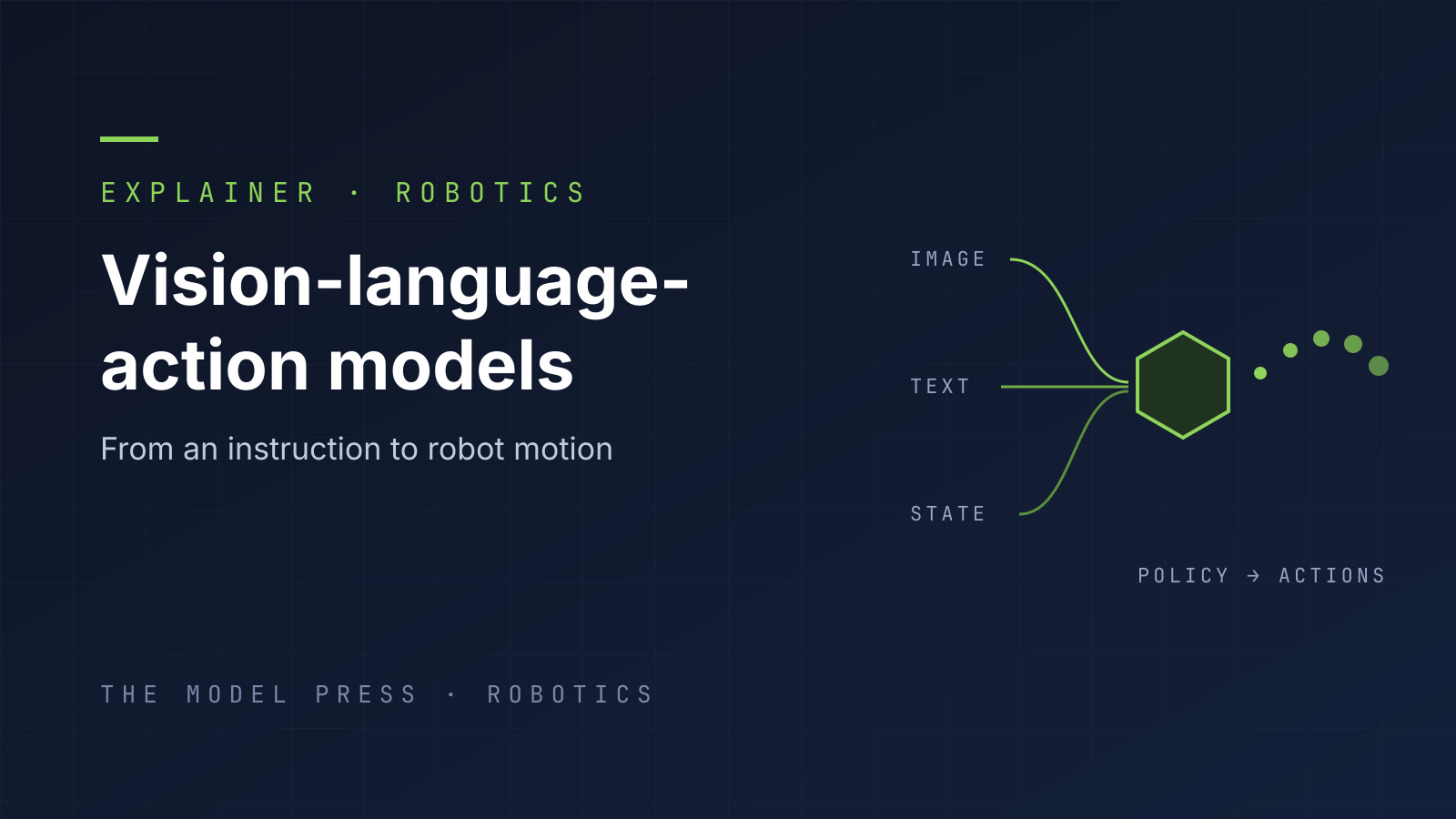
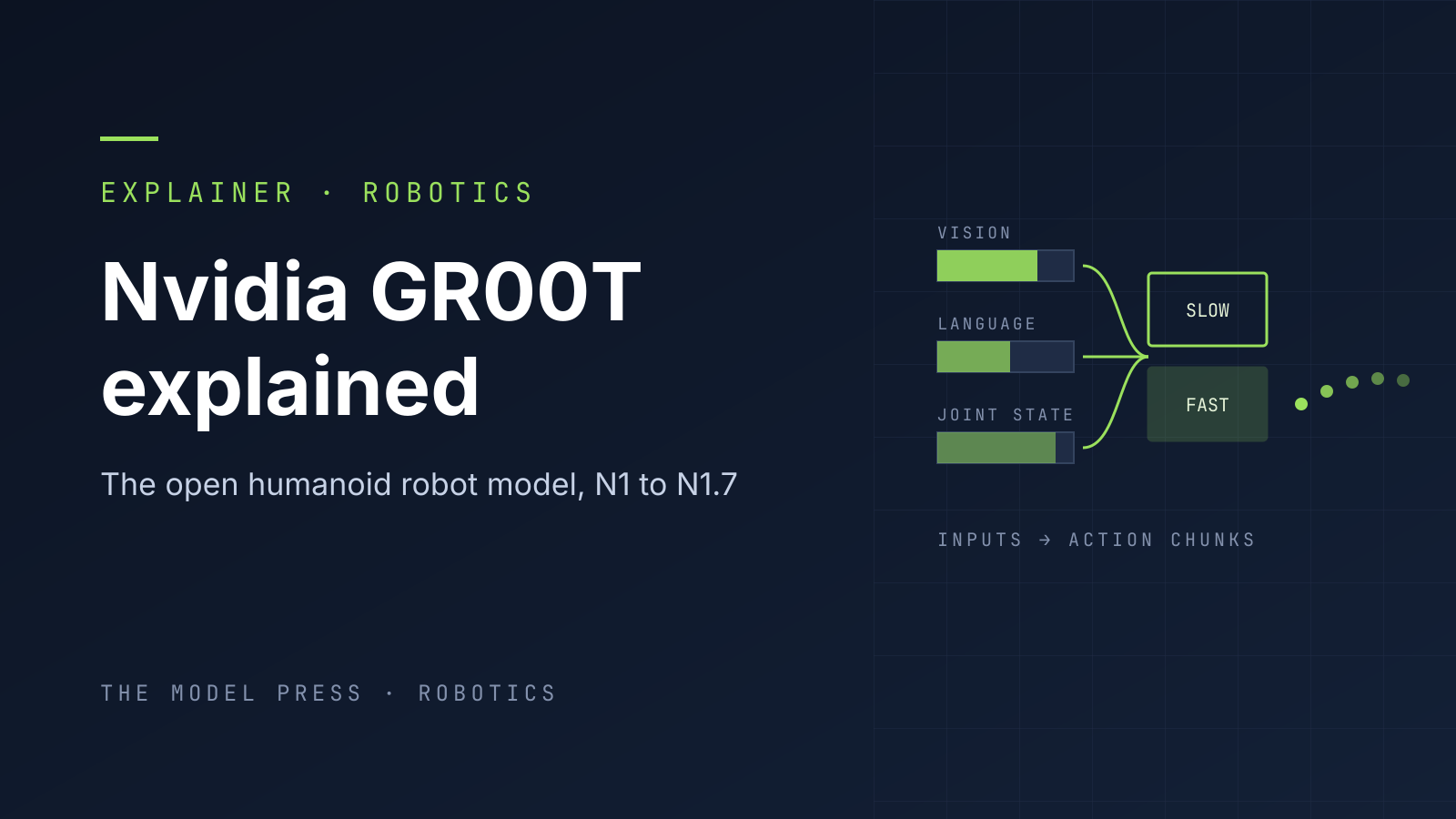
GR00T is a vision-language-action model: it connects what the robot sees and what it is told to the actions it takes. NVIDIA’s developer page lists three inputs, a video sequence from the robot’s cameras, a natural-language command and the robot’s current joint positions, and one output, “action chunks”, which are predicted sequences of relative joint motions. Predicting several steps ahead, NVIDIA says, keeps whole-body movement smooth and helps with stable walking and two-handed manipulation.
The GR00T N1 paper describes the design NVIDIA has kept since. A vision-language model, which NVIDIA calls “System 2”, interprets the scene and the instruction. A diffusion transformer, “System 1”, turns that into continuous motor actions at a higher rate. The paper gives 10 Hz for the reasoning module and 120 Hz for the action module on its test setup. Both parts are trained together, end to end.
The split matters because a robot needs both kinds of speed. Working out that “put the cup away” means opening a particular cupboard can take a moment; keeping a hand steady while it moves cannot wait for that. NVIDIA’s March 2025 announcement compares the two modules to fast, reflexive thinking and slow, deliberate thinking.
What GR00T is trained on
NVIDIA describes three kinds of training data: internet-scale human video for general knowledge of the world, real teleoperation recordings in which a person drives a robot, and synthetic data generated in simulation. Synthetic data is the part NVIDIA has pushed hardest, because recording people demonstrating tasks is slow.
At the N1 launch, NVIDIA said its GR00T Blueprint generated 780,000 synthetic trajectories, equal to 6,500 hours of human demonstrations, in 11 hours, and that combining them with real data improved GR00T N1’s performance by 40% over real data alone. For N1.5, NVIDIA said in its Computex 2025 release that its GR00T-Dreams blueprint produced the synthetic training data in 36 hours, against nearly three months of manual collection. For N1.7, the Isaac GR00T repository says pretraining added 20,000 hours of EgoScale human video, and that actions are expressed relative to the robot’s current hand position so that what the model learns from human video carries over to robot control.
These are NVIDIA’s own figures about its own training runs; they describe the method, not a measured result on any particular robot.
Version by version
GR00T N1 (March 18, 2025). NVIDIA called it “the world’s first open, fully customizable foundation model for generalized humanoid reasoning and skills” and released it with training data and evaluation scenarios on Hugging Face and GitHub. At the GTC keynote, a 1X humanoid did household tidying with a policy built on N1, and the paper shows N1 running on Fourier GR-1 humanoids.
GR00T N1.5 (May 19, 2025). NVIDIA described the update as better at adapting to new environments and workspace layouts and at recognising objects from user instructions, with higher success rates in sorting and putting objects away.
GR00T N1.6 (September 29, 2025). Announced at the CoRL robotics conference in Seoul, N1.6 brought in Cosmos Reason, NVIDIA’s reasoning vision-language model for physical AI, to break vague instructions into steps. NVIDIA said it also lets humanoids move and handle objects at the same time, with more torso and arm freedom for tasks such as opening heavier doors. Its developer page adds that N1.6’s training set covers the Unitree G1, AgiBot Genie-1 and Fourier GR-1 robots.
GR00T N1.7. NVIDIA’s GitHub repository presents N1.7 as the current version, with a new vision-language backbone, Cosmos-Reason2-2B, in place of the Eagle model used in N1.6, a longer action horizon and export paths for faster deployment. The repository says N1.7 performs comparably to N1.6, with better generalization and instruction-following. The two NVIDIA pages differ on its stage: the GitHub README calls N1.7 a general availability release with commercial support, while the developer page’s FAQ still describes a “1.7 early access” phase that excludes production support.
What NVIDIA added on October 21, 2026
At GTC Berlin, NVIDIA expanded the Isaac platform around GR00T:
- Agile ONE SN. Agile Robots announced a reference humanoid preconfigured with Isaac GR00T and powered by Jetson Thor, scheduled for early 2027. Agile Robots lists it at 1.40 m and 40 kg, with 31 degrees of freedom and two five-fingered hands with 20 degrees of freedom each.
- GR00T training workflows. NVIDIA is releasing three open-source reference workflows for its DGX Station desktop system, one of them for refining GR00T 1.7 models with reinforcement learning.
- Isaac Lab 3.0 and Isaac OS. Isaac Lab, the robot-learning framework, is now generally available in version 3.0; Isaac OS is a new open-source runtime that connects AI models, sensors and controls on the robot.
- Data. A SimReady library of more than 2,000 simulation-ready assets and the Human 1M dataset of human activity video are on Hugging Face.
NVIDIA’s release also lists companies working with GR00T, among them Sereact for goods handling, Bear Robotics through its Kino-2 platform and Bellboy for its hotel robot. NEURA Robotics, which unveiled its Neuron AI model on October 14, is named as using Isaac Sim and Isaac Lab for training data.
Where GR00T fits among robot models
GR00T is one of several foundation models for robots. Google DeepMind’s Gemini Robotics line, most recently Gemini 4 Argon for robotics, and Figure’s Helix are other examples. NVIDIA’s approach differs in that it publishes the GR00T weights, training data and code for any robot maker to adapt, and pairs them with its own hardware for training and for running the model on the robot. The GTC Berlin 2026 schedule shows where the latest announcements were made.
For the robots themselves, our guide to humanoid robots for sale lists which ones can be bought and at what price, and humanoid vs industrial robots explains how humanoids differ from factory arms.