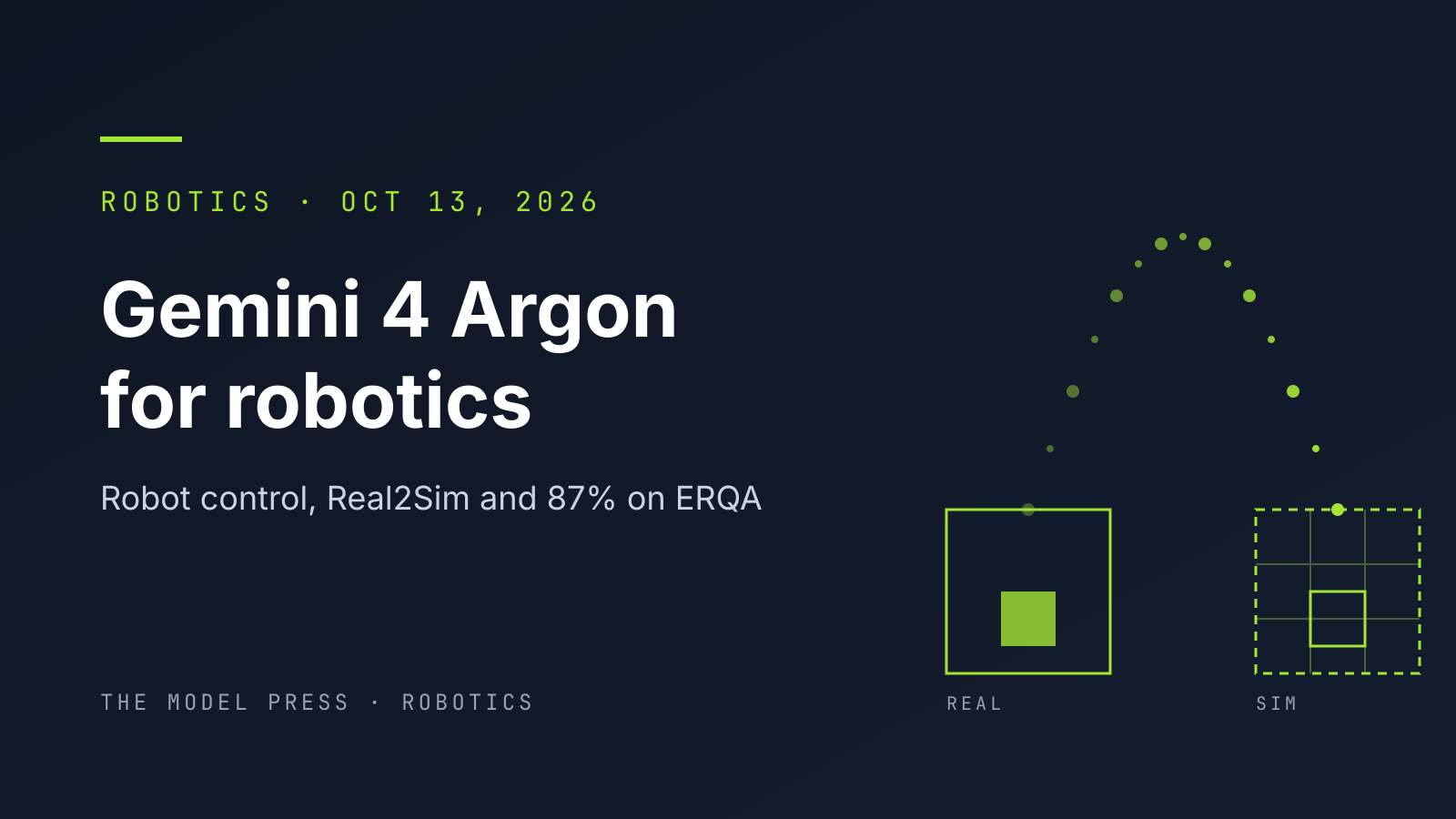
Google published “Gemini 4 Argon for Robotics” on October 13, 2026, a developer post that sets out how its newest general-purpose model can be used across the robotics stack: controlling robots, building physics simulations from camera footage, labelling robot video and generating training data. Google’s headline number is 87% on the Embodied Reasoning (ERQA) benchmark, a score it says Argon reached “using pure reasoning” and which, by Google’s account, beats every other frontier model.
Gemini 4 Argon is not a dedicated robot model. It is the same frontier model Google released to a limited group on September 30, 2026; the robotics post describes what developers can ask of it in physical tasks. That sets it apart from Google DeepMind’s Gemini Robotics 2, the robot model line launched on July 30.
On this page
Four areas Google demonstrates
The post groups its examples under four headings, each with the prompts Google used:
- Robot control. Argon drives a Boston Dynamics Spot quadruped (12-degree-of-freedom legs and a 6-degree-of-freedom arm) through a new skill: stepping on a foot-pedal bin and dropping soda cans inside. It first builds a MuJoCo digital twin of the bin to practise the move. Other examples have Argon set a fallen mug upright with a simple arm, using a camera grid and motion primitives, and steer video rollouts of Google’s Gemini Omni world model over 33 steps.
- Real2Sim. From a recorded teleoperation episode, an egocentric human video or a photo of a pen-and-paper sketch, Argon builds a calibrated simulation scene. In the sketch example it constructs a scene with an Apollo 2 humanoid throwing a ball at a stack of boxes and reports six of six targets knocked down in closed-loop physics.
- Physical understanding. Argon labels robot video at several levels of detail. For a 136-second ALOHA 2 episode of folding an origami fox, it produced six subtasks and 17 contact-level primitives, and held task progress flat during fumbles. It also estimates task progress as a value function, splitting a 60-second bimanual episode into 28 segments.
- Research and self-improvement. Argon reproduces robotics papers as browser simulations (Google cites 68 sandboxes) and improves its own runs on hardware.
The numbers Google reports
Most of the post is demonstration rather than measurement, but two results come with figures. Starting from a single photo of a real tabletop, Argon built a simulation twin, defined a curriculum of 77 tasks and generated more than 4,500 simulated episodes for fine-tuning a vision-language-action model. Google says that raised the real robot’s success rate from 56% to 75% and cut task completion time from 35 to 24 seconds. On a low-cost SO-101 arm, Argon’s pick-and-place run fell from 58.9 seconds on the first attempt to 22.9 seconds and then 17.4 seconds across three rounds of trial and self-review.
These are Google’s own results on tasks it chose, without a stated number of trials for most examples. ERQA is a multiple-choice benchmark of embodied reasoning questions that Google DeepMind itself open-sourced on GitHub with its first Gemini Robotics release. Because the questions are public, the 87% figure can be checked against other models’ published scores; the demonstrations cannot.
Who can use it
Google says developers can start building with Gemini 4 Argon now: on the paid tier of the Gemini API as gemini-4-argon in the Interactions API, and in Google AI Studio and Google Antigravity for Google AI Ultra subscribers. That is wider than the cyber-defender rollout through Google’s Fairwind Program that began the model’s release. The post describes no separate robotics product, safety evaluation for physical deployment or pricing for robot use.
For robot makers, the practical change is that a general model is being pitched as the tool around the robot, writing simulation scenes, reward checks and labels, as well as issuing commands. Argon is logged on our AI model release timeline, and our Gemini 4 Argon review collects independent evaluations of the model. For the machines these models are meant to run, see humanoid robots for sale, and for the latest change at Spot’s maker, Boston Dynamics’ new CEO. More announcements are in Humanoid robots news.