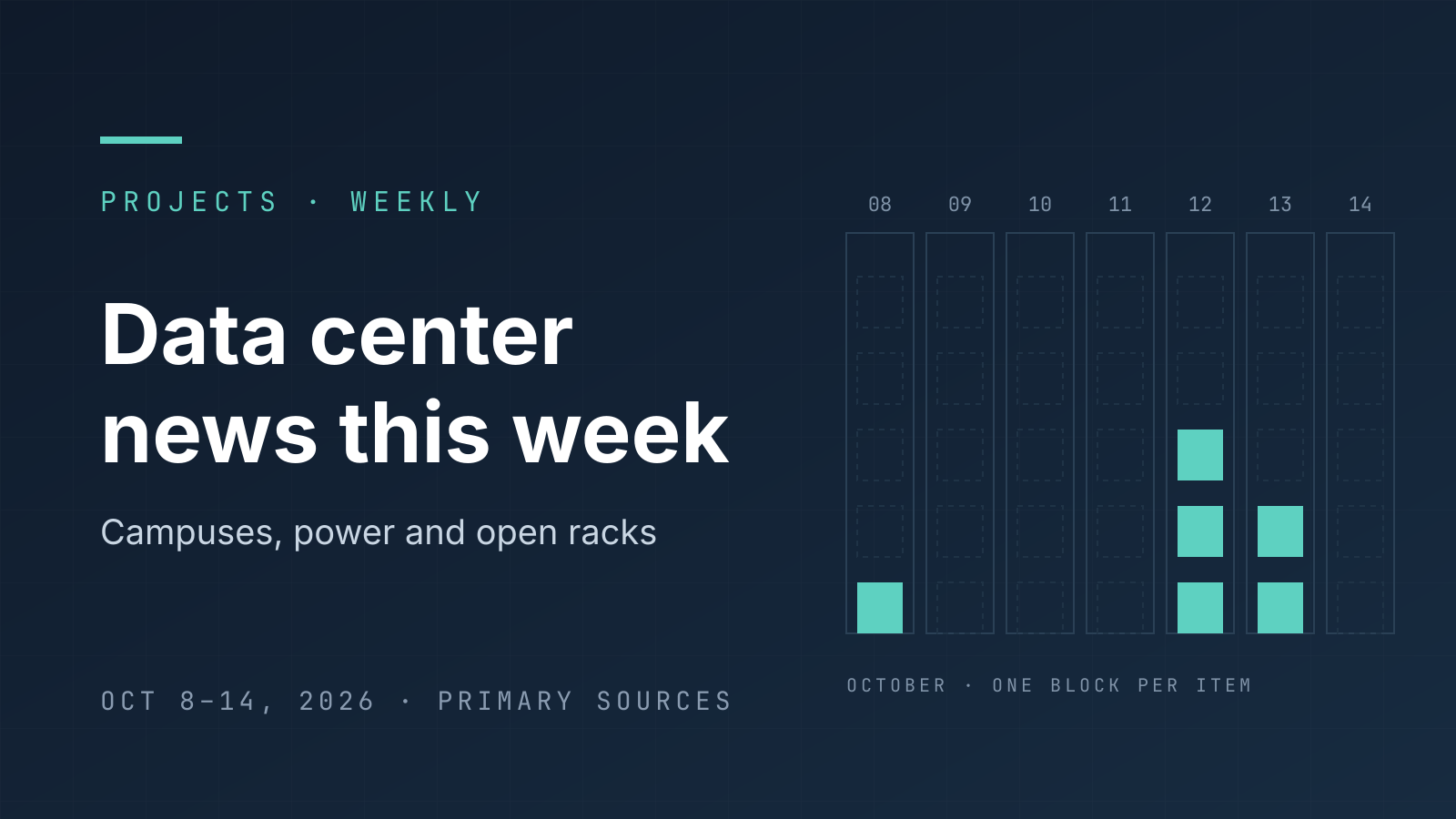
Data center news this week, October 8–14, 2026, came in two kinds: new AI campus plans with megawatt figures attached, and the rack, power and network designs those campuses will be built from. Sesterce put a price on a Finnish campus, Fermi America lined up AMD behind the first phase of its Texas site, Adani and Jabil moved toward building AI racks in India, and AMD and NVIDIA used the OCP Global Summit in San Jose to publish open rack designs. Every item links the original announcement.
On this page
The week at a glance
| Date | Company | What was announced | Stage |
|---|---|---|---|
| Oct 8 | Sesterce | Over €10 billion AI campus in Jämsä, Finland: 200 MW first phase, 600 MW in phase two | Planned; works to start in 2026 |
| Oct 12 | AMD | Helion open rack blueprint for agentic AI | Configurations planned for November 2026 |
| Oct 12 | NVIDIA | Vera Rubin rack and tray designs contributed to OCP through MGX 1.2 | Specification contribution |
| Oct 12 | Ultra Ethernet Consortium | Ultra Ethernet Specification 1.1 | Published specification |
| Oct 13 | Fermi America, AMD | Credit support for the 222 MW first phase of Project Matador | Agreement signed; lease and financing not yet closed |
| Oct 13 | Adani Enterprises, Jabil | MoU for a 50:50 AI and data-centre hardware joint venture in India | Non-binding MoU |
Sesterce plans a €10 billion campus at a former paper mill
On October 8, French AI infrastructure company Sesterce announced plans for a campus on the site of the former Kaipola paper mill in Jämsä, Finland, with a planned investment of over €10 billion. The first phase is 200 MW, with works planned to start in 2026; capacity is expected to rise to 600 MW in a second phase. Over the longer term Sesterce says it aims for more than one gigawatt of AI capacity in Finland.
Sesterce says it already has an anchor customer, without naming it. The company also attached four commitments to the project: 1 MW of new renewable generation in the Finnish grid for every 1 MW the campus consumes, within ten years of the campus becoming operational; closed-loop liquid cooling with no drinking water; a €10 million community fund once the campus is commissioned; and public facilities on site. The regional grid operator Elenia, quoted in the same release, describes the site’s existing high-voltage connection as a foundation for the first phase, not the full 600 MW.
Fermi lines up AMD behind Project Matador’s first phase
On October 13, Fermi America said it had signed a credit support agreement with AMD for the lease covering phase one of Project Matador in Carson County, Texas: 222 MW of gross power capacity, matching the first customer lease Fermi announced on August 10. Fermi calls the agreement “a key milestone toward securing project financing”. The two companies also signed a partnership framework for future expansion of up to 650 MW of gross power capacity.
The release does not say that the lease has closed or that project financing is in place, and none of the expansion capacity is described as leased. Fermi says the wider campus could ramp to about 17 GW, subject to binding customer agreements.
Adani and Jabil move toward an Indian AI rack maker
Adani Enterprises filed a media release with Indian stock exchanges on October 13 announcing a non-binding memorandum of understanding with Jabil for a proposed 50:50 joint venture to manufacture and assemble AI and data-centre equipment in India. The planned portfolio covers AI racks, servers, storage and networking equipment, plus power distribution units, liquid-cooling systems and transformers, with installation and commissioning services.
This is a hardware supply story rather than a campus: the companies describe multi-gigawatt rack manufacturing capacity, and the venture still depends on definitive agreements and approvals. Adani links it to the group’s stated commitment to develop 5 GW of green-energy-powered, AI-ready data centres by 2035. On the campus side in India, CoreWeave announced 240 MW at AdaniConneX in Navi Mumbai on October 6.
AMD Helion: an open rack for agent workloads
AMD introduced Helion on October 12, the opening day of the summit. It is a rack blueprint based on an Open Compute Project specification, aimed at agent workloads, where CPU core density, performance and power are matched to GPU acceleration as needed. AMD gives two example configurations: a CPU-only rack with 6th Gen AMD EPYC processors and up to 32,768 CPU cores, for hyperscalers that run agent execution separately from inference; and an all-in-one rack combining EPYC CPU nodes, AMD Instinct MI350P GPU nodes and general-purpose compute for enterprises. Both liquid- and air-cooled versions are possible.
AMD says it plans to contribute the Helion specification to OCP and that partner configurations are planned to be available in November 2026. AMD says Helion builds on the open-platform approach of its Helios rack-scale solution; AMD’s accelerator line-up is in our AI chips catalog.
NVIDIA opens Vera Rubin rack designs through MGX 1.2
NVIDIA contributed Vera Rubin rack and compute tray designs to OCP through its MGX architecture on October 12. The updated MGX 1.2 specification adds rack-scale blind-mate liquid cooling, a liquid-cooled 5,000A busbar, native 19-inch equipment support and fanless liquid-cooled compute trays, and supports rack deployments of up to 250 kW. A separate Vera CPU rack specification extends MGX to CPU-only racks.
Three networking announcements came with it. Meta is adopting NVIDIA’s Spectrum-6 102.4 Tb/s Ethernet switches for its Vera Rubin clusters, in a switch called N-IceCube that runs Meta’s FBOSS software. NVIDIA and Cisco announced USFP, a pluggable optics form factor about the size of OSFP that NVIDIA says will offer four times the bandwidth density of 200 Gb/s-per-lane optics and roughly 1.3 times the power efficiency, on a path to 400 Gb/s per lane. NVIDIA and Google also announced Falcon Transport support on future ConnectX-10 SuperNICs and BlueField DPUs. Background on the platform is in our Vera Rubin explainer.
Ultra Ethernet 1.1 brings scale-up links
Also on October 12, the Ultra Ethernet Consortium published Specification 1.1, adding a local transport profile for accelerators, in-network collectives and new congestion signalling. It is a specification, not shipping hardware; our Ultra Ethernet 1.1 report covers what changed.
What the week adds up to
The campus news is early-stage. Sesterce’s 600 MW is a plan whose first-phase works are scheduled to start in 2026, and Fermi’s first 222 MW is waiting on a lease closing and project financing. The OCP releases matter for the same projects from the other end: an operator planning Vera Rubin-generation or CPU-heavy agent capacity now has public specifications for liquid-cooled racks of up to 250 kW and for CPU-only agent racks, as well as the switches and optics to connect them. Our OCP Global Summit preview lists the keynote schedule, and announced campuses are tracked in AI data centers.