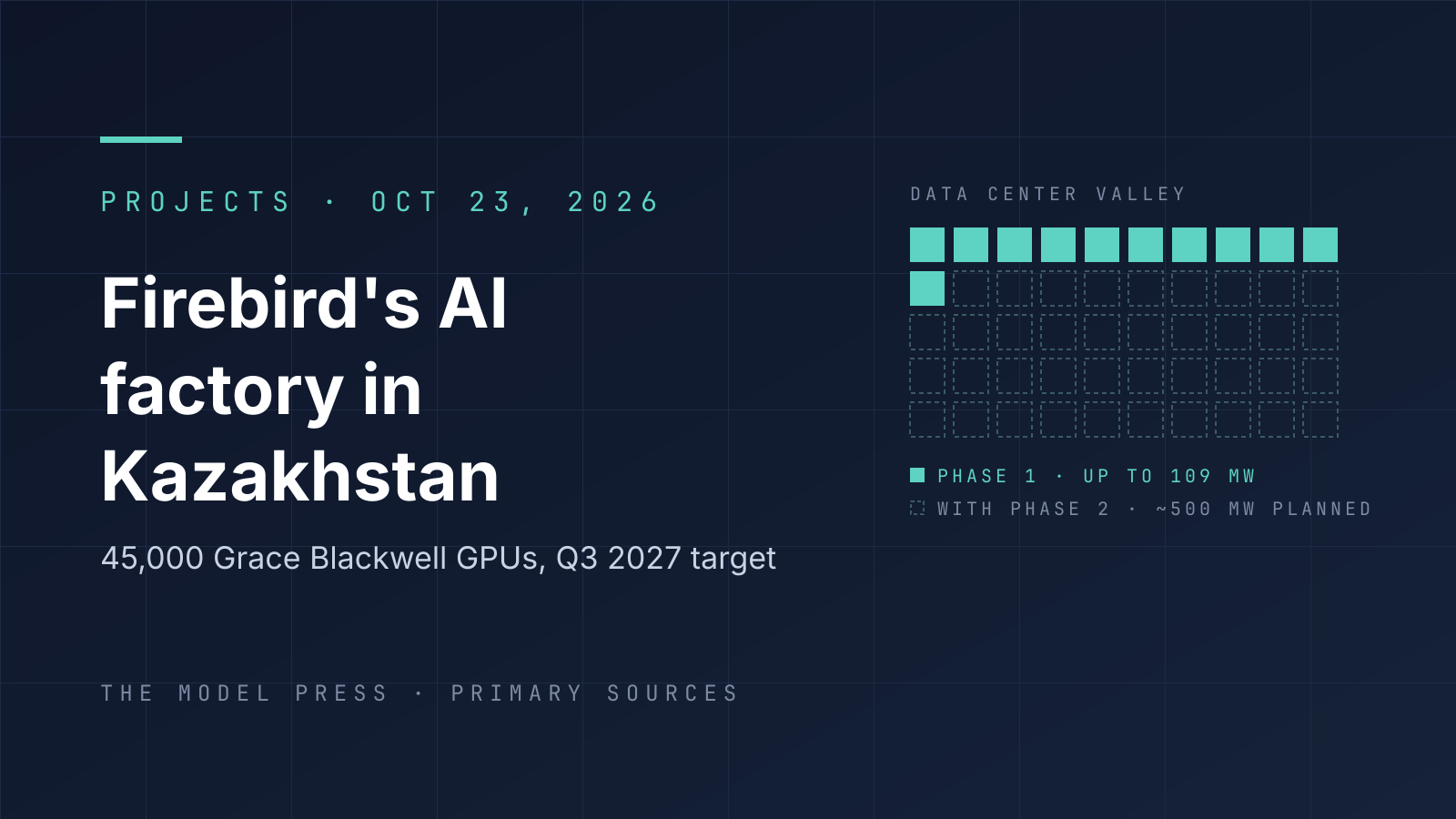
Firebird’s Kazakhstan AI factory has a U.S. export license for 45,000 NVIDIA Grace Blackwell GPUs, the U.S. AI cloud company announced on October 23, 2026. The first phase is under construction with Kazakhtelecom at Data Center Valley and targets a commercial launch in the third quarter of 2027. A planned second phase would take Firebird’s total potential capacity in the country to about 500 MW.
The announcement came the same day Firebird signed an investment agreement with the government of Kazakhstan at the Akorda presidential palace in Astana, during NVIDIA founder and CEO Jensen Huang’s visit. NVIDIA described the signing and the capacity figures in a blog post by Rev Lebaredian, dated October 22 and covering the Friday, October 23 visit.
On this page
What Firebird says Phase 1 includes
Firebird’s release puts numbers on the first phase that NVIDIA’s post does not:
| Item | As Firebird states it |
|---|---|
| Owner | Firebird Inc., a U.S.-based AI cloud and infrastructure company |
| Site partner | Kazakhtelecom, at Data Center Valley |
| Chips | More than 45,000 NVIDIA GB300 GPUs (Grace Blackwell), covered by a U.S. export license |
| Phase 1 capacity | Up to 109 MW (potential capacity of the AI cluster) |
| Estimated investment | $5 billion |
| Status | Under construction |
| Commercial launch target | Third quarter of 2027 |
| With planned Phase 2 | About 500 MW total potential capacity in Kazakhstan |
Firebird also says it will allocate at least 10% of total GPU capacity to Kazakhstani companies and government agencies, and plans a Firebird Labs Kazakhstan program for local startups, research and training. The company expects more than 130 permanent jobs.
The release does not say which chips a second phase would use or when it would start. One detail is worth noting: Huang’s quote in Firebird’s release refers to “Firebird’s expansion of NVIDIA Vera Rubin,” while the licensed Phase 1 hardware is described as Grace Blackwell. Neither company gives a Vera Rubin GPU count for Firebird.
Where Data Center Valley fits
Data Center Valley is Kazakhstan’s planned compute hub in Ekibastuz. On October 1, the office of President Kassym-Jomart Tokayev described it as infrastructure of about 300 MW with the potential to expand to 1 GW, and said two NVIDIA-based supercomputing clusters had already been launched in the country. In Firebird’s release, Deputy Prime Minister Zhaslan Madiyev, the minister of artificial intelligence and digital development, also refers to phased expansion of the hub to one gigawatt.
Those are three different figures and should not be added together: about 300 MW is the government’s stated site capacity, up to 109 MW is Firebird’s Phase 1 cluster, and about 500 MW is Firebird’s potential total if a second phase goes ahead. The 1 GW figure is a site-level expansion plan, not a commitment by Firebird. For how megawatts translate into data-center scale, see our explainer on AI data center power consumption.
Kazakhtelecom is building its own capacity alongside Firebird’s. According to NVIDIA’s post, the operator has already deployed 400 NVIDIA H200 and 480 NVIDIA B300 GPUs in Astana and Almaty, and plans to add more than 1,000 GPUs at Data Center Valley next year, along with more than 1,000 NVIDIA Vera Rubin GPUs in the Ekibastuz region.
Why the export license matters
Firebird’s June 2026 strategic cooperation agreements with the government set out the plan; the October 23 announcement adds two things those agreements did not: a U.S. export license covering the Phase 1 chips, and the statement that construction has started. Our explainer on AI chip export controls covers what the U.S. rules restrict and why licenses matter for large GPU shipments.
Kazakhstan is Firebird’s second market. The company says it launched its first AI factory in Armenia in August 2026 with more than 6,100 NVIDIA Blackwell GPUs; the Kazakhstan Phase 1 is roughly seven times that by GPU count.
What remains to be shown is delivery: the release gives a launch quarter, not a construction schedule, power-supply details or a date for the second phase. Announced AI projects and their stated capacity are tracked in our AI data centers tracker, and the scale of other campuses is compared in the biggest AI data centers.