NVIDIA CEO Jensen Huang gave the GTC Berlin keynote on October 21, 2026, at the Tempodrom, and the two biggest announcements were about building and securing AI infrastructure rather than new chips: DSX POD, a factory-built container design for Vera Rubin AI factories, and the OpenShell Reference Architecture for running AI agents under hardware-enforced rules. NVIDIA published the details the same morning on its keynote blog and in its newsroom.
GTC Berlin ran from October 20 to 22, with more than 100 sessions at STATION-Berlin. Our preview of the event covers the schedule and venues. This recap covers what NVIDIA announced on stage, from NVIDIA’s own pages only.
On this page
DSX POD: AI factories built in containers
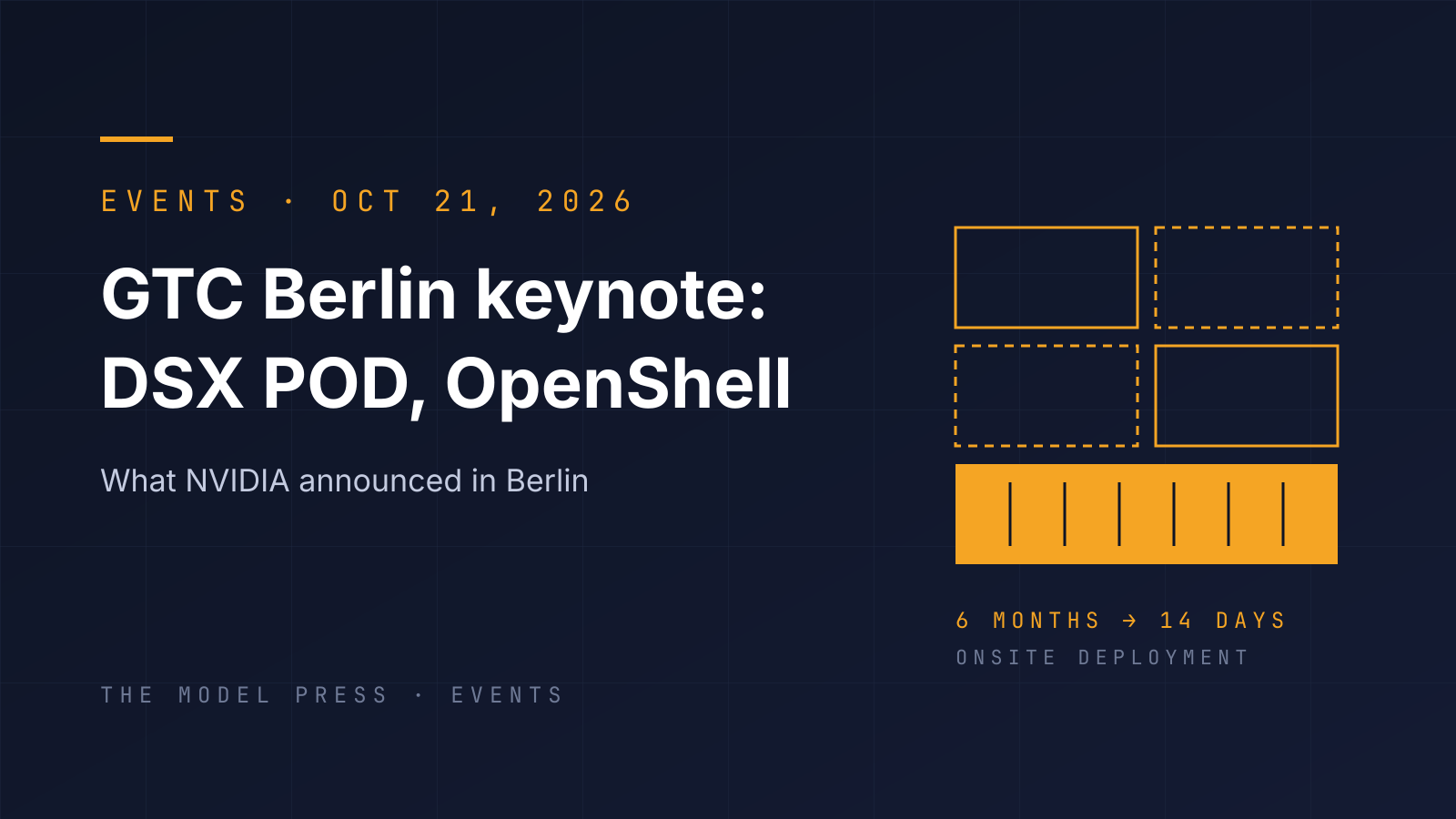
The headline infrastructure news was DSX POD, a reference design for complete Vera Rubin AI factories that partners assemble inside modular containers and test before shipping. Computing, networking, cabling, rack-level power and liquid cooling are integrated at the manufacturing site. The containers then connect to a prepared site’s power, cooling and network.
NVIDIA says this cuts deployment at a prepared site from six months to as little as 14 days. The keynote blog adds the condition: the 14 days start once site utilities are ready. DSX POD shortens installation, not the wait for power and cooling at the site.
The partner list is long: Anduril, Armada, Bull, Crusoe, DayOne, Dell Technologies, Delta, Eaton, Foxconn (Ingrasys), GIGABYTE, HPE, Lenovo, Pegatron, Quanta Cloud Technology, Schneider Electric, Vertiv and Wistron. NVIDIA says they will deliver DSX POD AI factories worldwide in early 2027. Huang also said on stage that Vera Rubin is in full production.
A second release covered the wider DSX platform in Europe. NVIDIA says its DSX reference designs use closed-loop liquid cooling and dry coolers for near-zero facility cooling water, and that DSX MaxLPS software lets operators generate the same number of tokens with up to 30% less power. It names CoreWeave, Firmus, Google Cloud, IREN, Lambda, Nebius, Nscale and Sharon AI as planning to use MaxLPS. The same release introduced DSX OS, open-source software for running AI factory infrastructure, and SimReady Central, a Hugging Face hub of simulation-ready power and cooling equipment models.
OpenShell Reference Architecture for AI agents
Huang then turned to agent security. He described an agent as five parts: a model, a harness that runs its work and memory, a sandbox around the harness, knowledge and tools. Because an agent can reach files, networks and tools, he argued, its privileges should be minimal and it should be monitored.
The OpenShell Reference Architecture, available now, is NVIDIA’s design for that. It combines:
- Vera Rubin infrastructure for model inference;
- Vera CPUs running the agent harnesses on NVIDIA OpenShell, the company’s open-source secure runtime;
- BlueField-4 DPUs running NVIDIA Sentry, which monitors agent behaviour out of band and enforces policy in silicon.
If an agent tries to move outside its software boundary, NVIDIA says Sentry quarantines and stops it in milliseconds. The architecture also extends to RTX Spark, DGX Spark and DGX Station systems for agents at the edge, and runs on Canonical, Red Hat and Microsoft Windows. NVIDIA’s technical blog breaks OpenShell into four components: a gateway that manages sandboxes and policies, a supervisor that checks outbound requests and mediates credentials, the sandbox itself, and a policy prover that formally checks permissions against an organisation’s limits.
NVIDIA lists Anthropic, AWS, Cisco, CrowdStrike, Google Cloud, Meta, Microsoft, OpenAI, SAP, ServiceNow and Siemens among the companies working with the architecture. Those are NVIDIA’s statements; the release does not say what each company has deployed.
Agent Knowledge Foundation and open models
Huang introduced the NVIDIA Agent Knowledge Foundation, a set of models and libraries for connecting agents to company data. It includes Nemotron tools for parsing documents, embedding queries and reranking results, and new NVIDIA Kumo models for predictions from structured data in databases.
He also listed NVIDIA’s open model families as starting points for companies to post-train on their own data: Nemotron for language, Cosmos for world models, GR00T for humanoid robots, Alpamayo for autonomous vehicles, Ising for quantum-classical computing and Earth-2 for physics AI.
Telecoms, healthcare, cars and robots
The rest of the keynote moved quickly through industries. On telecoms, Huang said NVIDIA had made its first commercial phone call on T-Mobile’s network with Nokia. On healthcare, he described AI-enabled adaptive radiation therapy being developed with Siemens Healthineers.
For cars, Huang said Volkswagen’s van, JLR, Volvo and Mercedes-Benz’s next-generation vehicles will be compatible with the NVIDIA Hyperion platform, and that Volvo Cars is adopting Hyperion with the Alpamayo software stack.
For robotics, he announced Agile ONE SN, a reference humanoid built on Isaac GR00T with a 31-degree-of-freedom body, expected next year. We covered it separately in NVIDIA Isaac adds Agile ONE SN.
Where to follow it
DSX POD packages a whole Vera Rubin AI factory as factory-tested containers, with partner deliveries planned for early 2027. Projects are tracked in our AI data centers tracker, and Vera Rubin specifications are in AI chips and our Nvidia Rubin explainer.