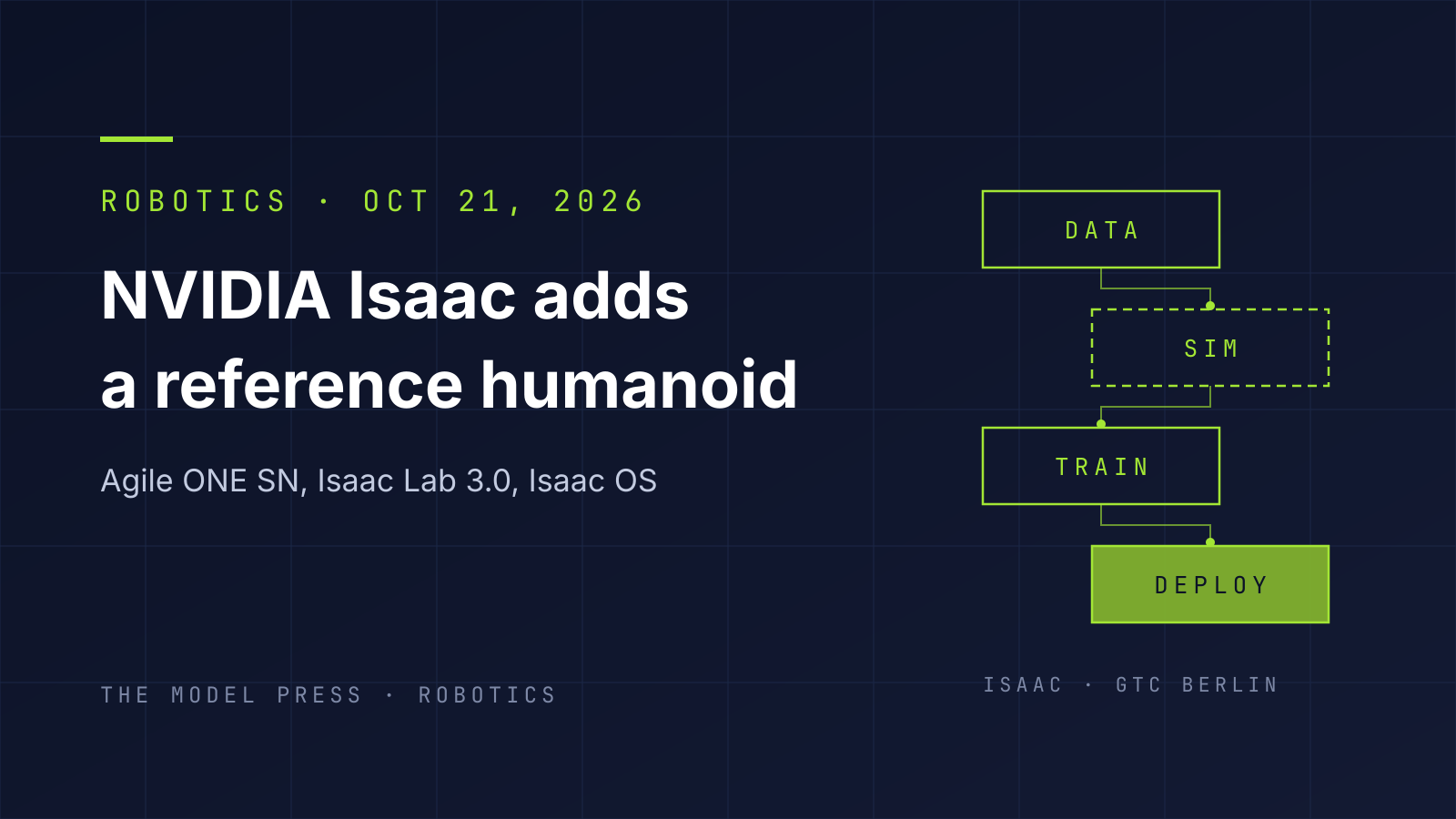
NVIDIA expanded its Isaac robotics platform at GTC Berlin on October 21, 2026, adding a reference humanoid, a new runtime, simulation assets and a human-motion dataset, and making Isaac Lab 3.0 generally available. The humanoid, Agile ONE SN, comes from the Munich company Agile Robots, which launched it the same day as a research platform preconfigured with NVIDIA Isaac GR00T. It is scheduled to be available at the beginning of 2027.
NVIDIA’s press release frames the update as one path from data collection to deployment for general-purpose robots. Most of it is software and data that developers can use with any robot; the reference humanoid is the hardware anchor.
On this page
Agile ONE SN: a humanoid for research labs
Agile Robots describes Agile ONE SN as a compact humanoid for research and development, with Agile ONE as its full-size industrial counterpart; skills and data developed on the smaller robot can later be transferred to the larger one. The specifications both companies publish:
| Agile ONE SN | As stated by Agile Robots and NVIDIA |
|---|---|
| Height and weight | 1.40 m, 40 kg |
| Body | 31 degrees of freedom, 3 kg payload per arm |
| Hands | Two WUJI Hand 2 five-finger hands, 20 degrees of freedom each, 1 kHz force control, tactile sensing |
| Total degrees of freedom | 71 across body and hands |
| Onboard compute | NVIDIA Jetson Thor: 2,070 FP4 teraflops, 128 GB unified memory |
| Sensors | Head and wrist cameras, lidar, inertial measurement units |
| Software | Isaac GR00T: GR00T 1.7 open VLA model, GR00T whole-body control, end-to-end reference workflow |
| Availability | Beginning of 2027 |
The robot ships with URDF and USD assets so teams can load it straight into Isaac Sim and Isaac Lab. Agile Robots says it is exploring integration with NVIDIA’s Halos safety platform, and NVIDIA lists Halos integration as planned. Both companies say Stanford University and ETH Zurich have shown interest; neither announces a customer order or a price. How GR00T’s vision-language-action design works is covered in our Nvidia GR00T explainer.
What changes in the Isaac platform
NVIDIA’s other additions, as listed in the release:
- Isaac Lab 3.0 is generally available. It is NVIDIA’s open-source framework for training robot policies, from a desktop to a data center, with multi-GPU workflows and the Newton and PhysX physics engines.
- Isaac OS is a new open-source runtime built on NVIDIA Holoscan that connects AI models, sensors, controls and robot hardware for deterministic, real-time operation in simulation and on physical robots.
- SimReady Central Library, on Hugging Face, holds more than 2,000 simulation-ready robot and factory assets, with contributions from companies including Comau, FANUC, Franka Robotics, Universal Robots and Vertiv.
- Human 1M Dataset contains human activities recorded as synchronized three-view video with 3D hand tracking. It is on Hugging Face, but NVIDIA says the full dataset is accessible to Cosmos Coalition partners.
- Three open-source reference workflows for the DGX Station desktop system: refining GR00T 1.7 models with reinforcement learning, training dexterous manipulation in Isaac Lab, and post-training Cosmos world models for synthetic data.
- Halos, NVIDIA’s safety platform on IGX Thor, is being integrated by Agile Robots, Agility, Dexory, FORT Robotics and KION, and SICK is evaluating it.
Robot makers named in the release
The release lists companies building on these tools, many of them European. ABB Robotics is integrating Omniverse libraries into RobotStudio HyperReality for virtual commissioning; KUKA uses them in Visual Components FactoryLens. Sereact trains its Cortex goods-handling platform with Isaac GR00T and Cosmos Transfer on Universal Robots arms. Humanoid, Hexagon Robotics and Bear Robotics use Jetson Thor, Isaac OS and related tools for robot behaviour and perception, and Schaeffler is contributing actuator technology to the Newton physics engine. NEURA Robotics uses Isaac Sim and Isaac Lab to train skills for Neuron AI, the foundation model covered in our NEURA Neuron AI report.
These are partner statements collected by NVIDIA; most describe development work rather than deployed fleets. One exception NVIDIA cites is Bellboy, whose Billie robot, built with Jetson and GR00T, is described as deployed at hotels operated by Marriott, Hilton, IHG and OYO.
Context
GTC Berlin ran from October 20 to 22; venues and the session programme are in our GTC Berlin preview. For who builds humanoids and what they can be bought for, see our humanoid robots for sale explainer, and for where humanoids differ from fixed industrial arms like the ABB and KUKA systems above, our humanoid vs industrial robots explainer. NVIDIA’s Jetson Thor and other edge modules are not yet listed in our data-center AI chips table.