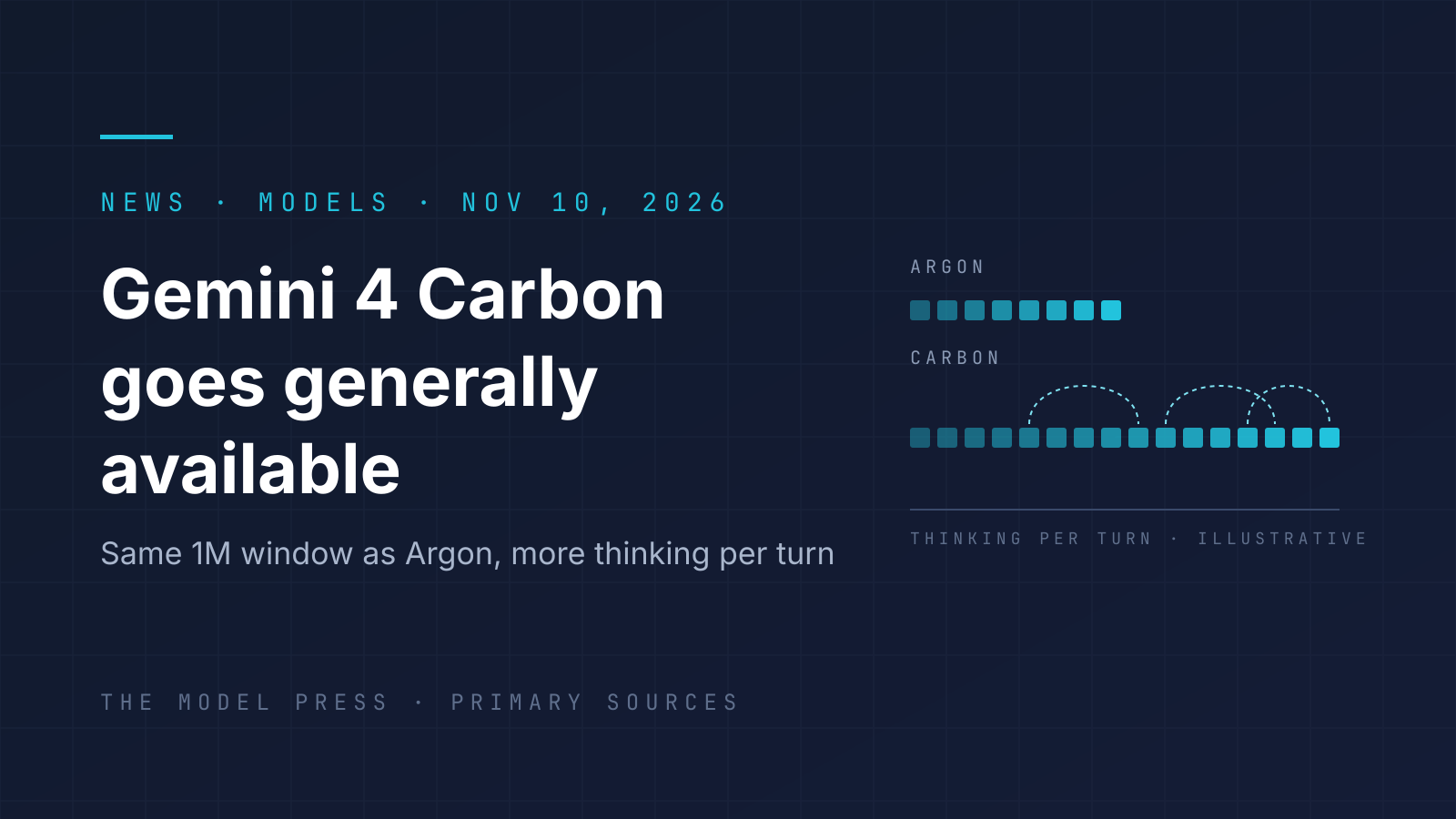
Google made Gemini 4 Carbon generally available on November 10, 2026, thirteen days after it announced the model on October 28 and gave it only to a group of cyber defenders. The November 10 post by Koray Kavukcuoglu opens Carbon to paying developers through the Gemini API, to businesses through Gemini for business, and to Google AI Ultra subscribers in the Gemini app, Google Antigravity and AI Mode in Search. The Gemini API release notes list it the same day as gemini-4-carbon, generally available.
Carbon is not a separate model family. Its model card says it “is based on Gemini 4 Argon” and refers to the Argon card for architecture, training data and hardware. What Google says distinguishes it is how long it thinks: it spends more thinking tokens per turn than Argon to explore, reason and verify, which Google’s own developer guide says raises token use and latency per turn. Google still calls Argon the right choice for most software engineering and knowledge work.
On this page
From limited access to general availability
| Date | What Google published | Who could use Carbon |
|---|---|---|
| October 28, 2026 | Announcement: benchmark results, cyber focus, staged rollout | A subset of cyber defenders through the Fairwind Program, “starting this week” |
| November 10, 2026 | General availability post, model card, API model page | Gemini API paid tier and Google AI Studio; Gemini for business; Google AI Ultra subscribers in the Gemini app, Antigravity and AI Mode in Search; verified defenders through Fairwind |
In the October post Google said it was taking part in the US government’s voluntary pre-release testing process and wanted more feedback on guardrails before a wider release. The November post does not say how that testing concluded. Free-tier API access is not listed: the API model page and the developer guide both name the paid tier.
What changes against Argon in Google’s own table
The model card compares Carbon with Argon and with three models from other labs on 17 benchmarks, all “as of October 2026”. The scores Google quoted on October 28 (AA Index 59, SEC-bench Pro 88.2%, ExploitGym 54.8%, CWE-bench 71.0%) are unchanged on the card, so general availability did not come with new headline results. The table below keeps only Carbon and Argon and adds the difference, which is our arithmetic on Google’s figures.
| Benchmark (as Google labels it) | Gemini 4 Carbon | Gemini 4 Argon | Difference |
|---|---|---|---|
| ExploitGym (cyber, via Fairwind) | 54.8% | 42.0% | +12.8 pts |
| GraphWalks, 256k to 1M tokens, BFS (F1) | 96.2% | 84.2% | +12.0 pts |
| Terminal-Bench-Science 0.1 (AA) | 64.8% | 52.9% | +11.9 pts |
| AA Index v5.0 | 59 | 50 | +9 |
| Agents’ Last Exam v1.1 | 77.4% | 69.0% | +8.4 pts |
| Terminal-Bench 4.0 (AA) | 65.2% | 57.1% | +8.1 pts |
| OSWorld-2.1, offline subset | 81.5% | 74.7% | +6.8 pts |
| FrontierSWE 2 | 61.2% | 55.0% | +6.2 pts |
| SWE-sweep | 9.6% | 4.3% | +5.3 pts |
| SEC-bench Pro (cyber, via Fairwind) | 88.2% | 83.4% | +4.8 pts |
| Blueprint-Bench 2, similarity | 58.6% | 54.4% | +4.2 pts |
| RiemannBench | 80.0% | 76.0% | +4.0 pts |
| CWE-bench (cyber, via Fairwind) | 71.0% | 68.0% | +3.0 pts |
| AutomationBench (Zapier) | 53.9% | 51.3% | +2.6 pts |
| Vals Index v2.2 | 70.4% | 69.2% | +1.2 pts |
| Chartography | 72.5% | 71.6% | +0.9 pts |
| Vending-Bench 2, final bank balance | $16,484 | $13,718 | +$2,766 (+20%) |
Sorted this way, the pattern is clear. The largest gains are on long-context retrieval across up to a million tokens, on exploit writing, and on long terminal sessions in science and coding: tasks where extra thinking and checking have room to pay off. On chart reading (Chartography) and on the broad Vals Index, Carbon is within about one point of Argon. SWE-sweep more than doubles in relative terms, but from 4.3% to 9.6%, so most of that benchmark’s tasks are still unsolved by either model.
Two cautions apply to reading the table. First, the three cybersecurity rows measure Carbon “when accessed through the Fairwind Program”, which Google describes as “Carbon for cyber” for verified defenders. The model card does not say the general-access Carbon scores the same on them. Second, Google publishes no figure for how many more tokens Carbon spends than Argon on these tasks, so the gains cannot be set against their extra compute from the card alone. Carbon is not first on every row either: on Google’s own table GPT-6 Astra scores higher on FrontierSWE 2 (65.5%) and Claude Opus 5.5 higher on OSWorld-2.1 (87.2%). How these benchmarks are built is covered in our SWE-bench explainer, and lab-published scores are collected on the LLM leaderboard.
Safety figures Google reports against Argon
The November 10 post sets Carbon’s safety results against Argon’s. All of them come from Google or from testers it names.
| Measure (as Google states it) | Carbon | Argon |
|---|---|---|
| Per-attempt breach rate against Google’s adaptive red-teaming agent | 0.8% | 3.1% |
| Automated cyberattack query success rate, Gray Swan testing | 2.17% | 9.86% |
| Google’s 375-task agentic honesty benchmark, tasks passed | 92% | 70% |
Google also says Carbon blocked 99% of attack trajectories in its simulated cyberattack environments, that Trajectory Labs found no new universal jailbreaks across 132 hours and more than 13,000 requests, and that Carbon reached a 0% attack success rate on the Gray Swan indirect prompt injection benchmark, while noting that prompt injection robustness “remains an area for continued improvement”. The details are in Google’s Gemini 4 Carbon safety and security report, linked from the announcement.
The API model, as documented
The API model page, checked November 11, 2026, gives these specifications:
| Item | Gemini 4 Carbon |
|---|---|
| Model code | gemini-4-carbon (stable) |
| Inputs | Text, image, video, audio, PDF |
| Output | Text |
| Context window | 1,048,576 tokens, shared by input and output |
| Maximum output | 65,536 tokens by default; up to 1,048,576 with long decode |
| Thinking levels | low, medium (default), high |
| Knowledge cutoff | March 2026, per the model card |
| Not supported | Live API, image generation, audio generation, explicit context caching (implicit caching only) |
| Consumption options | Batch API, Flex and Priority inference |
The context window, the long-decode limit and the thinking levels are the same as Argon’s, according to the developer guide, which says the two models share “the same 1M unified context window, built-in tools” and differ mainly in thinking tokens spent per turn. The guide recommends running evaluations at all three thinking levels and choosing the lowest that meets the quality bar. Alongside Carbon, Google is previewing a /swarm feature in Antigravity that splits one prompt across a team of agents, with Carbon assigned to the roles that need the deepest reasoning.
Where it fits
Carbon follows the same path as Argon, which Google announced on September 30 for Fairwind defenders and made generally available on October 13. Argon is covered in Gemini 4 Argon release and the Gemini 4 Argon review. Google’s releases sit in our AI model updates tracker next to the Gemini 4 Argon record.