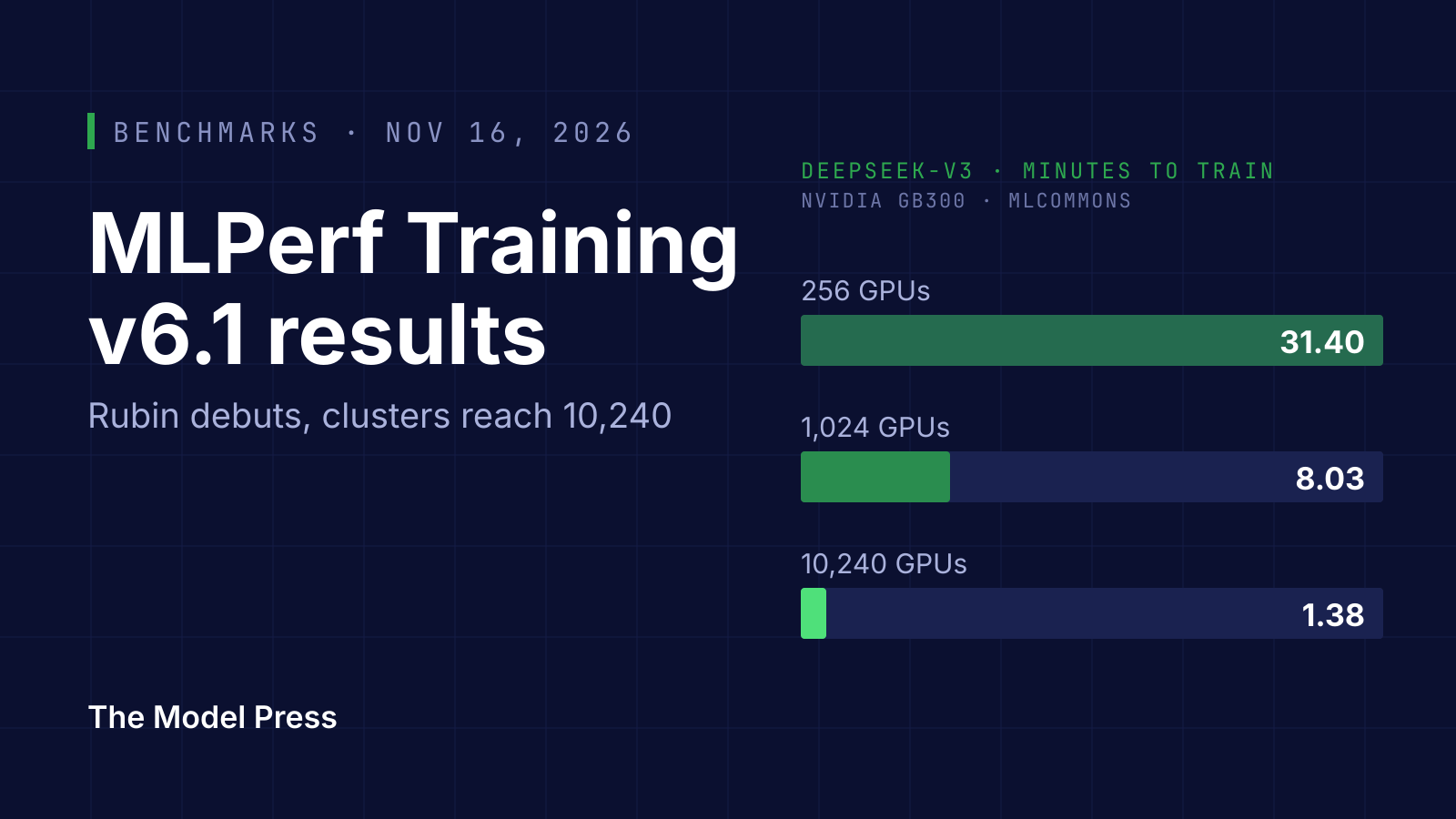
On November 16, 2026, MLCommons published the results of MLPerf Training v6.1, the benchmark round that measures how many minutes a system needs to train a model to a fixed quality target. The headline numbers: NVIDIA’s Rubin-generation GPUs and Google’s TPU7x (Ironwood) appeared for the first time, the largest systems used 10,240 accelerators, and an NVIDIA GB300 cluster of that size trained the DeepSeek-V3 benchmark in 1.38 minutes.
MLCommons counts 250 results from 153 systems. Its announcement lists 24 submitting organizations, and its follow-up analysis counts 25. Everything below comes from MLCommons’s two posts and NVIDIA’s own blog post; the vendor claims are labelled as such.
On this page
DeepSeek-V3: the fastest times at each scale
DeepSeek-V3 (671 billion parameters, mixture of experts) is the benchmark where the biggest systems ran. MLCommons lists these times to train:
| System | Accelerators | Minutes to train |
|---|---|---|
| NVIDIA GB300 | 10,240 | 1.38 |
| Google TPU7x | 8,192 | 1.70 |
| Azure, NVIDIA GB200 | 10,240 | 2.36 |
| NVIDIA GB300 | 1,024 | 8.03 |
| NVIDIA GB300 | 256 | 31.40 |
| University of Florida, NVIDIA B200 | 256 | 132.16 |
| Cisco, NVIDIA B300 | 64 | 163.19 |
Two systems reached the 10,240-accelerator scale: an NVIDIA GB300 NVL72 cluster and an Azure GB200 NVL72 cluster. Google’s TPU7x run used 8,192 chips in a single ICI slice.
What the scaling numbers say
The three GB300 rows give a worked example of what extra accelerators buy. This arithmetic is ours, from MLCommons’s times:
| Step on GB300 | Accelerators | Speedup | Efficiency |
|---|---|---|---|
| 256 to 1,024 | 4x | 31.40 / 8.03 = 3.9x | about 98% |
| 1,024 to 10,240 | 10x | 8.03 / 1.38 = 5.8x | about 58% |
Going from 256 to 10,240 GPUs is 40 times the hardware for a 22.8 times shorter run (31.40 / 1.38). In accelerator-minutes the 10,240-GPU run costs about 14,100, against about 8,000 for the 256-GPU run, so the fastest time is not the cheapest. MLCommons does not publish cost, and the rows are separate submissions, so treat these ratios as a reading aid and not as a property of the hardware.
On the same 10,240-accelerator scale, the GB300 time is 1.71 times shorter than the GB200 time (2.36 / 1.38). The two runs came from different submitters, so the gap mixes hardware, software and tuning.
Rubin debuts, and what NVIDIA claims
MLCommons lists NVIDIA Rubin (VR200) among the systems submitted in the Available category, alongside Google’s Ironwood. The Rubin times it gives:
| Benchmark | System | Accelerators | Minutes to train |
|---|---|---|---|
| Llama 3.1 8B | NVIDIA VR200 | 512 | 3.95 |
| Llama 3.1 8B | NVIDIA VR200 | 72 | 7.38 |
| Llama 2 70B LoRA | NVIDIA Rubin | 512 | 0.313 |
| Llama 2 70B LoRA | NVIDIA Rubin | 72 | 2.76 |
| FLUX.1 | NVIDIA Rubin | 512 | 6.88 |
| FLUX.1 | NVIDIA GB300 | 512 | 9.23 |
On Llama 3.1 8B, 7.1 times as many GPUs (512 against 72) cut the time by 1.9x. On Llama 2 70B LoRA the same step cut it 8.8x, more than the GPU ratio. MLCommons’s tables do not explain the difference between the two benchmarks.
In its own post dated November 16, NVIDIA says it swept every v6.1 training benchmark, that it was the only platform with results on every one, and that Vera Rubin NVL72 delivered up to 2x the performance per GPU of its GB300 NVL72 system. It also says Vera Rubin NVL72 scaled from 256 to 1,024 GPUs on DeepSeek-V3 with about 97% efficiency, cutting the time from 16 minutes to about 4. These are NVIDIA’s statements about results MLCommons published; NVIDIA adds that Rubin performance will keep improving through software.
Who else submitted
MLCommons says the accelerators came from three vendors, in 12 products:
| Vendor | Products | Systems |
|---|---|---|
| NVIDIA | H100, H200, GH200, B200, B300, GB200, GB300, VR200 | 122 systems from 21 submitters |
| AMD | MI300X, MI350X, MI355X | 27 systems from 9 submitters |
| TPU7x | 4 systems |
AMD’s entries include a Crusoe run that trained Llama 3.1 8B on 128 MI355X GPUs in 14.07 minutes. MLCommons also reports that tinygrad cut its MI350X Llama 3.1 8B time from 187.48 to 101.28 minutes between rounds, and KRAI cut its MI300X Llama 2 70B LoRA time from 28.65 to 22.83 minutes. Crusoe was a first-time MLPerf Training submitter.
For background on the chips, see our pages on Vera Rubin NVL72, GB300 NVL72, Google TPU7x Ironwood and AMD Instinct MI355X.
What changed in the benchmark suite
| Change | Benchmark | Detail from MLCommons |
|---|---|---|
| Added | Qwen3.5-397B GRPO | Agentic reinforcement-learning post-training on software-engineering tasks such as tool calling; 29 submissions from 7 submitters |
| Added | DLRMv4 (HSTU) | Generative recommendation on the Yambda dataset; 20 submissions from 8 submitters |
| Retired | Llama 3.1 405B | After 3 rounds |
| Retired | DLRM-DCNv2 | After 7 rounds, replaced by DLRMv4 |
| Kept | DeepSeek-V3, Llama 3.1 8B, Llama 2 70B LoRA, GPT-OSS-20B, FLUX.1 |
MLCommons also reports a shift toward bigger submissions. The median Closed-division result used 32 accelerators, against 8 in every round from v4.0 to v6.0, and 111 results used 64 or more accelerators, up from 73 in v6.0. Multi-node systems made up 117 of 153 systems (76%), up from 72 of 118 (61%).
Low precision is now routine: 116 of the 250 results used 4-bit linear layers (82 NVFP4 on NVIDIA, 34 MXFP4 on AMD), and 113 used FP8. Firmus cut its GB300 GPT-OSS-20B time from 69.60 to 52.90 minutes (about 24%) with NVFP4 kernels, according to MLCommons.
How to read these numbers
A time to train is a result for one model, one cluster and one software stack, submitted by one organization. It is not a ranking of chips. Results at different accelerator counts are not comparable without the scaling arithmetic above, and a chip that appears on only one benchmark has no result on the others. To check any figure, open the full tables on the MLCommons results site. Our explainer on what AI benchmarks measure covers how to read such tables, and AI inference vs training compute explains why training and inference are measured separately. For another Rubin result, see our report on the Vera Rubin NVL72 AgentPerf benchmark. DeepSeek-V3’s place in the model line-up is in DeepSeek models by date.