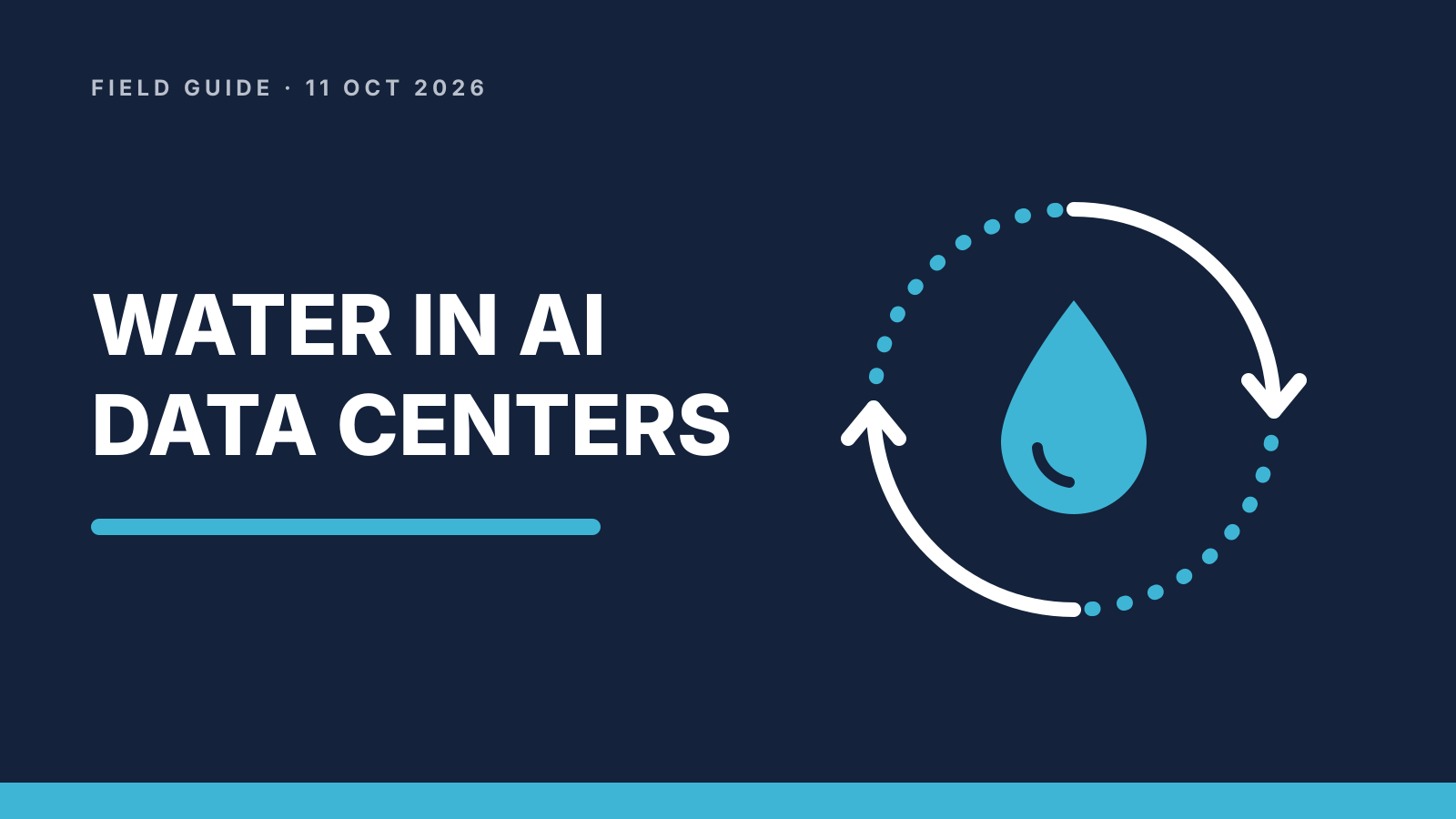
AI data center water use comes from two places: cooling at the site, where water carries heat away from the chips, and the power plants that generate the site’s electricity. Lawrence Berkeley National Laboratory estimated that US data centers consumed about 66 billion liters of water directly in 2023, up from 21.2 billion in 2014, and that the water used to produce their electricity was more than ten times larger. Newer AI campuses are moving to closed-loop designs that cut on-site water but use more energy.
On this page
Where the water goes
Chips turn almost all of their electricity into heat. A data center has to move that heat outside, and water is the cheapest way to do it.
- Evaporative cooling. Cooling towers and evaporative coolers reject heat by evaporating water. The evaporated water is consumed: it leaves the site as vapor. This is the main source of direct water use.
- Closed loops. Liquid-cooled racks, such as Nvidia’s GB200 NVL72, pump coolant through cold plates on the chips. The loop is sealed and filled once, so it consumes very little water after construction. The heat it collects still has to be rejected, by dry coolers, air-cooled chillers or evaporative towers.
- Electricity. Thermal and hydroelectric power plants consume water too. Berkeley Lab calls this the indirect water footprint and counts it separately from the site’s own use.
Berkeley Lab’s 2024 report describes the trade-off directly: water-cooled chillers are more energy efficient, while air-cooled chillers use no water but more energy. Saving water at the site can therefore raise power use, and with it the indirect water footprint at the power plant.
How much water US data centers use
The most complete public figures are in Berkeley Lab’s 2024 United States Data Center Energy Usage Report, prepared for the US Department of Energy:
| Measure (US data centers) | Figure | Source |
|---|---|---|
| Direct water consumption, 2014 | 21.2 billion liters | LBNL 2024 |
| Direct water consumption, 2023 | About 66 billion liters | LBNL 2024 |
| Share of 2023 direct use from hyperscale and colocation sites | 84% | LBNL 2024 |
| Projected hyperscale direct use, 2028 | 60–124 billion liters | LBNL 2024 |
| Indirect water footprint from electricity, 2023 | Nearly 800 billion liters | LBNL 2024 |
| Electricity used, 2023 | About 176 TWh, 4.4% of US electricity | LBNL 2024 |
The projection is a range because it depends on which cooling designs new data centers adopt. For the electricity side, see our explainer on AI data center power consumption.
How operators measure it: WUE
Water usage effectiveness (WUE) is liters of water per kilowatt-hour of IT energy. Berkeley Lab distinguishes site WUE, which counts the water used on site, from source WUE, which adds the water consumed to generate the electricity; the report uses about 4.52 liters per kWh for the indirect part. A data center can report a low site WUE while its source WUE stays high, so the two numbers answer different questions.
Microsoft reported a fleet-wide WUE of 0.30 L/kWh for fiscal 2024, which it said was 39% better than 0.49 L/kWh in 2021.
What AI data center operators say they changed
Microsoft. In December 2024, Microsoft said that since August 2024 all its new data center designs consume zero water for cooling, using chip-level cooling in a closed loop that is filled during construction and recirculated. It estimated the change avoids more than 125 million liters per data center per year, and said the move to mechanical cooling causes a “nominal increase” in annual energy use. Pilots were planned for Phoenix and Mount Pleasant, Wisconsin in 2026, with new sites on the design coming online from late 2027. Microsoft said it also uses reclaimed or recycled water at sites in Texas, Washington, California and Singapore. For its Fairwater site in Atlanta, it said the initial fill of the closed loop uses about as much water as 20 homes consume in a year.
Google. Google’s 2026 Environmental Report, published June 30, 2026, said the company replenished about 7.7 billion gallons of water in 2025, roughly 78% of its freshwater consumption that year, up from 64% in 2024, through 165 projects in 97 watersheds. Its goal is to replenish 120% by 2030. Replenishment funds water projects elsewhere in the watershed; it does not reduce what a data center consumes on site.
Meta, Crusoe and OpenAI. Recent AI campus announcements describe closed-loop systems: Meta’s 1 GW site in Sturgeon County, Alberta uses a closed-loop liquid-cooled system with dry cooling; the Crusoe and Lancium campus in Childress, Texas uses closed-loop, non-evaporative cooling; and OpenAI said its PORTS-Pike site in Ohio will use closed-loop, air-cooled systems that recirculate water. The details are in our comparison of AI and traditional data centers, and the AI data centers tracker lists the projects. How communities negotiate these terms comes up in our report on Amazon’s data center community commitments.