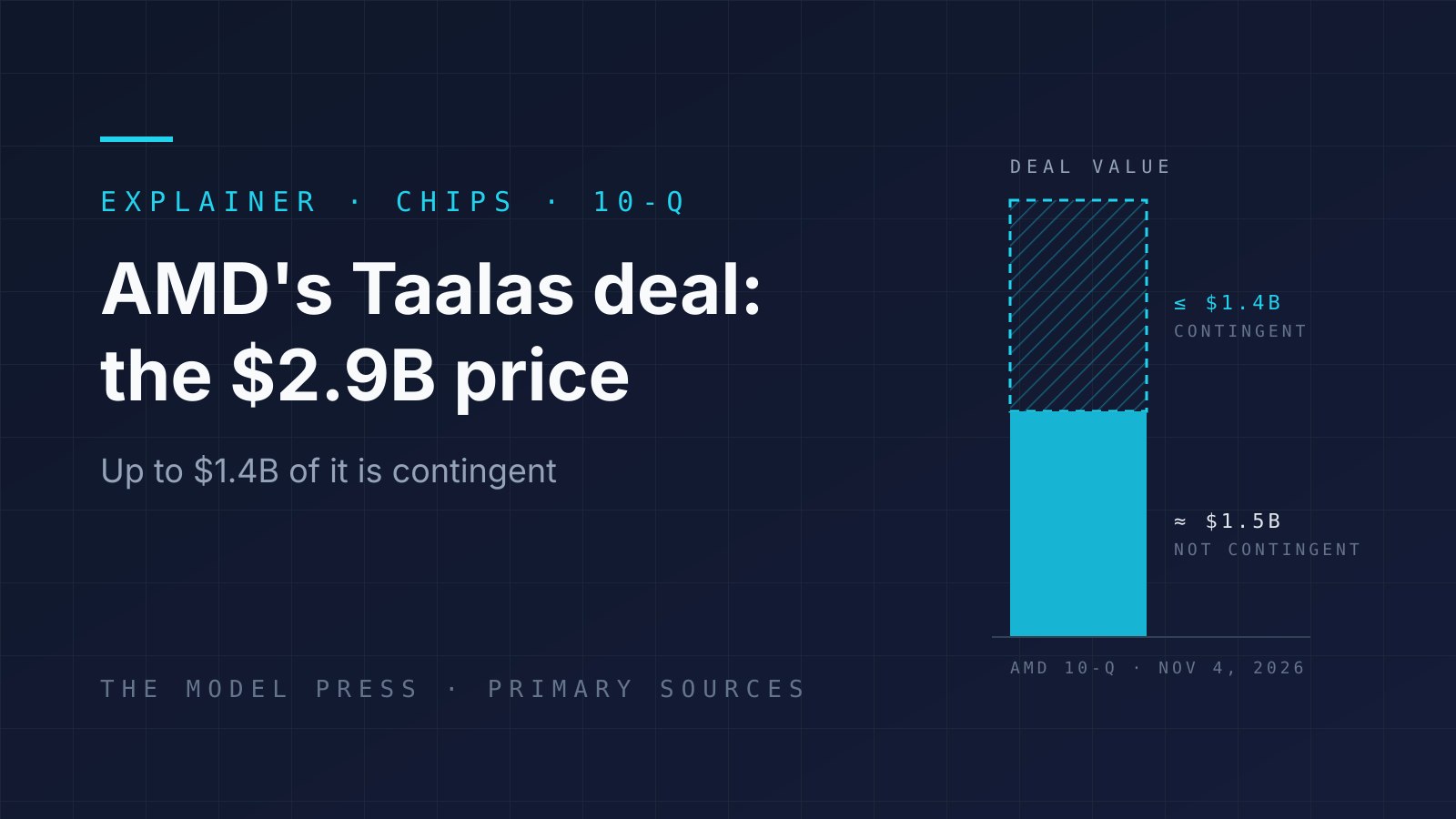
AMD values its Taalas acquisition at about $2.9 billion in cash and stock, and up to about $1.4 billion of that is contingent consideration, paid only if conditions the filing does not describe are met. The deal has not closed: AMD expects it to close in the fourth quarter of fiscal 2026, subject to regulatory approvals and customary closing conditions.
AMD announced the deal on August 6, 2026 without a price. The figure first appeared in Note 5 of its quarterly report on Form 10-Q, filed with the SEC on November 4, 2026.
Taalas, founded in 2023 and based in Toronto, builds what it calls “hardcore models”: chips with one specific AI model wired into the silicon. Its first chip, the HC1, runs Meta’s Llama 3.1 8B and nothing else.
On this page
What the 10-Q says about the price
AMD’s disclosure sits in the acquisitions note of the 10-Q: AMD entered into a definitive agreement in August 2026 “to acquire Taalas Inc., a developer of specialized inference silicon, in a cash and stock transaction valued at approximately $2.9 billion, including contingent consideration of up to approximately $1.4 billion.” The same note puts the expected close for both pending deals, Taalas and World Labs, “by the end of 2026”; the management discussion narrows that to the fourth quarter of fiscal 2026 and says both deals support “development of future super intelligence (SI) hardware, software and systems.”
What the filing leaves out: the split between cash and AMD shares, the conditions behind the contingent $1.4 billion, and the period over which it could be paid. AMD’s third-quarter results release of November 3 lists the Taalas agreement among its acquisitions but gives no price either.
Subtracting the contingent maximum from the headline value leaves about $1.5 billion that is not tied to those conditions. That is our arithmetic on AMD’s rounded figures, not a number AMD states.
How the Taalas terms compare with AMD’s other deals
The same 10-Q describes two other acquisitions, which allows a like-for-like look at the Taalas structure. Shares of contingent value below are our calculations from the filing’s figures.
| Deal | Status in the 10-Q | Value | Form of payment | Contingent part | Contingent share of value |
|---|---|---|---|---|---|
| Taalas | Pending, agreement August 2026 | About $2.9 billion | Cash and stock | Up to about $1.4 billion | About 48% |
| World Labs | Pending, agreement September 2026 | About $8.2 billion | All stock | None stated | None stated |
| ZT Systems | Closed March 2025 | $4.4 billion | $3.2 billion cash, $860 million stock | $361 million (settled October 2025) | About 8% |
Almost half of the Taalas value depends on future conditions, against about 8% for ZT Systems, the deal AMD closed in March 2025. AMD has not said what the Taalas conditions are, so the table shows the structure, not what will be paid.
What Taalas builds: the HC1
Taalas presented the HC1 in a launch post by co-founder and CEO Ljubisa Bajic on February 19, 2026. Taalas says the chip unifies storage and compute on one die “at DRAM-level density”, so the model’s weights sit on the chip itself instead of in a separate memory stack. The design, in Taalas’s words, needs no HBM, advanced packaging, 3D stacking, liquid cooling or high-speed I/O. The figures below are Taalas’s own, from that post and its products page, checked November 8, 2026.
| HC1 spec | Taalas figure |
|---|---|
| Model in silicon | Llama 3.1 8B (fixed); context window size configurable, fine-tuning through LoRA adapters |
| Process | TSMC 6 nm |
| Die size | 815 mm² |
| Transistors | 53 billion |
| System | 2.5 kW server |
| Number formats | Custom 3-bit base type, mixed 3-bit and 6-bit parameters |
| Output speed | 17,000 tokens per second per user, 1k input / 1k output, measured by Taalas |
| Taalas’s comparison claims | Nearly 10x faster than the current state of the art, 20x cheaper to build, 10x less power |
Two caveats come from Taalas itself. The aggressive 3-bit and 6-bit quantization “introduces some quality degradations relative to GPU benchmarks”, and the speed figure comes from Taalas’s own labs; its comparison chart mixes Taalas-measured Nvidia H200 and B200 baselines with Artificial Analysis figures for Groq, SambaNova and Cerebras.
The trade-off is flexibility. A GPU loads whatever model it is given; an HC1 runs one model for its whole life. Taalas says it can turn a model it has not seen before into hardware in about two months, and that its second-generation platform, HC2, moves to standard 4-bit floating-point formats with higher density. In February it said a mid-sized reasoning model on HC1 would follow in the spring and a frontier model on HC2 was planned for winter. Taalas’s site carries no later post on those plans (checked November 8, 2026), and the AMD release and filings cited here do not mention them.
Taalas has offered the HC1 as a chatbot demo and an inference API by application, not as a chip for sale, and it has not published a price. In the launch post it said the first product came from a team of 24 people and about $30 million spent, out of more than $200 million raised.
What AMD says it will do with Taalas
AMD’s August release says it plans to integrate Taalas’s technology into its accelerator roadmap and to build system-level products together with AMD Instinct GPUs, alongside its Helios racks, EPYC CPUs and ROCm software. AMD has not named a product, a date or which models such a system would run.
Pairing general-purpose GPUs with a specialized inference chip is a pattern other vendors already sell. SambaNova and Supermicro’s November 3 plan, covered in our SambaNova SN50 report, splits the work so GPUs read the prompt and SN50 chips write the answer. Whether AMD intends a similar split for Taalas silicon is not stated. For background on why the token-generation phase stresses memory rather than raw compute, see our inference vs training explainer; other inference-first designs are covered in our Groq LPU and Cerebras explainers, and memory stacks in the HBM explainer.
AMD’s ownership facts are on its company profile.