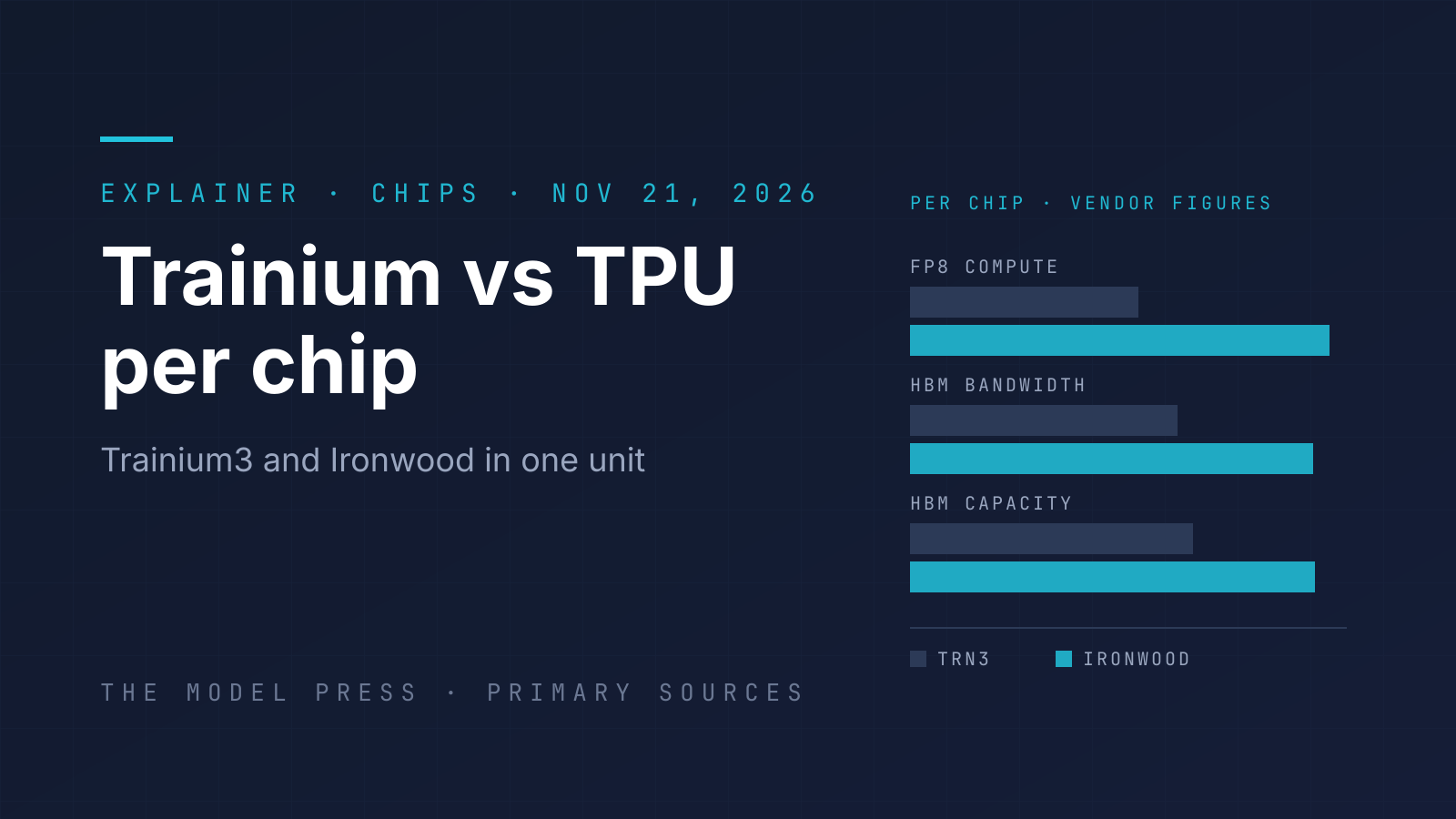
On the numbers Amazon and Google publish, Google’s TPU7x (Ironwood) is the larger chip and the larger system. Ironwood lists 4,614 FP8 TFLOPs, 192 GiB of HBM at 7,380 GB/s and pods of 9,216 chips; AWS lists Trainium3 with 144 GB of HBM3e at 4.9 TB/s and UltraServers of up to 144 chips. Both are generally available as of November 21, 2026. Neither company publishes a head-to-head benchmark, so the sources cannot say which runs a given model faster.
This page puts the two chips in one unit, shows where the vendors’ figures are not like for like, and covers what each company has said comes next. For each chip on its own, see our Trainium explainer and Google TPU explainer.
On this page
Per chip, in one unit
The table converts everything to the same units. The last column is our arithmetic on the vendors’ figures, not a number either company states. Figures were read from AWS’s Trn3 page and Google’s TPU7x documentation on November 21, 2026.
| Per chip | Trainium3 (AWS) | TPU7x Ironwood (Google) | Ironwood vs Trainium3 |
|---|---|---|---|
| Peak FP8 compute | About 2.5 PFLOPs (362 PFLOPs per UltraServer ÷ 144 chips) | 4.6 PFLOPs (4,614 TFLOPs) | 1.8x |
| HBM capacity | 144 GB HBM3e | 192 GiB, about 206 GB | 1.4x |
| HBM bandwidth | 4.9 TB/s | 7.38 TB/s (7,380 GB/s) | 1.5x |
| Chip-to-chip bandwidth | 2 TB/s per chip, NeuronLink-v4 | 1.2 TB/s bidirectional per chip, six ICI links | 0.6x |
| Largest tightly linked group | 144 chips (UltraServer) | 9,216 chips (pod) | 64x |
| How the group is wired | All-to-all switched fabric (NeuronSwitch-v1) | 3D torus of 4x4x4 cubes | Different designs |
| Status | Generally available on EC2 since December 2, 2025 | Generally available on Google Cloud |
Three things in that table are easy to get wrong.
GiB is not GB. Google’s documentation gives Ironwood’s memory in GiB (192 GiB is about 206 GB) and AWS gives Trainium3’s in GB. Read side by side without converting, the memory gap looks larger than it is.
AWS gives one compute figure, and it is for a server. AWS lists 362 petaflops for a full 144-chip Trn3 UltraServer, and its own pages call that figure both “FP8” and “MXFP8”. It does not say whether it assumes sparsity, a feature AWS lists for Trainium2. The 2.5 petaflops per chip above assumes the compute is split evenly across chips; if AWS counts sparse operations, the dense per-chip figure would be lower. Google’s 4,614 TFLOPs is a per-chip FP8 figure in a table that also lists BF16 (2,307 TFLOPs).
Interconnect numbers may not be measured alike. AWS says 2 TB/s per chip; Google says 1,200 GB/s of bidirectional bandwidth per chip, made of six links at 200 GB/s each. Neither page says how the other’s figure would be counted, so the 0.6x is a ratio of two labels, not a measured difference.
How much arithmetic per byte of memory
Dividing compute by memory bandwidth shows how each chip is balanced. A chip with more FLOPs per byte read from HBM is better suited to work that reuses each byte many times, such as large matrix multiplications in training. A chip with fewer is less likely to sit idle when weights and the KV cache must be read from memory for every generated token.
| Derived from the figures above | Trainium3 | Ironwood |
|---|---|---|
| FP8 FLOPs per byte of HBM bandwidth | About 513 | About 625 |
| Time to read all of HBM once | About 29 ms (144 GB at 4.9 TB/s) | About 28 ms (206 GB at 7.38 TB/s) |
The second row is the striking one. Ironwood has more memory and more bandwidth, but the two chips take nearly the same time to stream their whole memory once, so a model that fills HBM is limited to roughly 34 to 36 decoding steps per second on either, before any other overhead. The arithmetic ignores on-chip SRAM, caching and compression, so it is a bound, not a benchmark. Our HBM memory explainer covers why memory sets that limit, and the inference vs training explainer covers how the two workloads differ.
What a system means on each side
The bigger difference is the size of the group of chips that behave as one machine.
| Group of chips | Trn3 UltraServer | Ironwood pod |
|---|---|---|
| Chips | Up to 144 | 9,216 |
| FP8 compute | Up to 362 PFLOPs (AWS) | 42.5 exaflops (Google; equals 9,216 × 4,614 TFLOPs) |
| HBM | Up to 20.7 TB HBM3e (AWS) | About 1.9 PB (our arithmetic: 9,216 × 192 GiB) |
| Scale-out beyond the group | EC2 UltraClusters 3.0: “hundreds of thousands” of chips per AWS’s product page, up to 1 million per Amazon’s launch post | Up to 1 million TPU chips in a single cluster, per Google’s TPU page |
One Ironwood pod holds about 117 times the FP8 compute of one UltraServer by these figures, but the two are not the unit a customer necessarily buys. Both companies connect many groups into much larger clusters; the cluster sizes each quotes are maximums, and the pages do not describe how performance holds up between groups.
The wiring differs too. AWS says its all-to-all fabric cuts communication overhead for mixture-of-experts models, where any chip may need to reach any other. Google’s April 2026 TPU 8t and 8i technical deep dive makes a similar point from the other side: a 3D torus “creates a latency tax for all-to-all communication patterns,” so for the inference-focused TPU 8i it uses a topology called Boardfly, which Google says cuts the network diameter of a 1,024-chip pod from 16 hops to 7. Ironwood itself is a torus.
Software and how you get them
| Trainium3 | Ironwood | |
|---|---|---|
| Rented as | EC2 Trn3 UltraServers; AWS says Amazon Bedrock already serves production workloads on Trainium3 | Google Cloud capacity through Compute Engine and GKE, with reservations |
| Frameworks | AWS Neuron SDK: PyTorch, JAX, vLLM, Hugging Face Optimum Neuron; AWS says existing PyTorch and JAX code runs without code changes | JAX, PyTorch and vLLM, with XLA and Pallas kernels |
| Low-level access | Neuron Kernel Interface (NKI) | Pallas custom kernels |
| One quirk | Each Ironwood chip is two chiplets, and JAX shows them as two devices per chip |
The “without code changes” line is AWS’s claim, and Google makes a similar one for Ironwood’s supported models. Google’s TPU page now says TPUs have native, high-performance support for PyTorch and JAX; in April its blog described native PyTorch support as a preview, so check the current state for your framework version before planning a migration.
What each company says comes next
Neither current chip is the end of its line, and the next generations are announced in different detail.
| Status as of November 21, 2026 | What the company has published | |
|---|---|---|
| TPU 8t | Coming soon on Google’s TPU page | 12.6 PFLOPs FP4, 216 GB HBM, 6,528 GB/s, 9,600-chip superpods |
| TPU 8i | Coming soon | 10.1 PFLOPs FP4, 288 GB HBM, 8,601 GB/s, up to 1,152 chips connected |
| Trainium4 | In development, per Amazon’s December 2, 2025 announcement | Only ratios to Trainium3: at least 6x FP4, 3x FP8 and 4x memory bandwidth, and support for NVIDIA NVLink Fusion |
AWS gives no absolute Trainium4 figures, and its Trn3 page lists MXFP4 as a supported mode without a throughput number, so the FP4 figures for TPU 8t and 8i cannot be set against Trainium3 or Trainium4 yet. Google also announced two more systems built on the same eighth-generation chips on November 9; we covered them in our TPU 8i Max and TPU 8tx report.
Who runs what
Anthropic is the clearest example that the choice is not either-or. On October 23, 2025 it said its compute strategy “efficiently uses three chip platforms”: Google’s TPUs, Amazon’s Trainium and NVIDIA’s GPUs, and called Amazon its primary training partner. The same post announced a plan to expand to up to one million TPUs and “well over a gigawatt” of capacity in 2026. On April 20, 2026, Amazon announced that Anthropic would secure up to 5 GW of current and future Trainium capacity, including “significant Trainium3 capacity expected to come online this year”. The gigawatt figures are planned capacity and are not directly comparable with each other or with chip counts.
Google says TPUs are “the engine behind Gemini” and run Search, Photos and Maps. Amazon names Anthropic, Karakuri, Metagenomi, NetoAI, Ricoh, Splash Music, Decart and Amazon Bedrock among Trainium3 users. Customers and chip vendors both describe price-performance advantages over alternatives; none of the pages used here publishes the method behind those claims, so we leave the cost question open. Lab and chipmaker ownership details are in our AI companies directory, and specs for both chips sit in the AI chip catalog.