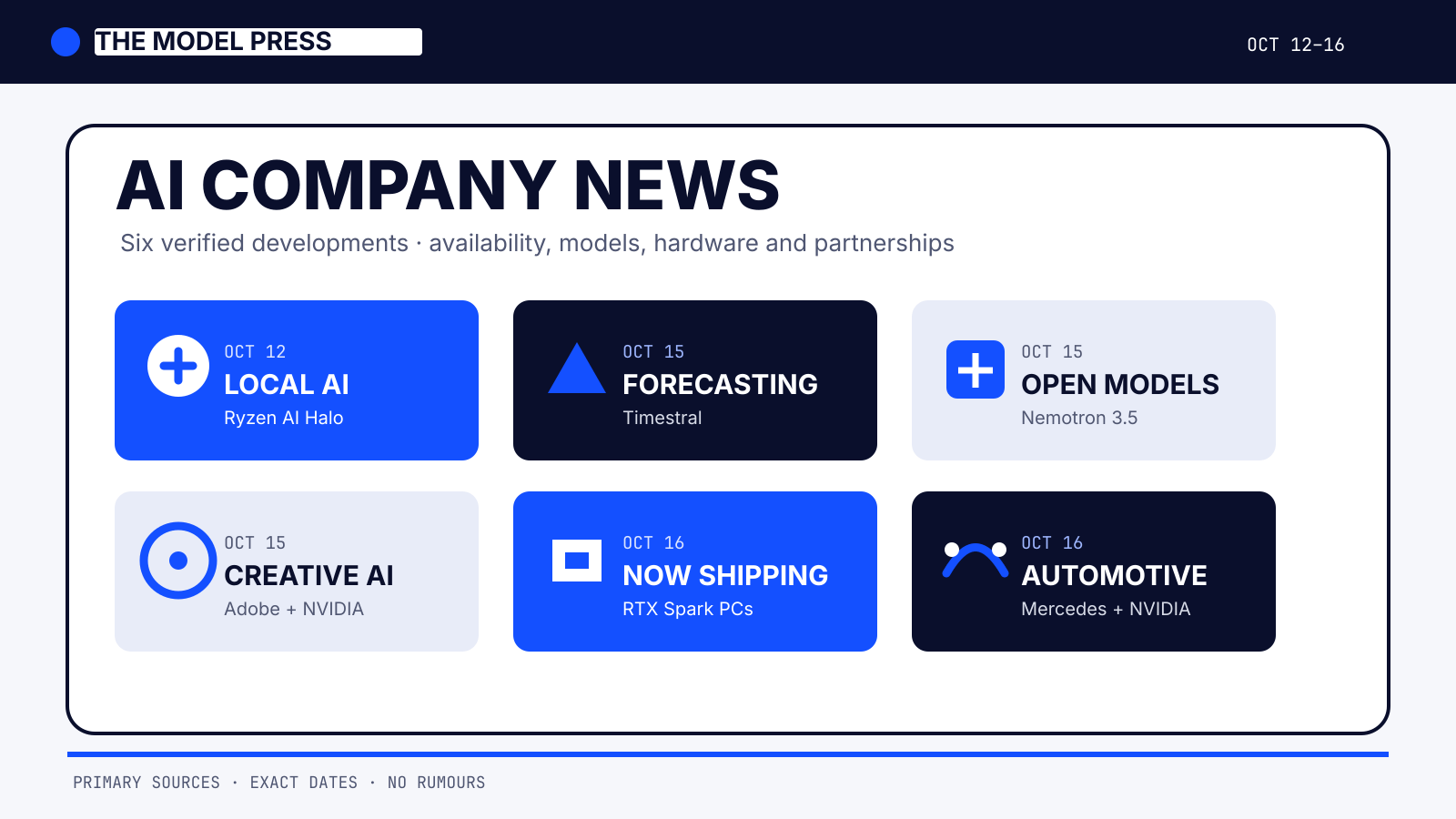
The six clearest AI company developments from October 12 through October 16, 2026 moved on three different clocks. AMD opened orders for a local AI development system. Mistral and NVIDIA released models that are available now, with one smaller NVIDIA model held for October 23. Adobe and Mercedes-Benz announced partnership work whose full product effects arrive later.
This digest covers developments that were not included in Friday’s AI news this week. Specifications and performance results remain company claims unless another source is named.
On this page
The six developments
| Date | Company | Development | Availability |
|---|---|---|---|
| Oct 12 | AMD | Introduced Ryzen AI Halo developer platform | Orderable from Micro Center; more Windows systems coming soon |
| Oct 15 | Mistral | Released the Timestral forecasting-model family | Released in four sizes |
| Oct 15 | NVIDIA | Released Nemotron 3.5 Super VL and Bolt models | Two models available; Bolt E4B due Oct 23 |
| Oct 15 | Adobe and NVIDIA | Expanded work on creative apps, Frame.io and Brand Concierge | App optimizations begin with RTX Spark; Brand Concierge version due later in 2026 |
| Oct 16 | NVIDIA | RTX Spark laptops moved from preorder to general availability | Shipping globally from six PC makers |
| Oct 16 | Mercedes-Benz and NVIDIA | Extended their automated-driving partnership | Development program; no new production date announced |
AMD opened orders for Ryzen AI Halo
AMD introduced Ryzen AI Halo on October 12 as a compact development platform built around the Ryzen AI Max+ PRO 495 processor. AMD lists up to 16 Zen 5 CPU cores, 40 RDNA 3.5 GPU compute units, a 55 TOPS NPU and as much as 192 GB of LPDDR5x unified memory. Up to 160 GB can be assigned as graphics memory.
The company says that memory configuration can run language models with 300 billion parameters or more at 4-bit quantization. That is a capacity claim for a specified configuration, rather than a promise about speed or output quality. AMD’s published comparisons also use its own September test systems and software.
The availability line is narrower than the platform announcement. AMD says the Ryzen AI Halo system can be ordered from Micro Center now. Other Windows systems using the processor and Microsoft’s Project Zenith are described only as coming soon.
Mistral released Timestral for time-series forecasting
Mistral released Timestral on October 15, its first family of time-series foundation models. The four sizes contain 5 million, 28 million, 123 million and 209 million parameters. They generate probabilistic, multivariate forecasts and can use historical covariates as well as values known in advance, such as a production schedule.
Mistral positions the family for sensor data, capacity planning, energy, supply chains, financial flows and other sequential data. The company says its largest model ranked first across five metrics on GIFT-Eval, TIME and fev-bench among the comparable pretrained and zero-shot entries it cited. It also says the results came from one checkpoint without ensembling and were submitted to the relevant leaderboards.
Those are vendor-reported benchmark results. They do not establish accuracy on a company’s own series, where missing data, regime changes and domain-specific fine-tuning can change the outcome.
NVIDIA added three Nemotron 3.5 models
NVIDIA released Nemotron 3.5 Super VL and two Bolt variants on October 15. Super VL is a 120-billion-parameter vision-language model for tool use, document understanding and multistep workflows. Bolt 74B-A9B is a 74-billion-parameter model quantized to fit within 24 GB of memory for local agent workloads.
Super VL and Bolt 74B-A9B were available on the announcement date. NVIDIA says the smaller Bolt E4B 4GB model will follow on October 23, so it should not be treated as shipping yet. The company published weights, datasets and training material for the released models and supports deployment through NVIDIA NIM, Hugging Face and several local runtimes.
NVIDIA’s speed, latency and leaderboard comparisons are its own selected evaluations. The more concrete availability distinction is that two models can be downloaded now while the 4 GB variant has a stated future date.
Adobe and NVIDIA expanded their creative-AI work
Adobe and NVIDIA expanded their collaboration on October 15 across Photoshop, Premiere, Substance 3D, Frame.io and Adobe Brand Concierge. Adobe says Photoshop, Premiere and Substance 3D were optimized for the RTX Spark platform, with beta support for Photoshop and Premiere available at the hardware launch and Substance work still coming.
The companies also described a revised Frame.io pipeline using NVIDIA hardware video decoding and TensorRT. Adobe reported roughly five-times-faster embedding generation, a four-to-five-times improvement in P95 processing latency and a search proxy about 80% smaller in selected early workloads. These figures are attributed to the companies and do not describe every Frame.io account or media library.
Brand Concierge is being optimized around NVIDIA Nemotron models. Adobe says that version will be available to enterprise customers later in 2026; NVIDIA’s use of it on NVIDIA.com is a customer deployment, not a general release date.
RTX Spark laptops moved from preorder to shipping
NVIDIA announced general availability of RTX Spark laptops on October 16. ASUS, Dell, HP, Lenovo, Microsoft and MSI are shipping systems globally, with configurations starting at $2,599 according to the final press release. Prices and configurations vary by region.
The platform combines a Blackwell RTX GPU, a Grace CPU, up to 128 GB of unified memory and up to one petaflop of FP4 AI compute. NVIDIA says supported systems can run local models and agents alongside creative and gaming applications. The petaflop figure is peak low-precision compute, not a measured application result.
This is a material update to the October 7 preorder announcement: laptops moved from orders with an October 16 promise to actual availability. Compact desktop and workstation timelines remain separate.
Mercedes-Benz and NVIDIA extended automated-driving development
Mercedes-Benz and NVIDIA extended their strategic partnership on October 16. The work combines Mercedes-Benz’s MB.OS vehicle software with NVIDIA’s Hyperion compute and sensor architecture, Alpamayo driving stack and Halos safety system.
The companies say the program will support driver assistance, automated parking and research toward future SAE Level 4 systems. They did not attach a new production model, launch market or customer delivery date to the October 16 announcement.
That distinction matters: the partnership is active engineering work, but the release does not make Level 4 capability generally available. NVIDIA is expected to discuss automotive and physical-AI systems at GTC Berlin on October 20–22.
What changed during the period
Two items crossed an availability line: Mistral released Timestral, and RTX Spark laptops began shipping after their preorder window. NVIDIA also released two Nemotron 3.5 models while assigning October 23 to a third.
AMD’s hardware is orderable through one named retailer, with broader Windows systems still ahead. The Adobe and Mercedes-Benz partnerships describe active product work, but their later components need separate release dates. Treating every announcement as equally available would erase the most useful part of the week’s company news.