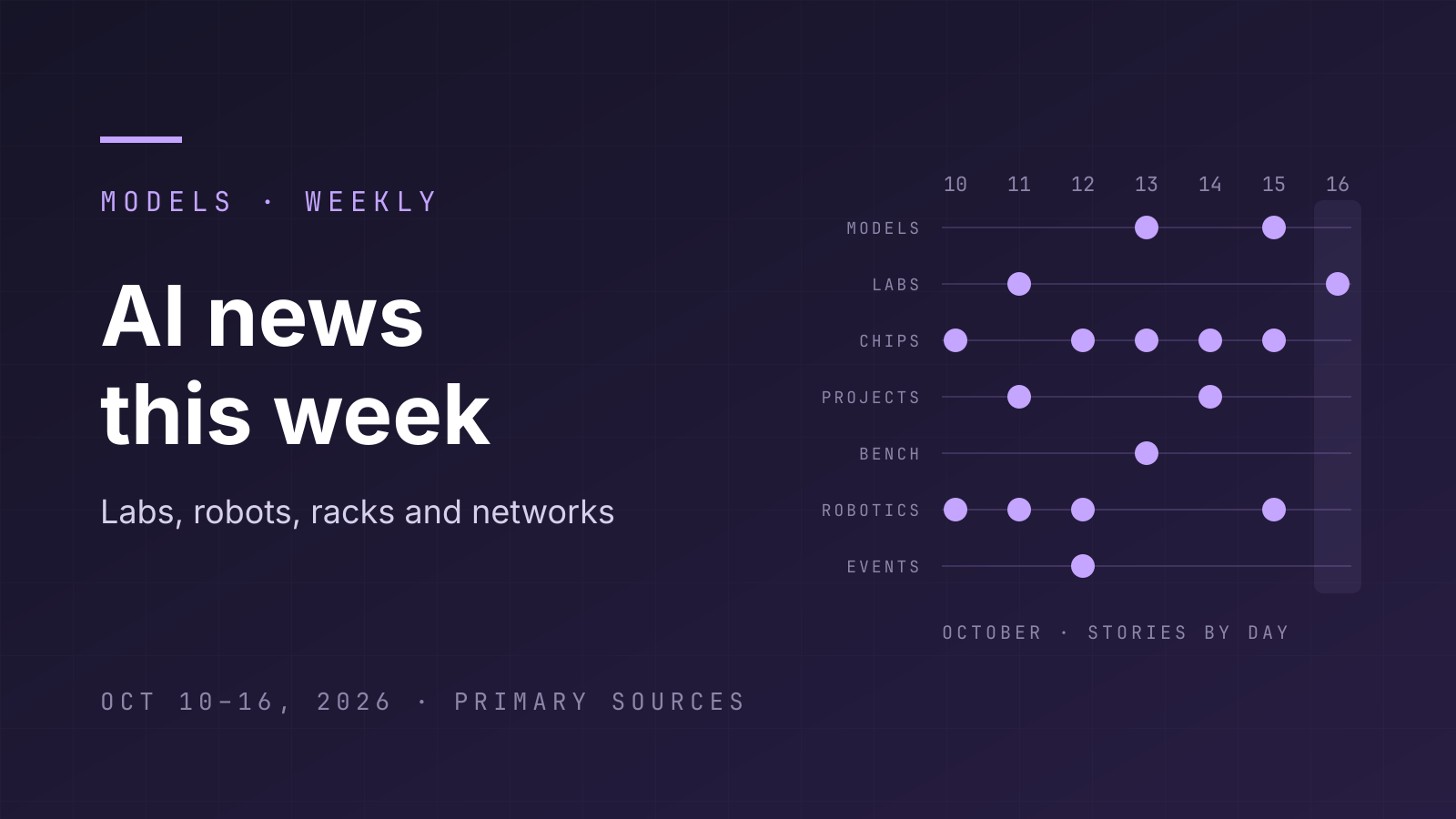
AI news this week, October 10–16, 2026, ran from rack specifications to who gets to look inside a frontier lab. Anthropic gave an outside evaluator, METR, employee-like access with the right to publish; NEURA Robotics introduced a robot foundation model that adds touch and sound to vision; the Ultra Ethernet Consortium, AMD and NVIDIA published network and rack designs at the OCP Global Summit in San Jose. Below is everything The Model Press published this week, with the event date of each development and a link to the company’s or maintainer’s own announcement.
On this page
The week at a glance
| Event date | Development | Section | Our report |
|---|---|---|---|
| Oct 15 | Anthropic embeds a METR team with employee-like access | Labs | Report |
| Oct 14 | NEURA Robotics introduces the Neuron AI robot model | Robotics | Report |
| Oct 12 | Ultra Ethernet Specification 1.1 published | Chips | Report |
| Oct 12–15 | OCP Global Summit: AMD Helion rack, NVIDIA Vera Rubin designs via MGX 1.2 | Events, Projects | Preview, weekly |
| Oct 7 | Anthropic releases Claude Haiku 5.5 | Models | Report |
| Oct 7 | Epoch AI publishes first InnovationEval results | Benchmarks | Report |
| Oct 6 | Boston Dynamics names Rohit Prasad CEO | Robotics | Report |
| Oct 6 | CoreWeave plans 240 MW in Navi Mumbai with AdaniConneX | Projects | Report |
The last four rows are earlier October events that we reported during this week; each report keeps its own event date.
Labs: Anthropic lets METR inside
On October 15, Anthropic announced that six employees of METR, a nonprofit that evaluates frontier AI models, now work with company hardware, office space and access to internal tools roughly on par with Anthropic’s own risk assessment teams. METR will publish its analysis of Anthropic’s risk levels, incidents or practices, and Anthropic says it cannot veto that publication; it can require redactions only in narrow, predefined categories such as customer data and model architecture details. Anthropic also set out three tiers of evaluator access and named SecureBio, Accenture and, in early discussions, Hugging Face as other evaluators. Our full report has the terms.
Models: Claude Haiku 5.5
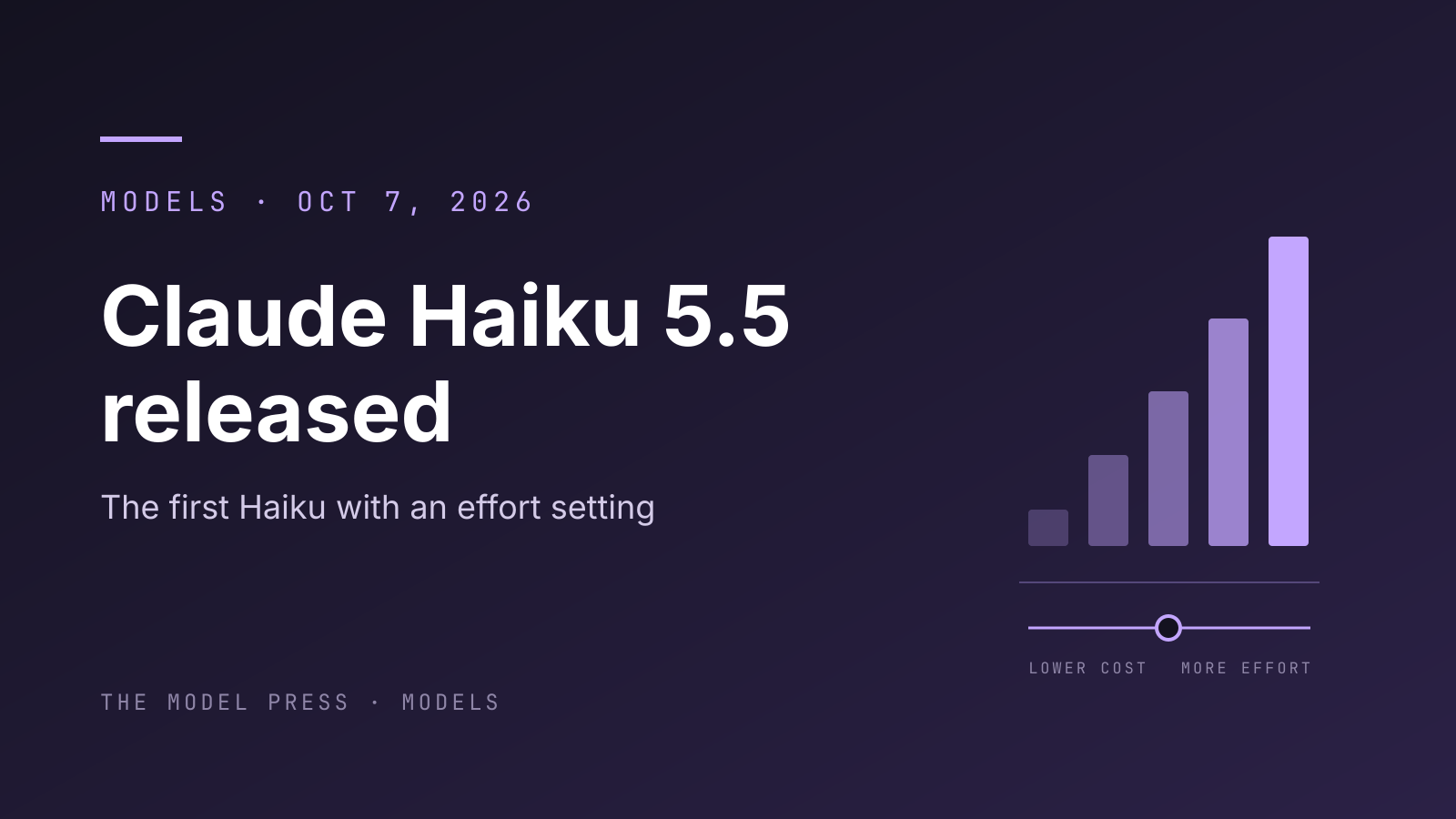
Anthropic released Claude Haiku 5.5 on October 7, describing it as its fastest model to date and aiming it at high-volume work such as summaries, classification and routing, and at subagent roles alongside Opus 5.5 and Sonnet 5.5. It is the first Haiku model with an adjustable effort setting. Our Haiku 5.5 report lists the benchmark scores Anthropic published; every release is logged in AI model updates.
Robotics: touch and sound for robot models
NEURA Robotics introduced Neuron AI on October 14, a model that combines 3D vision, touch and force, audio, robot state and language with memory, and that NEURA says runs across five of its robot embodiments. The company plans a fully autonomous eleven-minute laundry task with its 4NE1 humanoid at NVIDIA GTC Berlin. Our Neuron AI report covers the training data and what the announcement leaves out.
Earlier in the month, on October 6, Boston Dynamics appointed Rohit Prasad as chief executive, effective October 7; Prasad previously led Alexa and the Amazon Nova model family at Amazon.
Chips and networks: Ultra Ethernet 1.1 and OCP
The Ultra Ethernet Consortium released Specification 1.1 on October 12, adding scale-up networking support, in-network collectives that let capable switches perform reductions, new congestion signalling and programmable congestion management. It is a specification, not shipping hardware; our Ultra Ethernet 1.1 report explains the changes.
The OCP Global Summit opened in San Jose the same day. AMD introduced Helion, an open rack blueprint for agentic AI workloads, and NVIDIA contributed Vera Rubin rack and compute tray designs to the Open Compute Project through MGX 1.2. Accelerator specifications are in our AI chips table.
Projects: campuses on paper
Wednesday’s data center news this week collected the campus announcements: Sesterce’s planned campus in Jämsä, Finland with a 200 MW first phase, Fermi America’s AMD credit support agreement for the 222 MW first phase of Project Matador in Texas, and Adani Enterprises’ non-binding memorandum with Jabil for AI and data-centre hardware manufacturing in India. On October 6, CoreWeave announced 240 MW across three 80 MW buildings at AdaniConneX’s Taloja campus in Navi Mumbai, to run NVIDIA Vera Rubin. Announced projects are tracked in AI data centers.
Benchmarks: can agents automate AI research?
Epoch AI’s InnovationEval report, published October 7 and subtitled “Early evidence from InnovationEval: No”, asked AI agents to independently find a post-training method as good as a recent human-developed one. The best in-scope result from a model that had not seen the reference paper reached 15% of the human method’s gains. Our InnovationEval report has the method and results; published scores are collected on the LLM leaderboard.
Explainers published this week
- AMD Instinct MI355X: specs and how it compares — October 10
- Stargate AI: the OpenAI data-center project explained — October 11
- Do AI data centers use water? How much, and why — October 11
- HBM memory: why AI chips depend on it — October 12
- Humanoid robots for sale: what you can buy and the price — October 12
- KV cache explained: how it speeds up AI inference — October 13
- Google TPU: generations and who can use them — October 13
- CoreWeave and the neoclouds: who rents AI GPUs — October 14
- AWS Trainium: what it is and which models train on it — October 15
Also published this week from our earlier-event archive: Google DeepMind’s Gemini Robotics 2 launch (July 30), Huawei’s Ascend roadmap (September 17) and Anthropic and Accenture’s embedded evaluation partnership (September 18), plus Sunday’s AI company news for October 4–10.