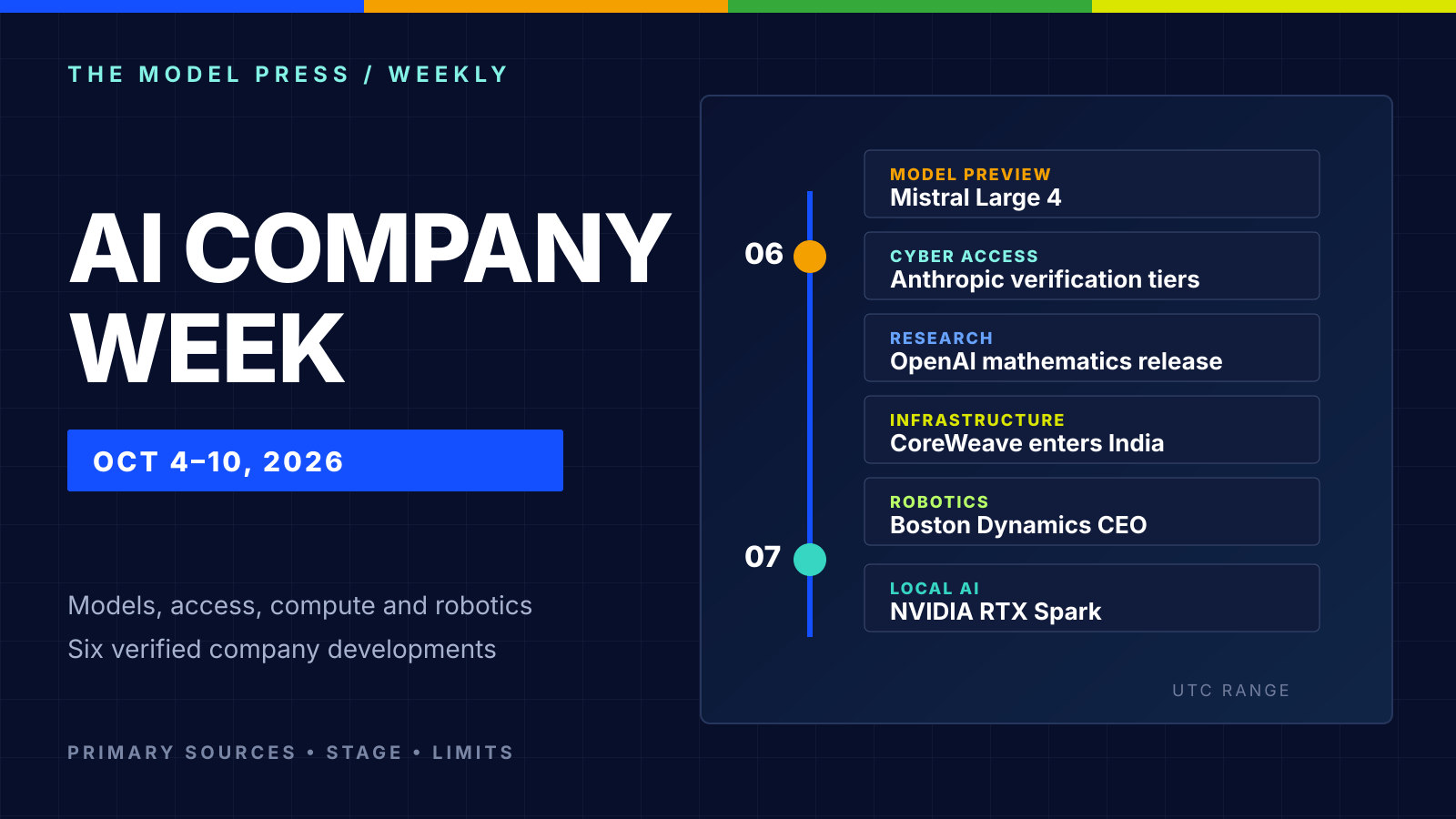
The seven completed UTC days from October 4 through October 10, 2026 produced a concentrated set of AI company news. Six of the clearest developments landed on October 6 and 7, spanning model access, cyber safeguards, mathematical research, AI infrastructure, robotics leadership and local AI hardware.
This digest separates what is available now from what companies have only announced or previewed. Product specifications, benchmark results and schedules below remain company statements unless another source is named.
On this page
Mistral opened Large 4 in public preview
On October 6, Mistral opened a hosted public preview of Mistral Large 4 through Mistral Studio. The company describes the model as natively multimodal, with one trillion total parameters and 52 billion active parameters. Mistral says the model is aimed at coding, agentic workflows, cybersecurity, scientific work and document or image understanding.
The important availability detail is that the downloadable weights were not released with the preview. Mistral said it planned to publish them by the end of October and would disclose more architecture and post-training information at that stage. Teams can evaluate the API now, but claims about self-deployment apply to the planned weight release.
Mistral also published extensive benchmark and demonstration material. Those results identify the tests and settings the company chose; they do not establish performance on a buyer’s own data or production workflow. Our Mistral Large 4 report tracks the preview and planned weight release. The official announcement was published October 6.
Anthropic split cyber access into three tiers
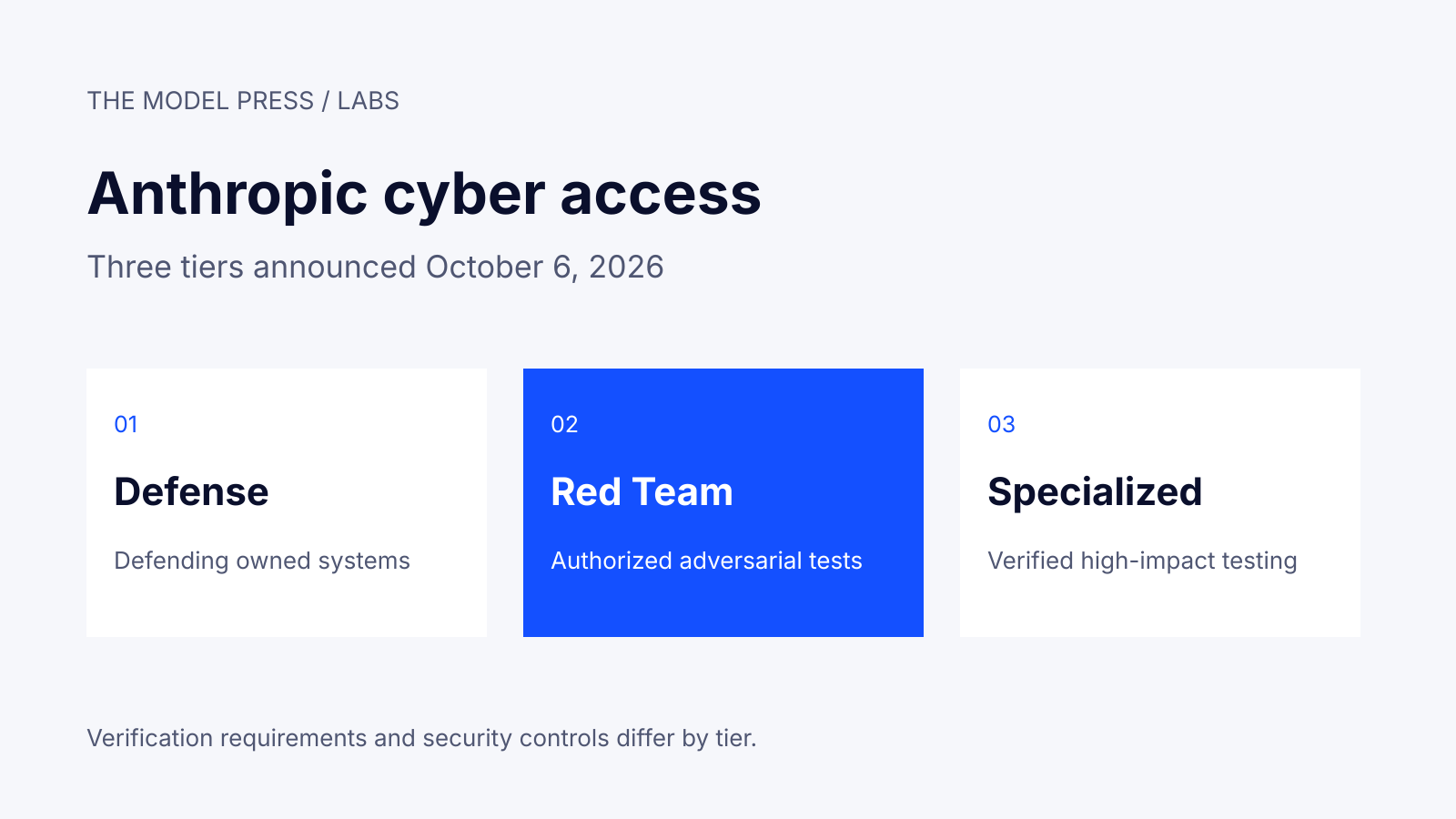
Anthropic expanded its Cyber Verification Program on October 6. The program now has Defense Access, Red Team Access and Specialized Access, with different eligibility reviews and controls. Defense Access covers defensive work such as incident response, malware analysis and vulnerability validation. Red Team Access adds authorized penetration testing. Specialized Access is reserved for verified organizations testing high-risk systems such as power grids, flight operations or interbank infrastructure.
This is an access-policy change, not a general removal of cyber safeguards. Anthropic says its generally available models keep conservative controls, while qualifying organizations can apply for reduced blocking under the program. The company also requires data retention for participants so it can monitor for misuse. A promised Enterprise Frontier Safeguards option is due later in the fall, according to Anthropic, rather than being available in the October 6 announcement.
Our Cyber Verification Program report covers the eligibility and retention distinctions. Anthropic’s official program update was published October 6.
OpenAI published mathematical results and proof formalizations
OpenAI said on October 6 that it was releasing a collection of mathematical results produced by an internal frontier model. The company published the work in a GitHub repository, with revision and citation protocols, alongside formalizations of many proofs in Lean. Lean formalizations can be checked by software, but they are not the same as independent mathematical review of every claim in the collection.
OpenAI also released ten summaries of model reasoning, estimates of compute use and statistics on attempted problems. It said the average result used compute comparable to roughly three hours of ChatGPT Pro thinking. That figure describes OpenAI’s estimate for this release, not a general cost or time guarantee for research work.
The practical consequence is a more inspectable package than a result announced only through a company post: researchers can examine papers, revisions and machine-checkable formalizations. OpenAI nevertheless describes the model as internal and says it is still working toward a responsible release. The official publication note is dated October 6.
CoreWeave announced a 240 MW India deployment
CoreWeave announced on October 6 that it plans to enter India through a collaboration with AdaniConneX. The proposed deployment at the Taloja campus in Navi Mumbai consists of three 80 MW buildings, for 240 MW in total. CoreWeave says it intends to deploy NVIDIA’s Vera Rubin platform there and design the facilities for direct liquid cooling.
The first phase is expected in mid-2028, so this is an announced infrastructure project rather than capacity customers can use now. CoreWeave also says the campus could add a further 240 MW later. That expansion is an option, not committed capacity in the current schedule.
For buyers, the announcement extends CoreWeave’s planned geographic footprint and places Vera Rubin infrastructure in India, but the useful dates are still years away. Our CoreWeave India report records the building count, cooling design and timeline. The official CoreWeave announcement was published October 6.
Boston Dynamics appointed Rohit Prasad as CEO
Boston Dynamics announced on October 6 that Rohit Prasad would become chief executive on October 7. Prasad previously led Alexa and artificial general intelligence work at Amazon, including the development of the Amazon Nova model family. Boston Dynamics says his appointment is intended to accelerate the integration of AI with its robotics portfolio.
A leadership appointment does not by itself supply a product date or a new capability for Atlas, Spot or Stretch. The near-term evidence is organizational: the company placed an executive with consumer AI and foundation-model experience in charge as it pursues what it calls Physical AI. Any effect on product availability will need to be evaluated through later technical and commercial announcements.
Our Boston Dynamics leadership report covers the effective date and prior role. Boston Dynamics published the official appointment notice on October 6.
NVIDIA opened RTX Spark laptop preorders
NVIDIA and Microsoft presented RTX Spark hardware and Windows agent infrastructure on October 7. NVIDIA opened laptop preorders that day and said those systems would be available on October 16. Compact RTX Spark desktops are due in November, while DGX Station for Windows remains a preview without a general shipping date in the announcement.
RTX Spark combines a Blackwell RTX GPU with a Grace CPU. NVIDIA lists configurations with up to 128 GB of unified memory and up to one petaflop of FP4 AI compute. Those are platform specifications and low-precision peak figures, not measurements of a particular model or application.
For developers, the main proposition is continuity with NVIDIA’s CUDA stack on a local Windows machine. Hardware configuration and delivery still depend on the system manufacturer. Our RTX Spark report separates the laptop, compact desktop and DGX Station timelines. NVIDIA’s official event report was published October 7.
What the week changed
The week’s releases moved in three different directions. Mistral widened hosted access while reserving the weights for a later milestone. Anthropic created more specific gates for sensitive cyber use. OpenAI exposed more of a research process without releasing the internal model behind it.
Infrastructure and hardware moved on slower clocks. CoreWeave’s India campus is an announcement for mid-2028, Boston Dynamics’ CEO change sets organizational direction without a product timetable, and RTX Spark splits availability across laptops, desktops and a workstation preview. Reading the stage beside each announcement matters more than treating all six as launches.