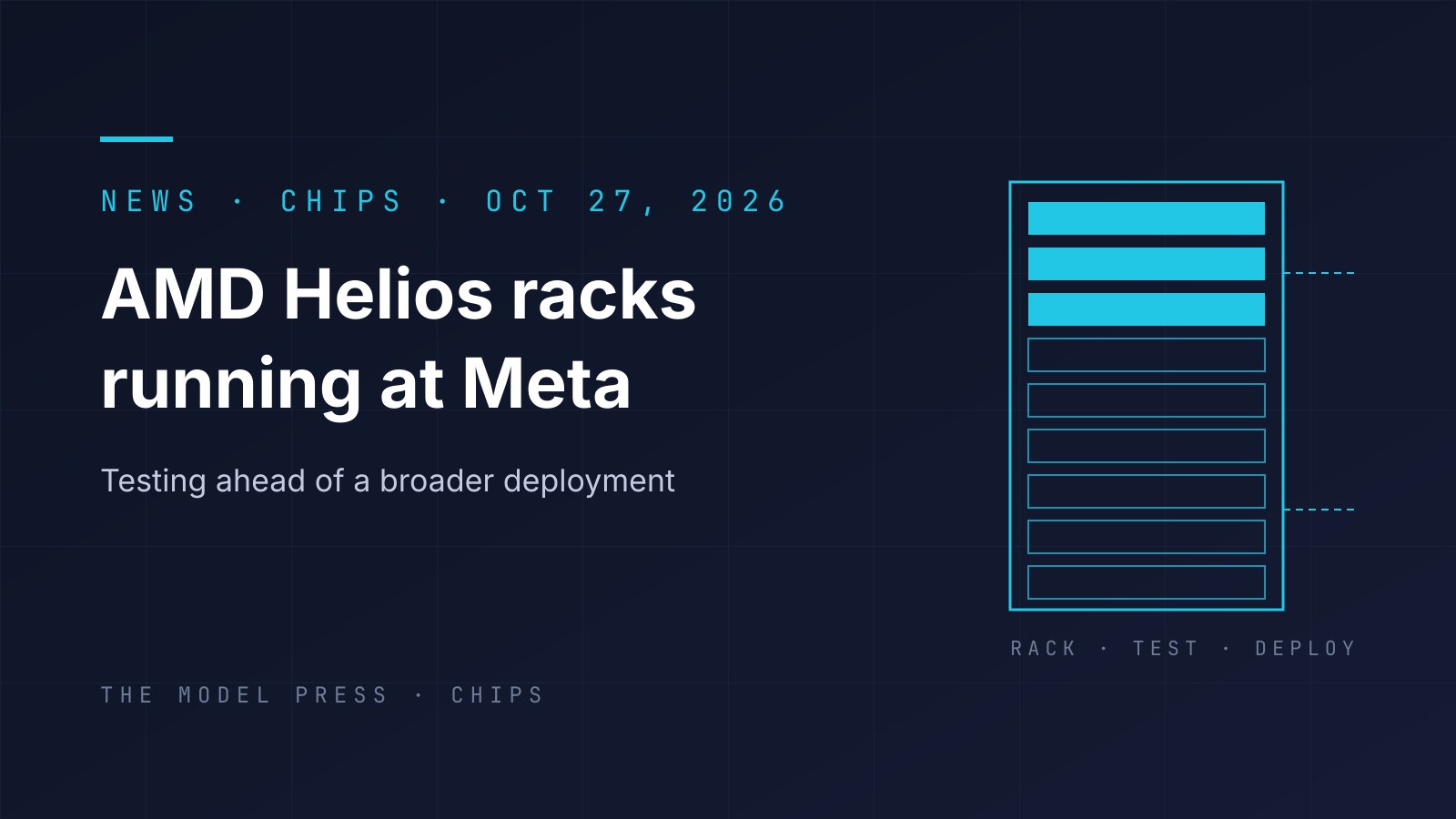
AMD said on October 27, 2026 that its first Helios rack-scale systems are installed at Meta and being tested “on the path to a broader deployment in the near future.” The AMD announcement names Meta as a site where Helios hardware is already running, and it adds two other details: Meta will deploy a custom AMD Instinct GPU tuned for its workloads, and AMD EPYC processors run the computing environments behind Meta’s Muse personal AI agent.
AMD did not give a rack count, a site, a power figure or a date for the wider rollout.
On this page
What AMD says is running at Meta
| Area | What AMD states | Stage |
|---|---|---|
| Helios rack-scale systems | Initial systems installed and being tested by Meta | Testing; broader deployment “in the near future” |
| Instinct GPUs | In production for training, ranking and recommendation engines | In production |
| Custom Instinct GPU | Meta will deploy a custom AMD Instinct GPU optimised for its workloads | Planned |
| EPYC CPUs | Millions deployed across generations; Meta is a lead customer for 6th Gen EPYC | In production |
| Muse agent | EPYC processors support the dedicated computing environments behind Muse | In production |
| Future parts | Collaboration on future EPYC (“Verano”), Instinct MI500 series and next rack-scale systems | Roadmap |
Helios is AMD’s rack-scale system for frontier AI. When AMD launched the Instinct MI400 Series on July 23, 2026, it described the Instinct MI455X as the GPU inside Helios; the MI455X’s published specifications, including 432 GB of HBM4, are on our MI455X page in the AI chips table. The October 27 release does not name the GPU model in the racks Meta is testing, so we do not assume it.
A custom Instinct GPU and the MI450 link
AMD says Meta was an “early definition customer” for the Instinct MI450 architecture and that Meta “will deploy a custom AMD Instinct GPU that is optimized for its workloads.” That is a different arrangement from buying a catalogue part: Meta’s requirements shaped the architecture, and the version Meta deploys will be tuned to its own workloads. AMD gives no specifications or timing for the custom part. It also says the work with Meta is informing the Instinct MI500 series and later rack-scale systems.
On the software side, AMD says the two companies have worked to make ROCm run through PyTorch so developers can use AMD GPUs “right out of the box”, and that they have optimised recommendation-model training on Instinct MI350X GPUs, contributing changes back to PyTorch, Triton and ROCm.
Day-0 support for Meta’s Muse models
AMD lists Day-0 support for Meta’s Muse Spark Open models on Instinct GPUs and for Muse Glimmer on Ryzen AI PCs and Radeon GPUs. Meta’s Muse line and the Muse glasses were introduced at Meta Connect 2026.
Where it fits
AMD’s July agreement with Anthropic for MI450-based capacity, covered in our AMD and Anthropic report, was announced as a capacity commitment; the Meta release describes hardware already on site, though still in testing. AMD CEO Lisa Su said the two companies are “building and deploying infrastructure at gigawatt scale”, but the release puts no gigawatt figure on Meta’s Helios deployment itself. Meta’s own large campuses are described in our Meta Hyperion explainer.
The release also says AMD will invest $1 billion in Meta’s equity offering, without further terms.