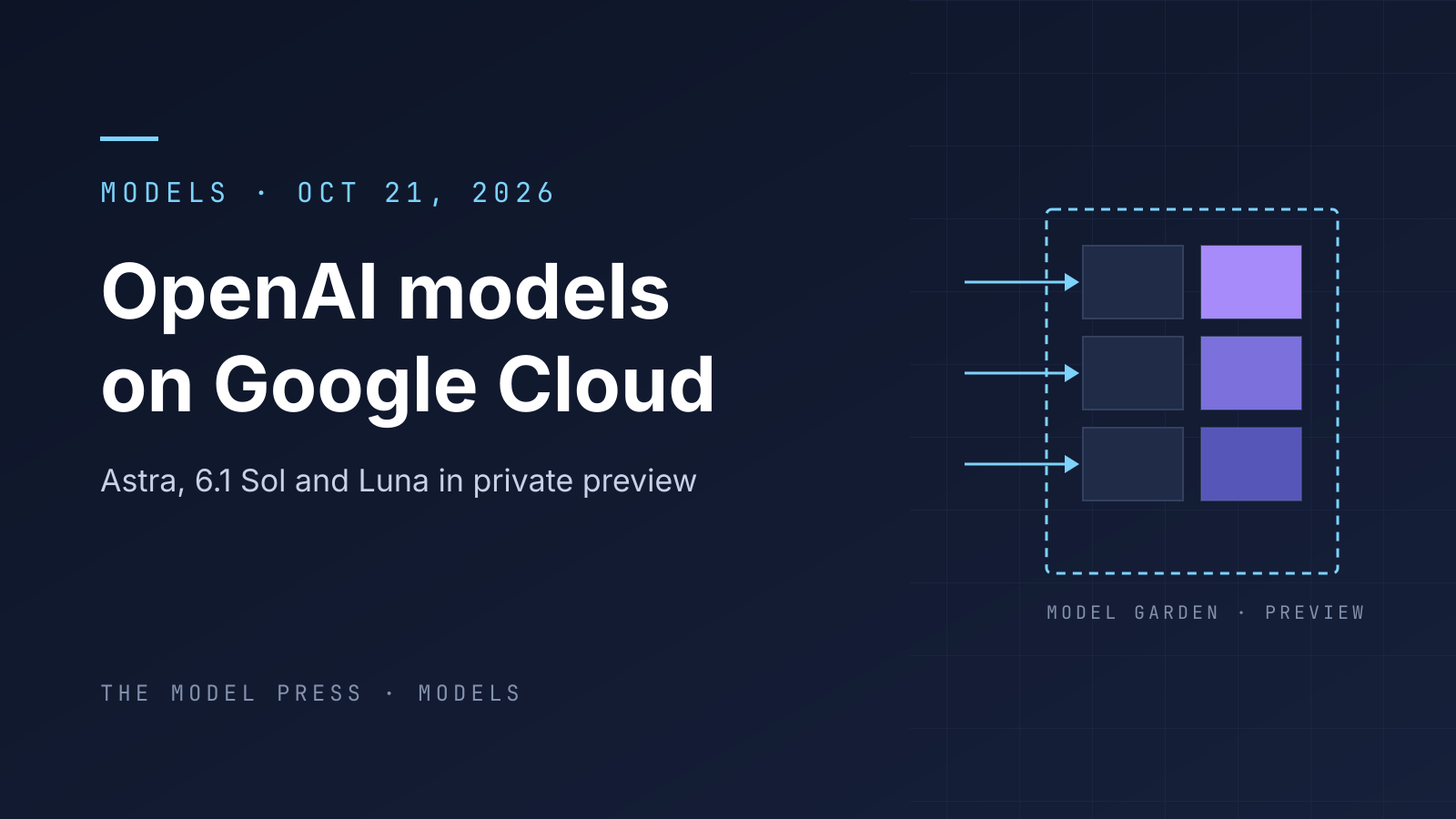
OpenAI models came to Google Cloud on October 21, 2026: OpenAI and Google Cloud announced that OpenAI’s frontier models and Codex workflows are being added to Model Garden, Google Cloud’s catalog of AI models. According to Google Cloud’s announcement, three models, GPT-6 Astra, GPT-6.1 Sol and GPT-6 Luna, are rolling out now in private preview to select enterprise customers. OpenAI’s post says general availability is planned “in the coming weeks”.
The deal puts OpenAI’s current models on the cloud of the company behind Gemini. OpenAI’s post ends with one line on the existing arrangement: Microsoft remains OpenAI’s primary cloud partner.
On this page
Which OpenAI models are on Google Cloud
Google Cloud lists three OpenAI models for Model Garden and describes each one this way:
| Model | How Google Cloud describes it | Status on Google Cloud, October 21, 2026 |
|---|---|---|
| GPT-6 Astra | For demanding work across coding, computer use, professional tasks and scientific research | Private preview, select enterprise customers |
| GPT-6.1 Sol | Near-Astra intelligence for agentic coding, computer use and professional work | Private preview, select enterprise customers |
| GPT-6 Luna | A fast model for everyday work at scale | Private preview, select enterprise customers |
Google says “more” OpenAI models are coming soon but does not name them. Customers outside the preview are asked to register interest through a form on both companies’ pages. GPT-6 Luna was released together with GPT-6 Sol on September 22 (our report), and GPT-6.1 Sol followed at OpenAI DevDay on September 29.
Codex, Antigravity and Gemini Agent
Codex is part of the announcement too. Google Cloud says that, from October 21, customers can build with the three models through its APIs and connect their local Codex CLI and Desktop workflows directly to its Gemini platform for inference.
Two further integrations are announced without a date. OpenAI says its models will “soon” be available in Google Antigravity, Google’s coding tool, and in the Gemini Agent; Google Cloud names Gemini for business and Antigravity as coming soon.
How customers buy access
Both companies say the models are bought through Google Cloud Marketplace, so the usage is billed by Google Cloud. OpenAI says enterprises with Google Cloud spend commitments can draw them down for these purchases; Google adds that usage appears on a single Google Cloud invoice. Neither post publishes per-model terms, and this report does not cover them.
Data handling Google describes
Google Cloud makes several statements about how OpenAI models run on its platform:
- customer prompts, context and outputs stay within the customer’s designated data perimeter and are not used to train foundation models;
- OpenAI models run on dedicated Google Cloud infrastructure, and queries pass through isolated gateways so data stays inside Google Cloud;
- every agent and model call runs under an authenticated identity, with VPC Service Controls and unified audit logging.
Two items are listed as not yet available: Zero Data Retention options and Confidential Compute are both described as “coming soon”. Google also says it is now the only hyperscale cloud provider offering access to all three leading closed-source model families, alongside more than 200 first-party, third-party and open models in Model Garden. That is Google’s own claim about its catalog.
What is still open
The announcement sets out access, not a finished launch. General availability has no date beyond OpenAI’s “coming weeks”, the Antigravity and Gemini Agent integrations have no date, and the two data-protection features above are still to come. Release dates and status for every OpenAI model are tracked in our AI model updates tracker, and our GPT-6.1 Sol review covers how that model has performed in published evaluations.