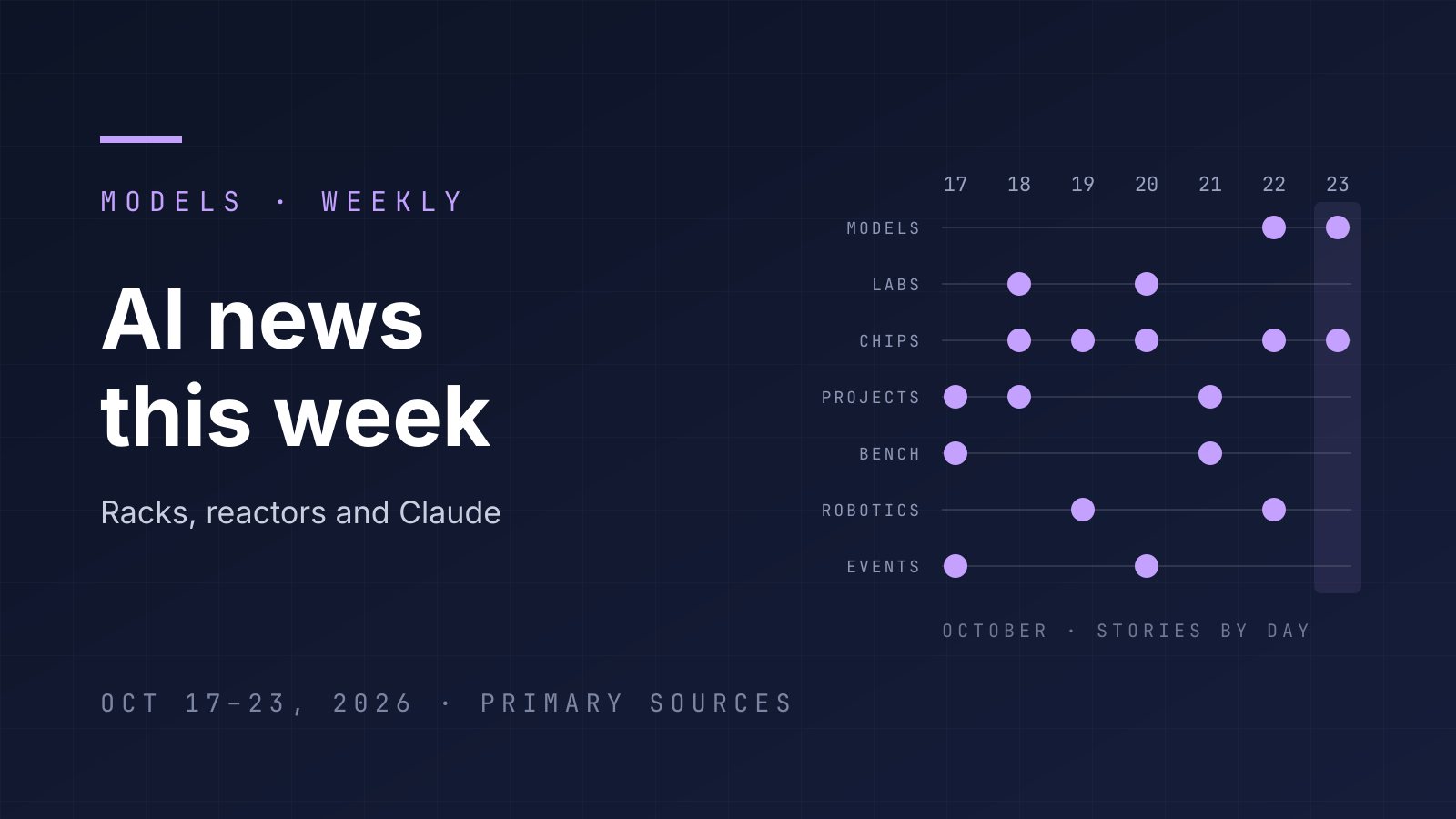
AI news this week, October 17–23, 2026, was about where models run and what they run on. OpenAI’s models started arriving on Google Cloud, Artificial Analysis published the first agent-workload results for NVIDIA’s Vera Rubin NVL72, Microsoft set out Azure Maia 300 as its main inference chip from 2027, and Anthropic took its first data centre lease in Canada while Amazon backed a 960 MW reactor plan in Indiana. Below is everything we published this week, each with its event date and the company’s or maintainer’s own announcement.
On this page
The week at a glance
| Event date | Development | Section | Our report |
|---|---|---|---|
| Oct 21 | OpenAI models enter private preview on Google Cloud | Models | Report |
| Oct 20–22 | NVIDIA GTC Berlin: venues, keynote time and sessions | Events | Preview |
| Oct 15–20 | EverWind and Anthropic, Amazon and X-energy, Hitachi group, Amazon Germany, SOAR AI | Projects | Weekly |
| Oct 15 | Artificial Analysis publishes AA-AgentPerf results for Vera Rubin NVL72 | Benchmarks | Report |
| Oct 15 | Sferical AI launches the Sferical One supercomputer in Sweden | Projects | Report |
| Oct 13 | Google publishes “Gemini 4 Argon for Robotics” | Robotics | Report |
| Oct 12 | Microsoft unveils Azure Maia 300 | Chips | Report |
The Maia 300, Gemini 4 Argon robotics, AgentPerf and Sferical One rows are events from October 12–15 that we reported during this week; each report keeps its own event date.
Models: OpenAI on Google Cloud
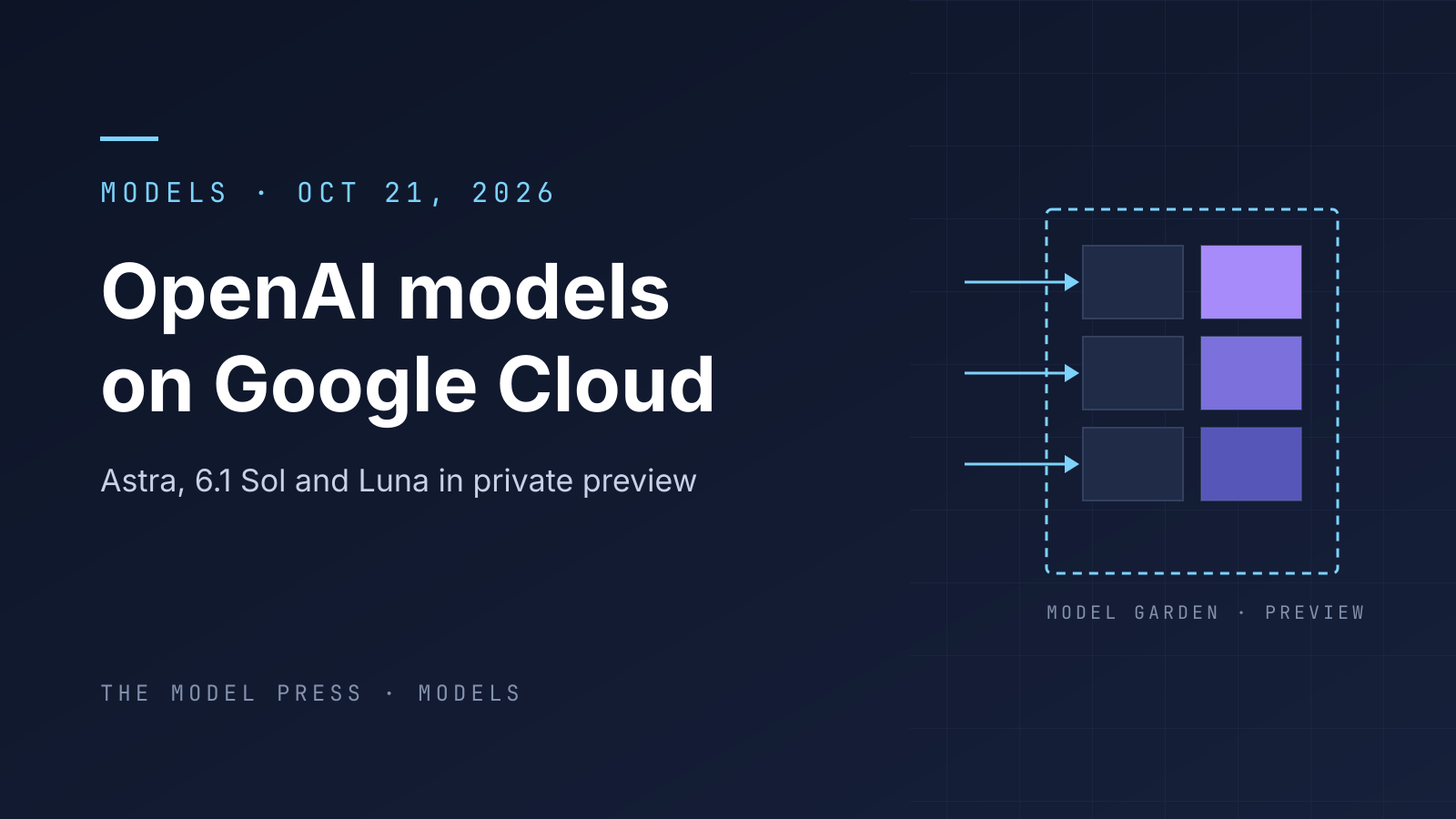
On October 21, OpenAI and Google Cloud announced that OpenAI’s models are coming to Model Garden. GPT-6 Astra, GPT-6.1 Sol and GPT-6 Luna started rolling out in private preview to select enterprise customers, and OpenAI’s post puts general availability “in the coming weeks”. Customers buy access through Google Cloud Marketplace, and Codex CLI and Desktop workflows can connect to Google’s Gemini platform for inference. OpenAI’s post also says Microsoft remains its primary cloud partner. Our full report covers the data-handling terms Google describes and what is still marked “coming soon”; the three models are logged in AI model updates.
Benchmarks: Vera Rubin on agent traffic
Artificial Analysis published AA-AgentPerf results for NVIDIA’s Vera Rubin NVL72 on October 15. Replaying real coding-agent traffic, the rack served up to about 5.7 times the total throughput per megawatt of a GB300 NVL72 on DeepSeek V4 Pro, and about 5.4, 3.0 and 2.8 times on DeepSeek V4.1 Flash, GLM-5.2 and Kimi K3, each at the per-user speed where the gap is largest. At peak throughput the lead narrows to 1.14 to 1.45 times. NVIDIA supplied the serving configurations for both racks. Our AgentPerf report explains the method, and the rack’s specifications are on our Vera Rubin NVL72 page.
Chips: Azure Maia 300 and the supply chain
Microsoft unveiled Azure Maia 300 on October 12, its third in-house AI accelerator, with production deployments from 2027. Microsoft lists 288 GB of HBM4 at 18.0 TB/s per chip, compute chiplets on TSMC’s N2P process and 96 accelerators in a 167 kW rack, and says it will scale Maia to multi-gigawatt deployments as the primary inference system for its own products. Our Maia 300 report has the rack and network details.
Four chip explainers went live this week: Groq and its LPU, Nvidia’s GPU roadmap from Hopper to Rubin, Broadcom’s custom AI chips and, today, TSMC and AI chips, which explains why Maia, Rubin and most other accelerators are made at the same foundry. Specifications are compared in our AI chips table.
Projects: leases, reactors and a shared supercomputer
Wednesday’s data center news this week collected the infrastructure announcements. EverWind announced a 420 MW campus at Point Tupper, Nova Scotia, with a first 95 MW phase in late 2027, and Anthropic said it had signed the lease. Amazon, X-energy and AEP agreed to explore twelve 80 MW Xe-100 reactors at a former coal plant in Indiana. Hitachi, Brookfield, Hartree and Tokyo Gas signed an MoU on self-powered data centers in Japan, Amazon plans €16 billion for Germany in 2027, and SOAR AI kept a December 31 date for 4,096 AMD Instinct MI355X GPUs in Ohio.
The one system already running is Sferical One. Sferical AI launched it on October 15 as a shared supercomputer for AstraZeneca, Ericsson, Saab, SEB, Wallenberg Investments and SKF: 1,152 NVIDIA GB300 GPUs in two DGX SuperPODs in Linköping, operating since late summer. Our Sferical One report has the configuration. Projects are tracked in AI data centers, and two new explainers put them in context: nuclear power for AI data centers and the largest AI data centers by announced capacity.
Robotics: a general model pitched at robots
Google’s developer post “Gemini 4 Argon for Robotics”, published October 13, sets out how its general-purpose model can drive robots, build physics simulations from camera footage and label robot video, with a self-reported 87% on the ERQA embodied reasoning benchmark. Most of the post is demonstration on tasks Google chose. Our report separates the measured results from the demos. Our new Nvidia GR00T explainer covers the dedicated robot foundation model on the other side of that approach.
Events: GTC Berlin
NVIDIA GTC Berlin ran from October 20 to 22, with Jensen Huang’s keynote at the Tempodrom on October 21 and every pass type listed as sold out. Our GTC Berlin preview has the venues, pregame guests and session tracks. For next year’s calendar, see AI conferences 2027.
Explainers published this week
- Nuclear power for AI data centers: the deals so far — October 17
- Groq AI and its LPU: what the inference chip does — October 18
- Nvidia’s data-center GPU roadmap, Hopper to Rubin — October 19
- AI model cards and system cards: what labs disclose — October 20
- AI conferences 2027: dates and venues announced so far — October 20
- AI chip export controls: what the US rules restrict — October 20
- GPQA Diamond explained: the Google-proof science benchmark — October 21
- Largest AI data centers in the world, ranked by announced capacity — October 21
- Broadcom AI chips: custom XPUs and who designs them — October 22
- Nvidia GR00T explained: the Groot robot foundation model, N1 to N1.7 — October 22
- TSMC and AI chips: why so many accelerators run through it — October 23
- Claude models list: every Anthropic model by date — October 23
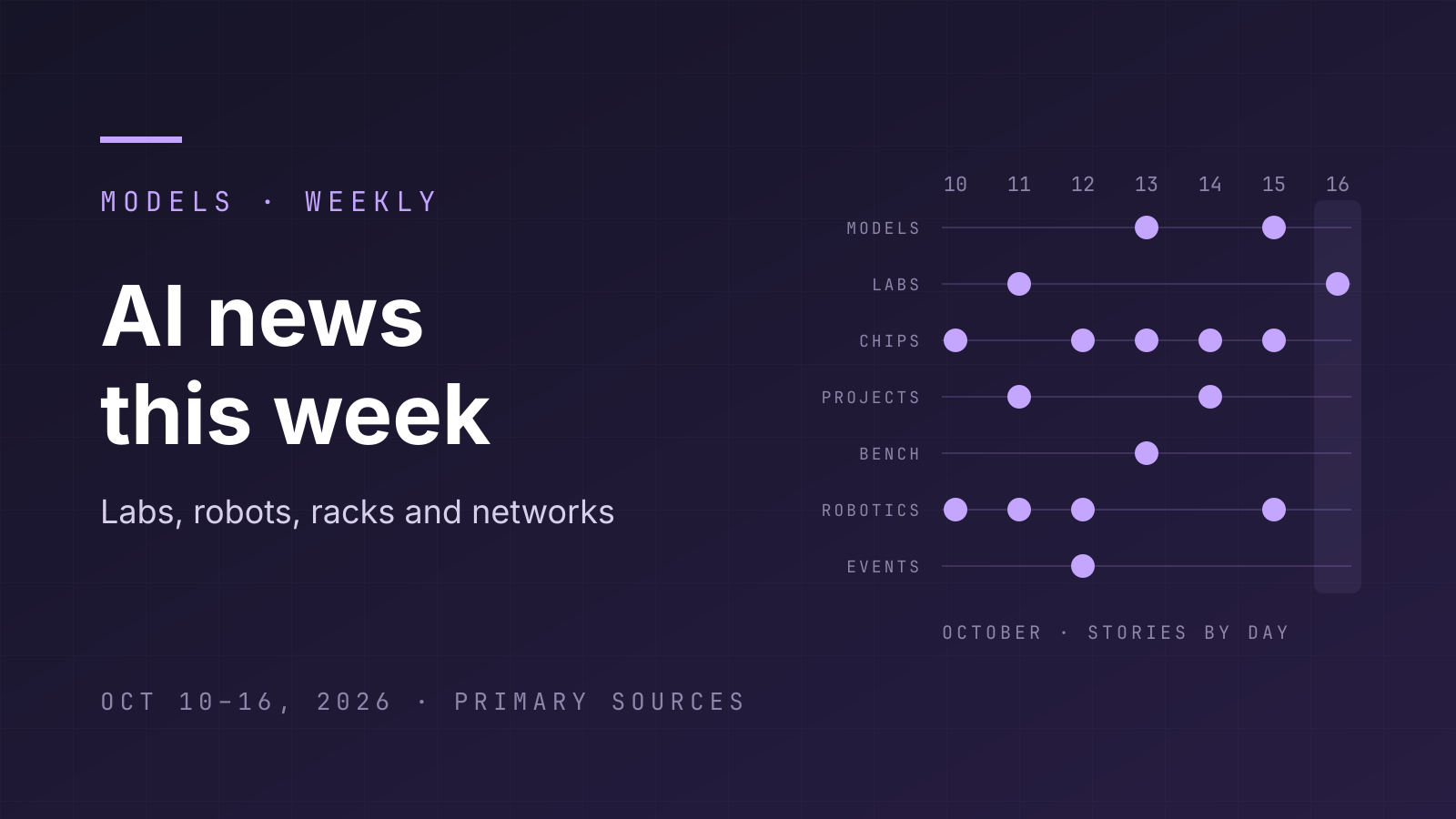
Also published this week: Sunday’s AI company news for October 12–16. The previous roundup is AI news for October 10–16.