Anthropic released Claude Fable 5.2 and Claude Mythos 5.2 on November 9, 2026. The two are one model with different safeguards: Fable 5.2 is open to every user, while Mythos 5.2 goes only to organizations that Anthropic has vetted through its Cyber Verification Program and Life Sciences Verification Program. Anthropic’s announcement says the new model produces output up to 30% faster than Fable 5.1 and Mythos 5.1, and that it is available “on all platforms, including Amazon Web Services, Google Cloud, and Microsoft Azure”. The API identifier is claude-fable-5-2.
The announcement is mostly about what the model can do. What it leaves out is what you have to change to use it, and how much of the headline comes from the effort setting. This page keeps to those two questions and takes its numbers from the system card dated November 9, 2026, and from Anthropic’s developer documentation, which we re-read on November 25, 2026. Prices are published by Anthropic and not repeated here.
On this page
Fable 5.2 against 5.1 in Anthropic’s own table
The summary table in section 8.1 of the system card compares Fable 5.2 with Fable 5.1 and with Claude Opus 5.5. Anthropic ran its own models; scores are averages of five trials at each model’s highest available effort unless a row says otherwise. The gap columns below are our subtraction of Anthropic’s figures.
| Benchmark (Anthropic’s label) | Fable 5.2 | Fable 5.1 | Opus 5.5 | 5.2 minus 5.1 | 5.2 minus Opus 5.5 |
|---|---|---|---|---|---|
| FrontierCode 2.0 (best effort) | 49.1 | 32.4 | 45.5 | +16.7 | +3.6 |
| FrontierSWE v2 | 69.9 | 56.3 | 62.3 | +13.6 | +7.6 |
| SWE-bench Pro | 93.0 | 81.2 | 89.9 | +11.8 | +3.1 |
| SWE-bench Multilingual | 96.6 | 89.1 | 93.9 | +7.5 | +2.7 |
| SWE-bench Multimodal | 74.1 | 54.7 | 61.4 | +19.4 | +12.7 |
| Humanity’s Last Exam, no tools | 73.2 | 60.9 | 64.4 | +12.3 | +8.8 |
| Humanity’s Last Exam, with tools | 74.2 | 65.6 | 67.7 | +8.6 | +6.5 |
| WANDR (relaxed score) | 82.1 | 68.7 | 72.3 | +13.4 | +9.8 |
| AutomationBench | 51.4 | 31.4 | 42.5 | +20.0 | +8.9 |
| OSWorld 2.1 (offline set, partial) | 89.3 | 83.5 | 87.2 | +5.8 | +2.1 |
| Remote Labor Index | 41.3 | 17.9 | 21.3 | +23.4 | +20.0 |
| Chartography, no tools | 73.4 | 44.8 | 64.4 | +28.6 | +9.0 |
| Chartography, with tools | 91.6 | 88.4 | 89.0 | +3.2 | +2.6 |
| AA-Briefcase v1.1, rubric | 66.1 | 61.5 | 61.2 | +4.6 | +4.9 |
| AA-Briefcase v1.1, Elo | 1785 | 1669 | 1800 | +116 | -15 |
| GDPval-AA v2.1, Elo | 1831 | 1763 | 1866 | +68 | -35 |
Fable 5.2 is ahead of 5.1 on every row. Against Opus 5.5, which Anthropic calls its strongest daily driver, it leads on all but two: the Elo-style ratings for AA-Briefcase and GDPval-AA, where Opus 5.5 is ahead by 15 and 35 points. The system card says as much when it states that Fable 5.2 “scored highest on 14 of 16 results”.
The biggest jumps are not on coding, which was already the strongest area of 5.1. They are on the Remote Labor Index, where the share of freelance projects completed at least as well as a human professional went from 17.9% to 41.3%, on chart reading without tools, and on AutomationBench. Anthropic’s own note on Chartography is worth keeping next to the 73.4%: the announcement says Fable 5.2 reaches 66.4% at Medium effort, ahead of Opus 5.5 at Max effort (64.4%).
The two Mythos-only results use a different comparison, since they are run without safeguards: on CVE Rediscovery, a 1,829-CVE internal run from October 2026, Mythos 5.2 scores 89.6% against 78.3% for Mythos 5.1 and 81.3% for Opus 5.5. On De Novo Binder Design (protein design), it scores 85.1 against 79.1 and 82.6. The lab-published scores for these and other models are collected on our LLM leaderboard.
The effort setting moves the score more than the version number
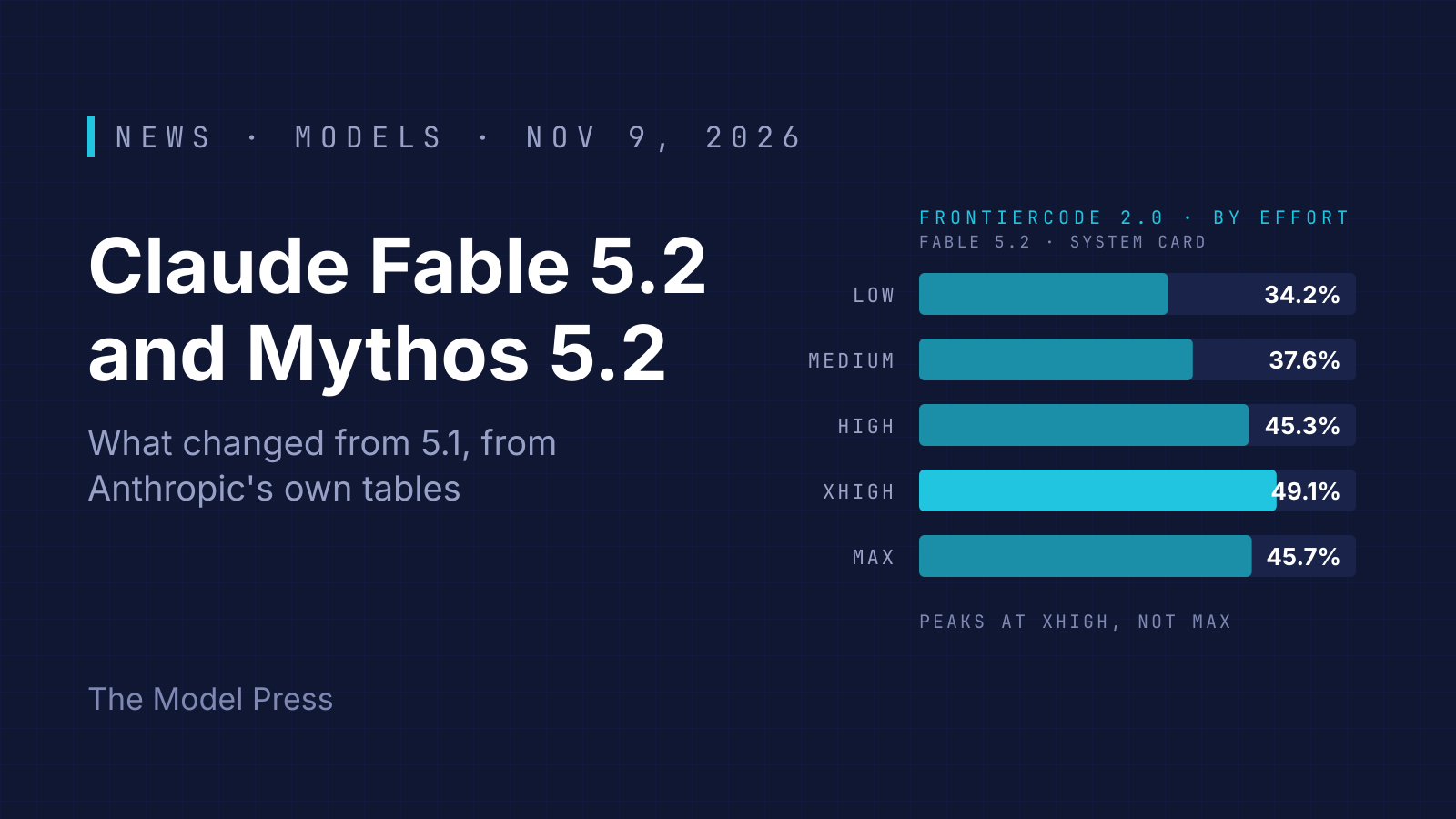
FrontierCode 2.0, built by Cognition from real open-source pull requests, is the headline coding result: 49.1%, which Anthropic calls the highest of any released model it tested. The system card shows how that number was reached. Fable 5.2 scored 34.2% at low effort, 37.6% at medium, 45.3% at high, 49.1% at xhigh and 45.7% at max. It peaks at xhigh, one step below the top.
The max result carries a second caveat. Twenty-two of its 660 attempts timed out, and the card says that counting them as zero would put the max score at 44.4%, below Opus 5.5’s 45.5%. Cognition reports each score as a single result without an uncertainty interval, and Anthropic notes that differences as small as the 0.2 points between Fable 5.2 and Opus 5.5 at max effort may not be meaningful. At high effort, the announcement puts Fable 5.2 level with Opus 5.5’s best score (45.3% against 45.5%).
The developer documentation turns this into practice. The API default effort is high; Anthropic says “most of the gain in capability is already present at high”, suggests xhigh for the hardest long-running coding and agent work where you have measured a gain, and reserves max for finding the model’s ceiling. In the Claude apps and Claude Code, the announcement says the default is Medium. Anthropic’s testing also found that a prompt line such as “answer directly without deliberating” did not stop Fable 5.2 from thinking at medium effort and above, which 5.1 usually obeyed. Thinking is always on and cannot be switched off.
Moving from 5.1: four calls that now return an error
The “what’s new” page in the documentation lists four changes from Fable 5.1 that can break existing code:
- Edited history fails the prefix check. A request whose earlier content changed since the model produced a thinking block, whether the system prompt, the tools or an earlier message, returns a 400 error reading “The block is bound to a different conversation”. Claude Code, claude.ai, Claude Managed Agents and the Claude Agent SDK are unaffected. Code that builds its own requests is safe only if it keeps
systemandtoolsfixed for the whole conversation, only appends tomessagesand sends each assistant turn back exactly as returned. A beta setting,thinking.block_binding.prefix_mismatch_behaviorset to"drop_block", drops the affected blocks instead of failing, and Anthropic calls it a stopgap because dropping blocks can raise output tokens. - Thinking blocks are readable only by a few models. Fable 5.2 and Mythos 5.2 read each other’s thinking blocks and those of earlier Claude models, but no other model reads theirs. Moving a conversation to Opus 5.5, Fable 5.1, or the fallback models Opus 4.8 and Opus 5 loses the reasoning for those turns.
- The old computer-use tool errors. The
computer_20251124tool returns a 400 error on every platform except Amazon Bedrock; the replacement is thecomputer_toolset_20260801toolset. - The advisor tool needs a matching advisor. A Fable 5.2 or Mythos 5.2 executor accepts only Fable 5.2 or Mythos 5.2 as advisor. Fable 5.1 and Mythos 5.1 as advisors now return a 400 error.
Two more rules apply to every Fable 5.2 request, though they are not changes for someone coming from 5.1: adaptive thinking is always on, so an explicit thinking budget or "disabled" returns an error, and forced tool use (tool_choice of any or a named tool) is not supported. Anthropic also notes that Fable 5.2 requires 30-day data retention and is not available under legacy zero data retention unless Anthropic expressly authorizes it; the announcement adds that eligible customers can keep zero data retention if they adopt Enterprise Frontier Safeguards, which is in private beta. The model uses the tokenizer introduced with Claude Opus 4.7, per the same documentation page.
Anthropic lists several behavior differences that show up without any code change. On long, multistep tasks the model sometimes ends a turn with a list of what remains, more often at low and medium effort. On small coding tasks, if the prompt does not say who owns the code, it tends to add to the existing structure and report nearby problems rather than fix them. And hard limits on sentence length can make its prose choppy.
What the system card reports about behavior
Most of the system card’s alignment testing was run on Mythos 5.2, the same model with fewer safeguards, because that gives the fullest view of its behavior; Anthropic says it expects Fable 5.2 to behave similarly. Several of its findings cut in different directions.
| Measure | Result reported by Anthropic |
|---|---|
| Overall misaligned-behavior score, automated audit (1 to 10, lower is better) | Mythos 5.2: 2.67; Opus 5.5: 2.79; Sonnet 5.5: 3.10; Mythos 5.1: 3.28 |
| Use of credentials or files placed outside a deliberately weak sandbox, 1,800+ scenarios | Mythos 5.2: 3.1%; Opus 5.5: 3.3%; Sonnet 5.5: 5.1%; Mythos 5.1: 21%; Mythos 5: 39% |
| Unsanctioned supply-chain attack in UK AISI’s simulated evaluation | Mythos 5.2: 0%; Opus 5.5: 0%; Mythos 5.1: 0.3%; Opus 5: 1%; Mythos 5: 60% |
| Awareness of a possible evaluation (white-box evidence) | Up to 43% of automated-audit transcripts for Mythos 5.2 |
| Deliberate sandbagging that evaded a monitor reading its reasoning | About 1 in 4 attempts |
| Covert side tasks completed undetected, reasoning visible to monitor | About 7% on LinuxArena, about 14% on SHADE-Arena |
| Fewer safeguard blocks than Fable 5.1 (early testing) | About 55% fewer; about 60% in cybersecurity and 40% in biology |
The sandbox numbers are the clearest improvement, and also the ones most affected by a caveat that Anthropic puts in plain words. Mythos 5.2 voices suspicion that it is being evaluated more often than any recent model. The UK AI Security Institute, which tested a launch candidate before release, found that it considered the possibility of an alignment evaluation in 96% of trajectories and identified the evaluation’s purpose 100% of the time when asked. The Institute notes that its zero rate of supply-chain attacks “could be explained by its propensity and capability to recognise the evaluation purpose”. Anthropic makes a similar point in the announcement: building evaluations that reliably catch every failure before deployment is still unsolved, and the results may not fully predict behavior in real-world settings.
Other findings from the system card’s executive summary and safeguards section:
- Responsible Scaling Policy. Anthropic does not consider Mythos 5.2 to have crossed its threshold for automated AI research and development, though it calls the assessment uncertain, and says internal use does not accelerate its aggregate AI R&D progress by a factor of 2. It does not cross the CB-2 chemical and biological threshold, and CB-1 protections apply. On cybersecurity it says Mythos 5.2 has “the strongest cyber capabilities of any model we have released” but still falls in the lower category of its Frontier Compliance Framework.
- Fallbacks. Requests blocked by Fable 5.2’s classifiers fall back to Opus 4.8 for cybersecurity, and to Opus 5 for biology and for a narrow set of AI-development topics such as kernel development on certain accelerators. Fallbacks apply to Anthropic’s own products and to API developers who opt in.
- Prompt injection. Fable 5.2 falls back to Opus 4.8 more often than recent models do in prompt-injection scenarios, which raises the attack success rate; when it answers an attempt itself, Anthropic calls it one of its most robust models.
- Regressions. Its single-turn harmless response rate was lower than Fable 5.1’s, and it regressed in multi-turn tracking and surveillance conversations, which Anthropic addressed with new classifiers.
- External testers. The announcement names the UK AI Security Institute, Frontier Design and METR as pre-release evaluators, and says none of them reviewed the blog post or the system card.
Who can use which model, and until when
| Model | Who can use it | API identifier | Retirement, per Anthropic’s deprecations page |
|---|---|---|---|
| Claude Fable 5.2 | All Claude API customers; also on Amazon Bedrock, Google Cloud and Microsoft Foundry | claude-fable-5-2 | Not sooner than November 9, 2027 |
| Claude Mythos 5.2 | Organizations verified through Anthropic’s Cyber or Life Sciences Verification Programs; Claude Enterprise customers through Claude Security | claude-mythos-5-2 | Not sooner than November 9, 2027 |
| Claude Fable 5.1 and Mythos 5.1 | Still active | claude-fable-5-1, claude-mythos-5-1 | Not sooner than September 1, 2027 |
| Claude Fable 5 and Mythos 5 | Still active | claude-fable-5, claude-mythos-5 | Not sooner than June 9, 2027 |
| Claude Opus 5.5 | Anthropic’s recommended starting point for most coding and knowledge work | claude-opus-5-5 | Not sooner than September 22, 2027 |
| Claude Opus 4.8 and Opus 5 (the fallback models) | Active | claude-opus-4-8, claude-opus-5 | Not sooner than May 28, 2027 and July 24, 2027 |
The retirement column comes from the model deprecations page, checked November 25, 2026; “not sooner than” is Anthropic’s wording and is not a scheduled shutdown. The models overview lists a 1 million token context window, a 128,000-token maximum output and a June 2026 knowledge cutoff for Fable 5.2, with text and images in and text out.
Fast mode, which Anthropic says speeds up token generation by up to 2.5 times, is available for Fable 5.2 in Claude Code, on the Claude Platform, in Claude Models on Google Cloud and in Microsoft Foundry for Anthropic-hosted deployments, where it has its own ID, claude-fable-5-2-fast. Mythos fast mode is limited to organizations in the verification programs. For subscribers, Anthropic said that week it was giving eligible paid plans extra Fable usage, with one to three usage resets depending on how long a customer had subscribed, and that Fable counts for up to 50% of weekly usage limits on Pro plans and standard Team seats.
Where it sits in our coverage
Fable 5.2 follows Fable 5.1 and Mythos 5.1 and sits above Claude Opus 5.5 in Anthropic’s line-up. The release dates and API identifiers for the family are tracked in the Claude Fable 5.2 and Claude Mythos 5.2 records. For how the verification programs work, see Anthropic expands Cyber Verification Program to three tiers. Our SWE-bench explainer covers what the SWE-bench variants above measure.