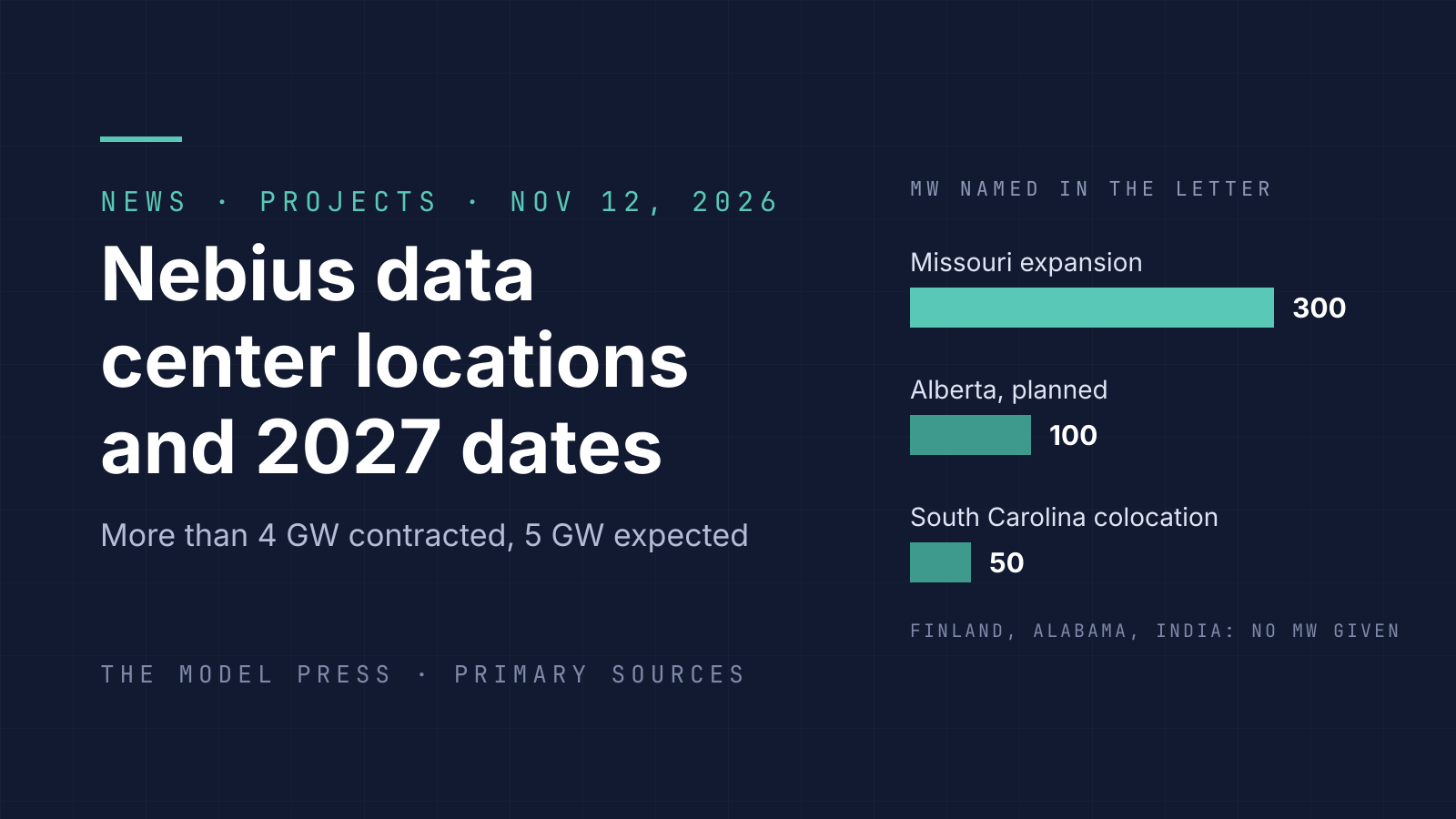
Nebius named its data center locations for 2027 in its November 12, 2026 shareholder letter, which also says it has more than 4 GW of contracted power, still expects 5 GW by the end of 2026 and has pushed several third-party sites into the first half of 2027. The letter gives a megawatt figure for only three of the places it mentions.
The letter is an exhibit to a Form 6-K filed with the SEC. This page puts every site it dates into one table, sorted by who owns the site, and lists what the letter does not say.
On this page
Every dated site in the November 12 letter
| Site | Model | What the letter says | Due |
|---|---|---|---|
| Missouri | Owned | A 300 MW expansion, with a “1.1 GW site under contract” | 2027 |
| Lappeenranta, Finland | Owned | Named as a new owned site; no megawatts given | 2027 |
| Mäntsälä, Finland (second site) | Owned | Named as a new owned site; no megawatts given | 2027 |
| Alabama | Owned | Named as a new owned site; no megawatts given | 2027 |
| New Jersey | Colocation, Microsoft contract | More than half of the contracted capacity delivered by the end of 2026; remaining tranches “now scheduled for 2Q27” | End of 2026, then 2Q27 |
| Alberta, Canada | Exclusive site rights | A planned 100 MW multi-campus project, with potential to scale to several hundred MW | 2027 target |
| South Carolina | Colocation | A new 50 MW colocation, Nebius’s eighth US site | 2027 |
| India (two sites) | Colocation | Two colocations, Nebius’s first in the Asia-Pacific region; no megawatts given | 2027 |
Our tracker holds a record for each figure the letter quantifies: the Missouri expansion, the Alberta project and the contracted-power total. A separate 50 MW lease with AIB Data Centers in the Southeastern US, announced on September 30, has its own record. The letter does not say whether that lease is the South Carolina colocation, and this page does not treat them as the same.
Owned sites carry 2027, and the delays are at third parties
Nebius splits its own build from what it rents. Of the owned sites in the table, the letter says the Missouri, Lappeenranta, second Mäntsälä and Alabama sites represent “more than 3 GW of capacity” at scale, “which we expect to be delivered over the next 3 to 3.5 years.” Spread evenly, that is 0.86 GW a year over 3.5 years and 1 GW a year over three, which sits close to the company’s repeated line that it expects to “bring online more than 1 GW of new capacity each year.” The even spread is our arithmetic, not a schedule Nebius published; the letter says the build is phased and gives no per-year figures.
On timing the letter is direct. Of its own sites it says “These sites are on time or ahead of schedule.” Then: “Where we rely on third parties, there have been delays.” Delivery dates at “a number of colocation sites” shifted into the first half of 2027.
New Jersey is the one delay the letter explains. Late in the third quarter, the site’s operator DataOne started to retire some of the site’s temporary generation ahead of the move to permanent power, and Nebius says it is deploying Bloom fuel cells as the main power source; the letter says Bloom generation is already online. The effect on the Microsoft contract is the split in the table: more than half of the capacity by the end of 2026 and the rest in the second quarter of 2027.
What 4 GW to 5 GW leaves open
“We continue to expect to have 5 GW of contracted power by year-end 2026,” the letter says, from a starting point of more than 4 GW. That target is not new. Nebius raised it to 5 GW in its second-quarter letter of August 12, 2026, where it wrote “today we are raising our year-end contracted power target again to 5 GW”, so the November letter holds the number rather than moving it.
The November letter is dated November 12, which leaves 49 days to the end of the year to close a gap of less than 1 GW. The three additions it quantifies add up to 450 MW (300 plus 100 plus 50), and the letter presents them, with the two India colocations, as part of how contracted power reached its current level. It does not name the contracts that will take the total from more than 4 GW to 5 GW.
Nebius also ties the rest of its plan to the same capacity. It guides to about $27 billion of capital spending in 2026, above its earlier $20 billion to $25 billion range, and $40 billion to $45 billion in 2027, “sized for more than 1 GW of new capacity.” Those are company guidance figures and say nothing about what any single site costs.
What the letter does not say
- Megawatts for most owned sites. Lappeenranta, the second Mäntsälä site and Alabama appear without a figure, and so do the two India colocations.
- Whether the 1.1 GW includes the 300 MW. The sentence reads “A 300 MW expansion in Missouri, where we now have 1.1 GW site under contract”. If the expansion is inside the 1.1 GW, the Missouri contract was 800 MW before it; the letter does not settle this.
- How much capacity is live. The letter calls the third quarter its biggest quarter-over-quarter increase in active capacity to date and says four new sites started generating revenue, but gives no megawatt total.
- The size of the New Jersey contract in megawatts. It speaks only of fractions of the capacity contracted with Microsoft.
- Anything more about the sites in its capacity graphic. The graphic also lists Iceland, Estonia, the UK, France, Spain, Israel and US locations in Minnesota, Pennsylvania, Kansas City and Oklahoma, with no megawatts or dates beside them.