Google said on November 5, 2026 that it is building its first data center in Wyoming, in Laramie County near Cheyenne, as a long-term $17 billion investment. In its announcement, Google names four partners: Tallgrass Energy, Black Hills Energy, American Electric Power (AEP) and Related Digital. The campus will be air-cooled, and part of its power is to come from a 702 MW natural-gas fuel cell plant with carbon capture.
Google’s post gives no IT capacity in megawatts, no chips, no building count and no opening date. The power side is better documented, because the two utilities behind it published their own terms in October. Put together, the three primary sources show how the site will be supplied and where they leave gaps.
On this page
How the Cheyenne campus will be powered
| Announced | Company | What it supplies | Size | Timing |
|---|---|---|---|---|
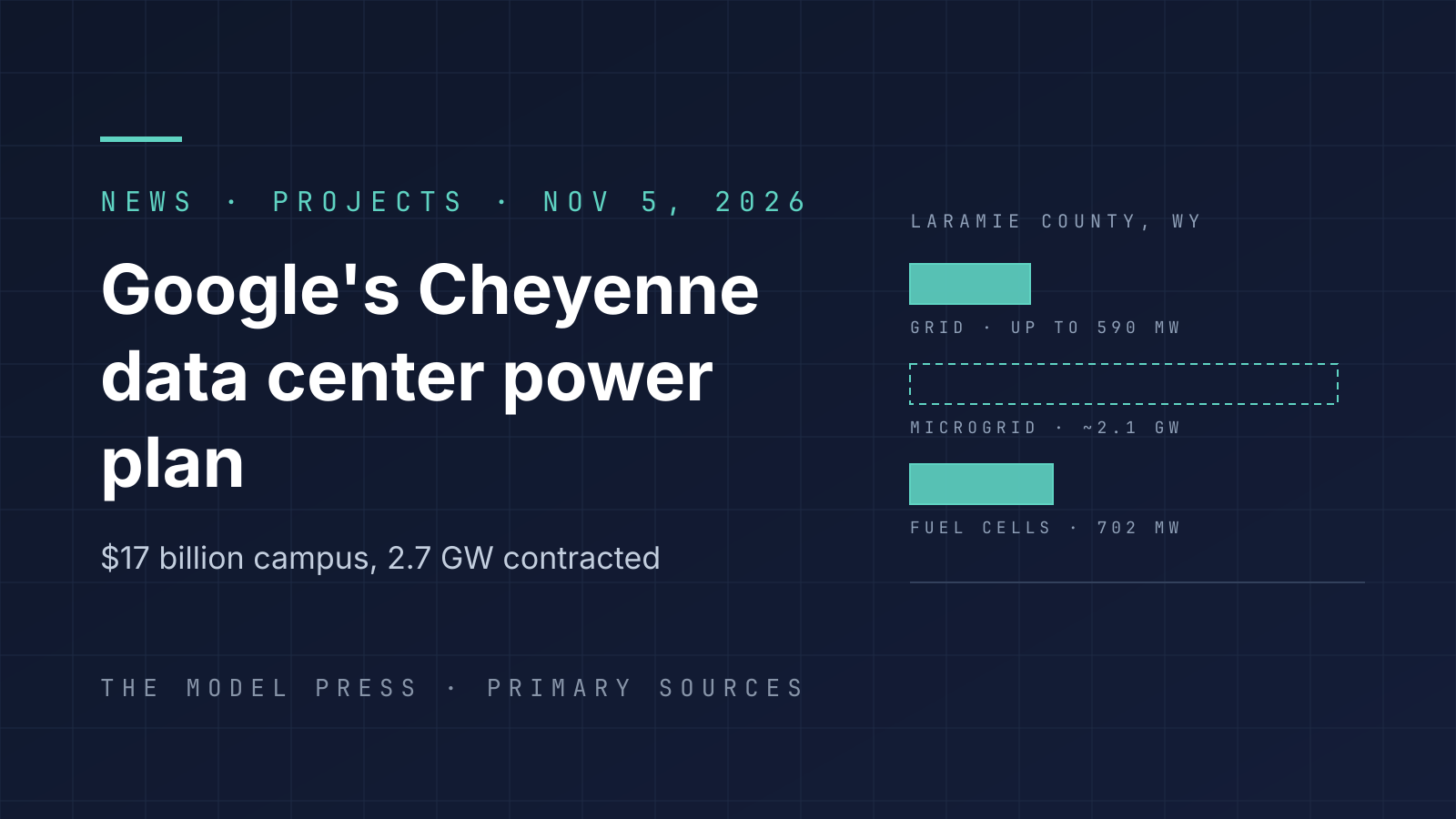
| October 6, 2026 (agreements effective September 30) | Black Hills Corp. | Grid-connected service from new company-owned gas generation at its Cheyenne Prairie Generating Station, plus market energy | Up to 590 MW: 564 MW nameplate of new gas units ($1.8 billion, built 2027–2029) and 26 MW from market purchases and retail service | Service starts late 2027, ramps to peak load in 2030; terms through 2048 |
| October 6, 2026 | Black Hills Corp. (as manager, not owner) | Output of Wyoming-based third-party resources, run through a privately managed microgrid under Black Hills’ Large Power Contract Service tariff | About 2.1 GW | Same contract term |
| October 14, 2026 | AEP, through Cheyenne Fuel Cell LLC (about 92% AEP, nearly 8% funds advised by Basalt Infrastructure Partners) | Fuel cells developed by Bloom Energy, sold to Google under a 20-year power purchase agreement | 702 MW; AEP plans to invest about $4 billion | Construction to start in 2026; fully operational by the end of 2028 |
| November 5, 2026 | Google, with Tallgrass Energy | Carbon capture for the fuel cells, with storage at Tallgrass’s Eastern Wyoming Sequestration Hub; power from gas generators operated by Tallgrass and Black Hills | Not stated | Not stated |
Sources: the Black Hills press release filed with the SEC on October 6, AEP’s October 14 release and Google’s November 5 post, all checked November 6, 2026.
Black Hills puts the total resource mix at 2.7 GW, and it says that figure includes reserve margins and excludes transmission expansion. It is the capacity contracted to serve the campus, not the load the data center will draw; neither Black Hills nor Google has published a peak load.
Is the 702 MW fuel cell plant part of the 2.1 GW?
No company has said. AEP describes its plant as serving “Google’s growing energy needs in the greater Cheyenne area” and notes that it follows the Google–Black Hills agreements; Black Hills does not name the third parties behind its 2.1 GW. Our arithmetic for the two readings:
- If the fuel cells sit inside the 2.1 GW, they would be about a third of the third-party resources (702 ÷ 2,100 ≈ 33%) and about 26% of the 2.7 GW total.
- If they sit outside it, the contracted supply for the Cheyenne area would be about 3.4 GW (2.7 GW + 0.702 GW).
Until one of the companies says which, the 2.7 GW figure from Black Hills is the only total that a primary source states.
What Google adds about carbon capture and water
Fuel cells convert natural gas into electricity through an electrochemical reaction instead of burning it, as both AEP and Google describe them. Google says carbon capture and storage will catch “a large majority” of the plant’s carbon emissions and store them underground at Tallgrass’s nearby hub. It gives no capture rate, and AEP’s release speaks of “plans to integrate” capture technology. Google says the project brings its total contracted carbon-capture capacity to nearly 1 GW. It is also running a front-end engineering and design (FEED) study on fitting Tallgrass’s combined-cycle turbines with carbon capture, which is a study, not a commitment.
On water, Google says the Wyoming data center will be air-cooled. Why that matters for a large campus is covered in our explainer on AI data center water use, and the scale of the power draw in context is in how much power AI data centers use.
Who pays for the power
Google says it will pay for 100% of the power it uses and cover the infrastructure its growth requires. Black Hills says its agreements are structured so that costs of serving the data center do not shift to its existing retail customers, and its filing adds that Google has provided $399 million of refundable advances for long-lead equipment, which Black Hills expects to repay by June 30, 2027.
Black Hills also lists the permits behind its part of the build: a certificate for the Robinson substation approved in May 2026, an industrial siting permit for the Cheyenne Prairie expansion filed in July 2026, and an air-quality permit for that expansion approved in August 2026.
Other announced AI campuses and their stated capacity are logged in our AI data centers tracker.