Lambda said on November 4, 2026 that it will build the Red Clay Technology Center Campus in Lowndes County, Alabama, an estimated $33.1 billion investment. In its announcement, the AI cloud company says construction should start in the first quarter of 2027 and take up to five years, with power from Alabama Power pending regulatory approval. The site, near U.S. Highway 80 and Alabama Highway 21, was readied by developer Cloverleaf Infrastructure as “Project Red Clay”.
Lambda’s post does not give a capacity in megawatts, a chip type or an opening date. Those figures are in the briefing packet Cloverleaf gave the Lowndes County Commission on October 5, before the commission approved the project’s development and tax abatement agreements on October 13. The packet describes a 1,000 MW base case and spells out how the $33.1 billion was modelled, what the agreements actually bind the operator to, and when the county’s tax money arrives. Lambda says it will uphold all requirements of those agreements.
On this page
What Lambda announced and what the county documents add
| Lambda, November 4 | Cloverleaf packet and handout, October 5–9 | |
|---|---|---|
| Investment | Estimated $33.1 billion | $33.1 billion “initial investment” in the 1,000 MW base case; the agreement sets a $16 billion minimum (commercially reasonable efforts, within seven years) |
| Capacity | Not stated | 1,000 MW base case, site planned for up to 1,500 MW |
| Timeline | Construction from Q1 2027, up to five years | Construction Q1 2027, first operations Q4 2028, 1,000 MW complete Q4 2029; first building must be in service by December 30, 2030 |
| Jobs | More than 225 full-time roles, more than 1,000 construction jobs | About 225 at 1,000 MW, averaging about $100,000 with benefits; agreement minimum of 125 net new full-time jobs within ten years |
| Power | Alabama Power, pending regulatory approval; Lambda pays the full cost of power and grid infrastructure | Commercial terms reached with the utility, still needing Alabama Public Service Commission approval |
| Water | Closed-loop cooling; N-Drip partnership to return at least as much water as the site uses | Capacity requested for up to 100,000 gallons a day from the Pintlala Water System, mostly for the initial fill |
| Land | Not stated | Capped at 2,200 acres unless the county consents to more |
Sources: Lambda’s November 4 post; Cloverleaf’s commissioner briefing packet (October 5), public meeting handout (October 9) and September community update. All checked November 7, 2026.
The packet was written before the operator was named; it refers to “a nationally recognized end user” that would take over every obligation. Lambda’s announcement is that end user stepping in. Lambda has not published its own capacity figure, so the 1,000 MW and the timeline milestones above are Cloverleaf’s base case, not a statement by Lambda.
Where the $33.1 billion comes from
The packet’s tax model lists its cost assumptions: construction at $10 million per MW, and IT equipment at $30 million per MW of IT load at a power usage effectiveness (PUE) of 1.3. Reading the 1,000 MW as total facility power, those assumptions reproduce the headline almost exactly. This is our arithmetic, not a breakdown Lambda or Cloverleaf published:
- Construction: 1,000 MW × $10 million = $10.0 billion
- IT load: 1,000 MW ÷ 1.3 ≈ 769 MW
- IT equipment: 769 MW × $30 million ≈ $23.1 billion
- Total: about $33.1 billion, or about $33 million per MW of facility power
On that reading, roughly 70% of the headline is servers and networking gear rather than buildings, and the packet assumes that equipment is replaced every seven to eight years. The figure is a modelled estimate for the base case. What the agreement commits the company to is smaller: “commercially reasonable efforts” to invest at least $16 billion within seven years of the in-service date, about 48% of the headline, and 125 net new full-time jobs within ten years.
When Lowndes County’s tax money arrives
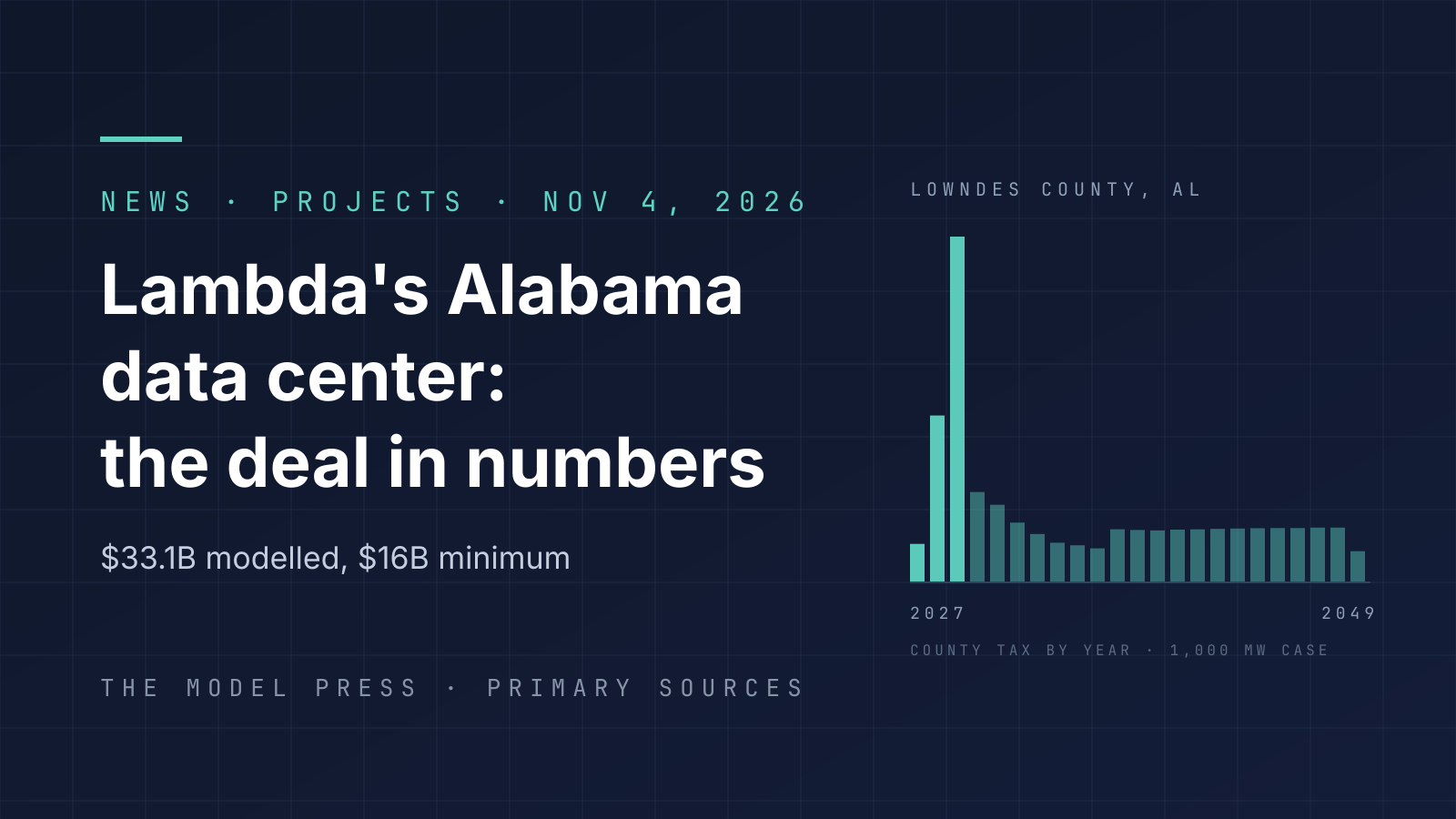
Cloverleaf and Lambda both cite more than $2.8 billion in local tax revenue through 2049, including more than $1.6 billion for Lowndes County Public Schools. Cloverleaf’s releases describe that as about $124 million a year on average. The packet’s year-by-year table, from the Lowndes County Economic Development Commission’s model of the 1,000 MW case, shows the money is front-loaded:
| Tax years | County revenue after abatement | Of which schools | What drives it |
|---|---|---|---|
| 2027–2029 | $974.6 million (34% of the total) | $544.2 million | Sales and use tax on construction and the first servers: $824.3 million |
| 2029 alone | $611.5 million | $336.4 million | Peak build year |
| 2030–2036 | About $98 million a year on average, falling from $159.8 million to $60.2 million | About $55 million a year | Property tax only, as equipment depreciates |
| 2037–2048 | About $95 million a year | About $54 million a year | Property tax plus about $40.9 million a year of sales tax on server refreshes |
| 2049 | $55.2 million | $31.0 million | Last in-term assessment |
| 2027–2049 total | $2,851.6 million | $1,610.5 million | 50% of county non-school taxes abated: $1,149.3 million |
Source: Appendix A of the commissioner briefing packet; period sums and averages are our calculation from its table.
So the “$124 million a year” is the 23-year total divided by 23. After construction ends, the model puts the county’s yearly take at roughly $55 million to $160 million, and averages about $94 million a year from 2030 to 2049. For scale, the packet puts current local school revenue at about $7.6 million a year. The model assumes the first building is in service in 2029 and current tax rates; the packet says actual revenue will depend on final investment, timing and valuation.
The agreements tie the abatement to performance. If the first building is not in service by December 30, 2030, apart from permitted delays, the company must repay the county and state taxes abated up to that point. The abatement ends if the site stops operating as a data center for more than six consecutive months, and school taxes are never abated.
Power, water and what is still open
Alabama Power is the named supplier, but the Alabama Public Service Commission has not yet approved the arrangement, according to Cloverleaf’s October handout. Lambda says it will pay the full cost of the power and grid infrastructure through upfront commitments that apply even if plans change, and that both Lambda and Alabama Power have signed the White House Ratepayer Protection Pledge.
Cloverleaf says the cooling loop recirculates the same water, so most of the 100,000 gallons a day it requested would go to the initial fill, with daily use afterwards “similar to what a typical office building uses”. The development agreement also sets noise limits of 55 dBA at residential-adjacent property lines, setbacks of 500 ft from residential property lines (300 ft where 500 ft is not feasible, with a heavier buffer), and generator testing only on weekdays between 9 AM and 5 PM. How much water large campuses use is covered in our explainer on AI data center water use, and the scale of a 1 GW load is put in context in how much power AI data centers use.
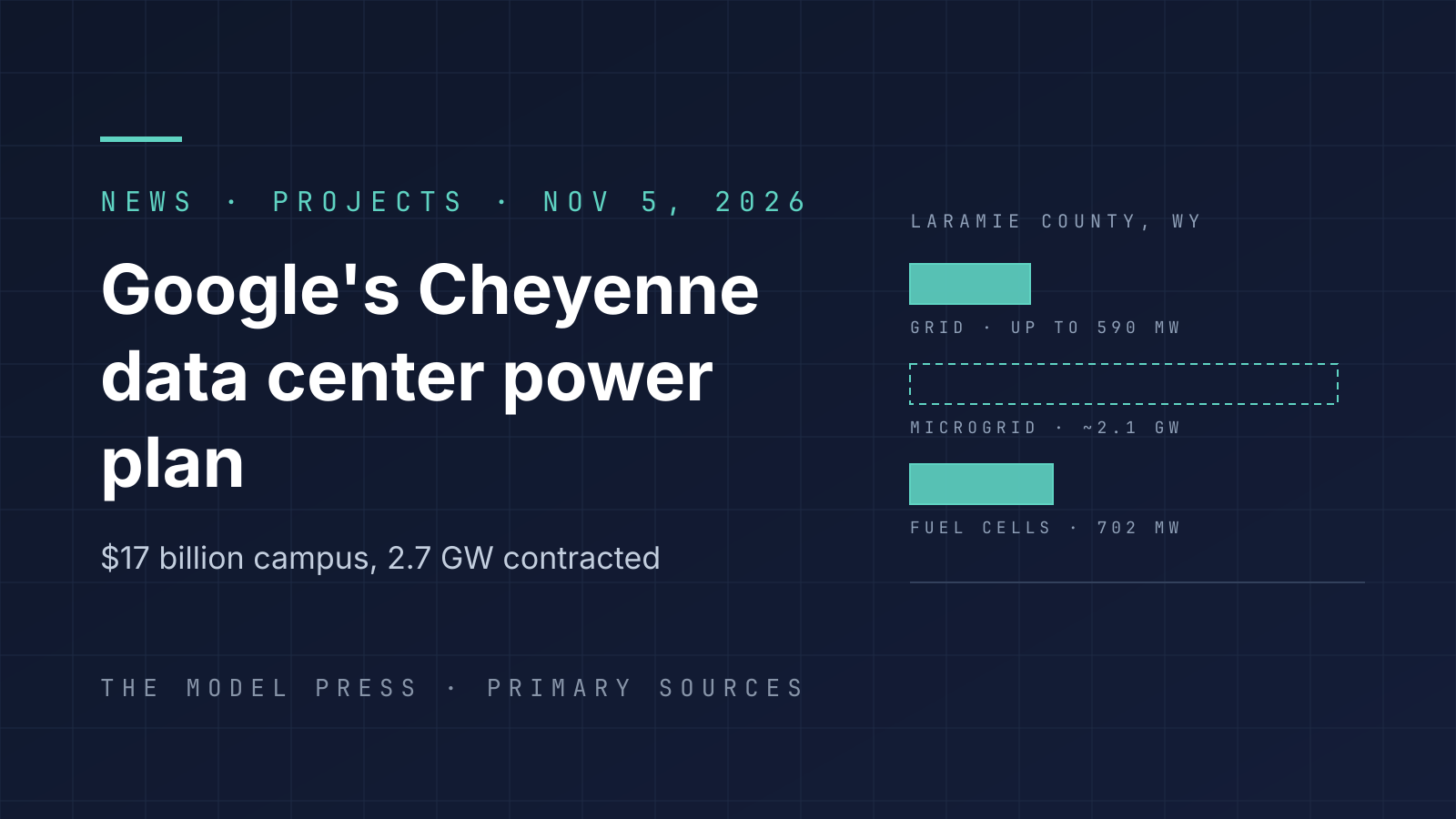
Not stated by Lambda or Cloverleaf: which GPUs or systems the campus will run, which customers it will serve, the number and size of buildings in the final design, and whether the site will grow past 1,000 MW. Lambda says more on timing, design and impacts will be shared “as it becomes available”. Lambda is one of the GPU clouds described in our CoreWeave and neoclouds explainer; Google’s Cheyenne, Wyoming campus, announced a day later, is another recent example of a site whose power deals are documented better than its IT load. Other announced campuses are logged in our AI data centers tracker.