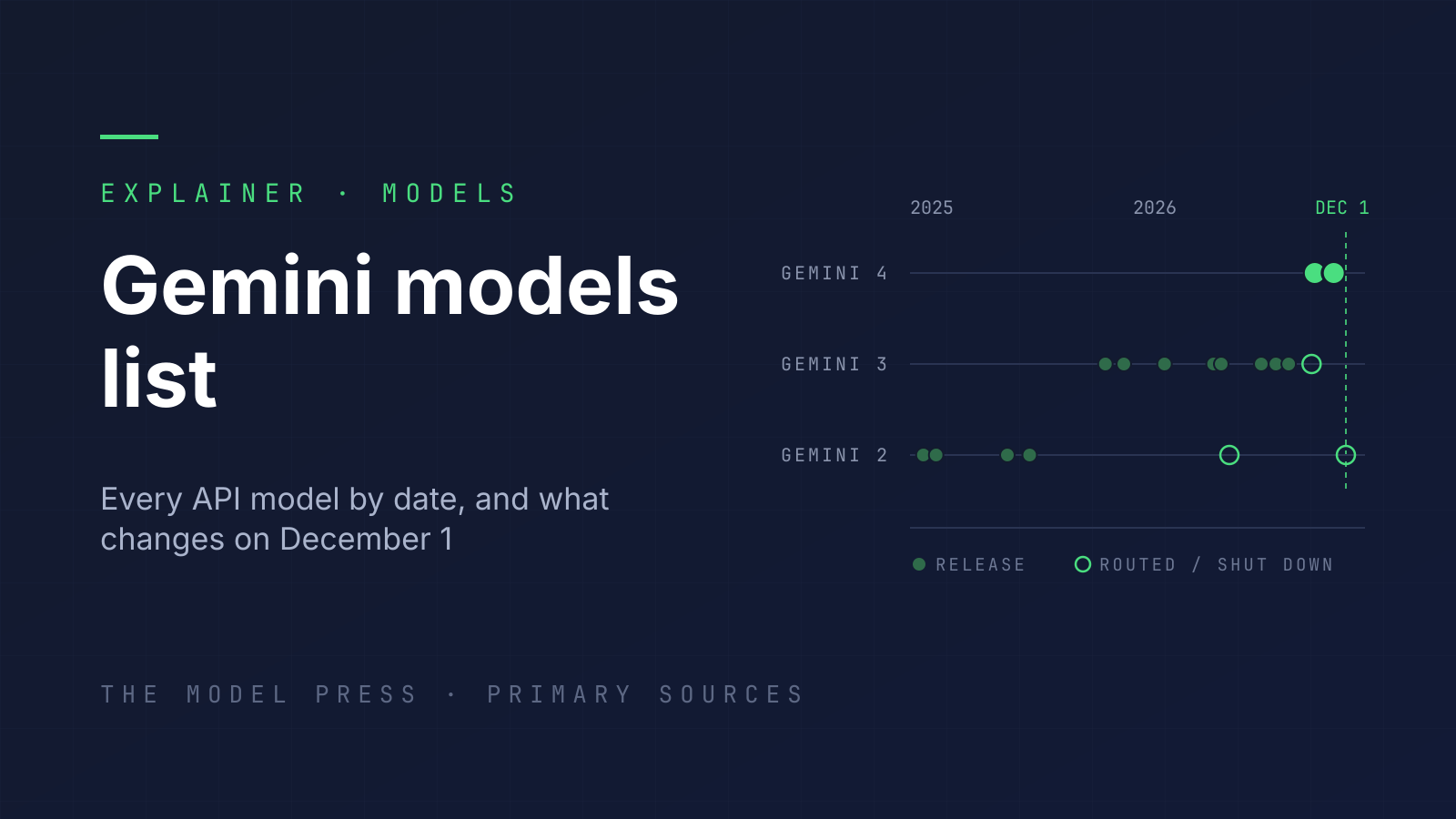
This Gemini models list covers every model in Google’s Gemini API since Gemini 2.0 Flash, with release dates, model IDs and status as of November 14, 2026. The current top line is Gemini 4: Carbon (gemini-4-carbon, generally available November 10), Argon (gemini-4-argon, October 13) and Hydrogen (gemini-4-hydrogen, November 12). The next big change comes on December 1, 2026, when API calls to Gemini 2.5 Pro and Gemini 2.5 Flash start being routed to newer models.
Release dates come from Google’s Gemini API release notes and its deprecations page; model IDs and limits come from the Gemini models page and each model card. All three were checked on November 14, 2026. Gemma, Google’s family of open-weight models, is left out.
On this page
Gemini 4: Carbon, Argon and Hydrogen
| Model | API ID | First announced | Generally available in the API | Google’s positioning |
|---|---|---|---|---|
| Gemini 4 Argon | gemini-4-argon | September 30, 2026, to cyber defenders only | October 13, 2026 | Long-horizon coding, agentic, math and science work with fewer tokens per turn than Carbon |
| Gemini 4 Carbon | gemini-4-carbon | October 28, 2026, limited access | November 10, 2026 | “Our strongest frontier model”; spends more thinking tokens per turn |
| Gemini 4 Hydrogen | gemini-4-hydrogen | November 12, 2026 | November 12, 2026 | Fast everyday coding and agents; Google’s recommended upgrade from Gemini 3.8 Flash |
According to the three model cards, all three share the same limits. Input, thinking and output share one 1,048,576-token window. Output is capped at 65,536 tokens by default and can run to 1,048,576 tokens with long decode. Each takes text, image, video, audio and PDF input and returns text.
Hydrogen differs in two documented ways. It adds a fourth thinking level, xhigh, alongside low, medium and the default high, as set out in What’s new in Gemini 4 Hydrogen. Google lists it on both the free and paid tiers of the API, and it is now the default model for the Antigravity managed agent. Google’s Hydrogen announcement adds that the rollout reaches Google Search and the Gemini app on the same day.
Argon came first and took the longest route to general availability. Google introduced it on September 30 for a group of cyber defenders and trusted testers, then opened it to everyone on October 13. Carbon followed the same path: an October 28 announcement with limited access, then general availability on November 10. Hydrogen skipped the limited stage. Our reports on the Argon release and the Carbon release cover both launches.
What changes on December 1, 2026, and after
Google announced on November 2 that Gemini 2.5 Pro and Gemini 2.5 Flash are deprecated. Neither can be picked in Google AI Studio any more, and only projects that used them before can still call them through the API. From December 1, requests to those IDs are answered by a different model:
| If your code calls | From | Requests go to, or the model shuts down | Source |
|---|---|---|---|
gemini-2.5-pro | December 1, 2026 | Routed to gemini-3.8-flash | Release notes, Nov 2 |
gemini-2.5-flash | December 1, 2026 | Routed to gemini-3.5-flash-lite | Release notes, Nov 2 |
gemini-omni-1.1-flash | December 3, 2026 | Routed to gemini-omni-1.2-flash | Release notes, Nov 5 |
gemini-3.1-flash-tts-preview, gemini-2.5-flash-preview-tts, gemini-2.5-pro-preview-tts | December 18, 2026 | Shut down; replacement gemini-3.8-flash-tts or gemini-3.8-flash-lite-tts | Deprecations |
gemini-2.5-flash-native-audio-preview-12-2025 | March 31, 2027 | Shut down; replacement gemini-3.8-live | Deprecations |
gemini-3.1-flash-lite | May 7, 2027 | Shut down; replacement gemini-3.5-flash-lite | Deprecations |
The 2.5 Flash row is the one most likely to surprise someone. It does not route to another Flash model. It routes to 3.5 Flash-Lite, the smaller tier. Google’s November 2 note also lists breaking changes for both moves: stricter validation of function calling and thought_signature, thinking_level replacing thinking_budget, removed sampling parameters, and no more prefilled model turns. A 2.5 Pro integration that keeps its model string after December 1 therefore reaches a model with a different request format, not just a newer version of the same model.
Not every 2.5 model is going. Google’s models page states that gemini-2.5-flash-lite “is not deprecated and will continue to be served until further notice”, although since September 18 only existing users can call it.
The shutdown dates in the table are what Google calls “the earliest possible dates” on which a model might be retired; it promises to confirm the exact date in advance.
Routed is not the same as shut down
The Gemini API now retires models in two ways, and the difference matters for anyone with a hard-coded model string.
A shut-down model stops answering. Gemini 3 Pro Preview went this way on March 9, 2026, and the Gemini 2.0 Flash family on June 1, 2026.
A routed model keeps its ID, but the API answers with its replacement. Since October 8, 2026, gemini-3.7-flash calls are served by gemini-3.8-flash, and gemini-3.5-flash calls by gemini-3.6-flash. The deprecations page lists both with the shutdown date “N/A” and says the endpoint “is not shutting down”. Code keeps working, but the model behind it has changed. Gemini 2.5 Pro and 2.5 Flash move to this second group on December 1.
Full list by API release date
| Model | API ID | Released in the API | Status on November 14, 2026 |
|---|---|---|---|
| Gemini 2.0 Flash | gemini-2.0-flash | February 5, 2025 | Shut down June 1, 2026 |
| Gemini 2.0 Flash-Lite | gemini-2.0-flash-lite | February 25, 2025 | Shut down June 1, 2026 |
| Gemini 2.5 Pro | gemini-2.5-pro | June 17, 2025 | Deprecated November 2, 2026; routed to gemini-3.8-flash from December 1, 2026 |
| Gemini 2.5 Flash | gemini-2.5-flash | June 17, 2025 | Deprecated November 2, 2026; routed to gemini-3.5-flash-lite from December 1, 2026 |
| Gemini 2.5 Flash-Lite | gemini-2.5-flash-lite | July 22, 2025 | Not deprecated; existing users only |
| Gemini 3 Pro Preview | gemini-3-pro-preview | November 18, 2025 | Shut down March 9, 2026; the ID now points to gemini-3.1-pro-preview |
| Gemini 3 Flash Preview | gemini-3-flash-preview | December 17, 2025 | Preview; no shutdown date; Google names gemini-3.6-flash as replacement |
| Gemini 3.1 Pro Preview | gemini-3.1-pro-preview | February 19, 2026 | Preview; no shutdown date |
| Gemini 3.1 Flash-Lite Preview | gemini-3.1-flash-lite-preview | March 3, 2026 | Shut down May 25, 2026 |
| Gemini 3.1 Flash-Lite | gemini-3.1-flash-lite | May 7, 2026 | Available; earliest shutdown May 7, 2027 |
| Gemini 3.5 Flash | gemini-3.5-flash | May 19, 2026 | Deprecated; routed to gemini-3.6-flash since October 8, 2026 |
| Gemini 3.6 Flash | gemini-3.6-flash | July 21, 2026 | Available |
| Gemini 3.5 Flash-Lite | gemini-3.5-flash-lite | July 21, 2026 | Available |
| Gemini 3.7 Flash | gemini-3.7-flash | August 13, 2026 | Deprecated; routed to gemini-3.8-flash since October 8, 2026 |
| Gemini 3.8 Flash | gemini-3.8-flash | September 2, 2026 | Available |
| Gemini 4 Argon | gemini-4-argon | October 13, 2026 | Current |
| Gemini 4 Carbon | gemini-4-carbon | November 10, 2026 | Current |
| Gemini 4 Hydrogen | gemini-4-hydrogen | November 12, 2026 | Current |
Two things stand out in the dates. Google shipped six Flash or Flash-Lite releases between May and September 2026 (3.1 Flash-Lite, 3.5 Flash, 3.6 Flash, 3.5 Flash-Lite, 3.7 Flash, 3.8 Flash), and two of them are already routed away: 3.7 Flash eight weeks after its release, 3.5 Flash after less than five months. There is also no generally available Pro text model in the 3.x line: Gemini 3 Pro and 3.1 Pro stayed in preview, and the next step up after 3.8 Flash is Gemini 4.
Gemini 3.8 Flash Cyber, released with 3.8 Flash on September 2 for vetted security organizations only, does not appear on the public models page and is not in this table; our 3.8 Flash and Flash Cyber report covers it.
Voice, image, video and specialized models
| Model | API ID | Released in the API | Use |
|---|---|---|---|
| Gemini Embedding 2 | gemini-embedding-2 | April 22, 2026 (GA) | Multimodal embeddings |
| Nano Banana 2 and Nano Banana Pro | gemini-3.1-flash-image, gemini-3-pro-image | May 28, 2026 (GA) | Image generation and editing |
| Nano Banana 2 Lite | gemini-3.1-flash-lite-image | June 30, 2026 (GA) | Low-latency image generation |
| Gemini Robotics ER 2 | gemini-robotics-er-2-preview | July 30, 2026 (preview) | Embodied reasoning for robots |
| Gemini 3.5 Transcribe | gemini-3.5-transcribe, gemini-3.5-transcribe-live | August 26, 2026 | Speech to text |
| Lyria 3.5 | lyria-3.5 | September 3, 2026 | Full-length music generation |
| Gemini 3.8 Live and Live Extended Thinking | gemini-3.8-live, gemini-3.8-live-extended-thinking | September 15, 2026 | Real-time voice agents |
| Gemini 3.8 Flash TTS and Flash-Lite TTS | gemini-3.8-flash-tts, gemini-3.8-flash-lite-tts | September 22, 2026 | Text to speech |
| Nano Banana 2.1 | gemini-nano-banana-2.1 | October 6, 2026 | Image generation; gemini-3.1-flash-image deprecated the same day, no shutdown date |
| Gemini Omni 1.2 Flash | gemini-omni-1.2-flash | November 5, 2026 | Video generation and editing, up to 15 seconds |
| Gemini Decision 1 | gemini-decision-1 | November 11, 2026 | Yes/no, choice and score decisions with zero output tokens |
Release dates for these come from the same release notes. The AI model release timeline tracks Google’s releases alongside other labs’ since July 2026, with a record for each model and its source.
How Gemini model IDs work
Google uses four kinds of model string, described on its models page:
- Stable, such as
gemini-3.6-flash: a fixed model that “usually” does not change. Google recommends these for production. - Preview, such as
gemini-3.1-pro-preview: usable in production and billed, but with tighter rate limits and as little as two weeks’ notice before deprecation. - Latest, such as
gemini-flash-latest: an alias that is swapped to each new release of that variant, with two weeks’ email notice before the model behind it changes. - Experimental: not suitable for production, and endpoints can change without notice.
In practice, a pinned stable ID gives the most notice before anything changes, and routing (above) is now the more common way that notice ends.