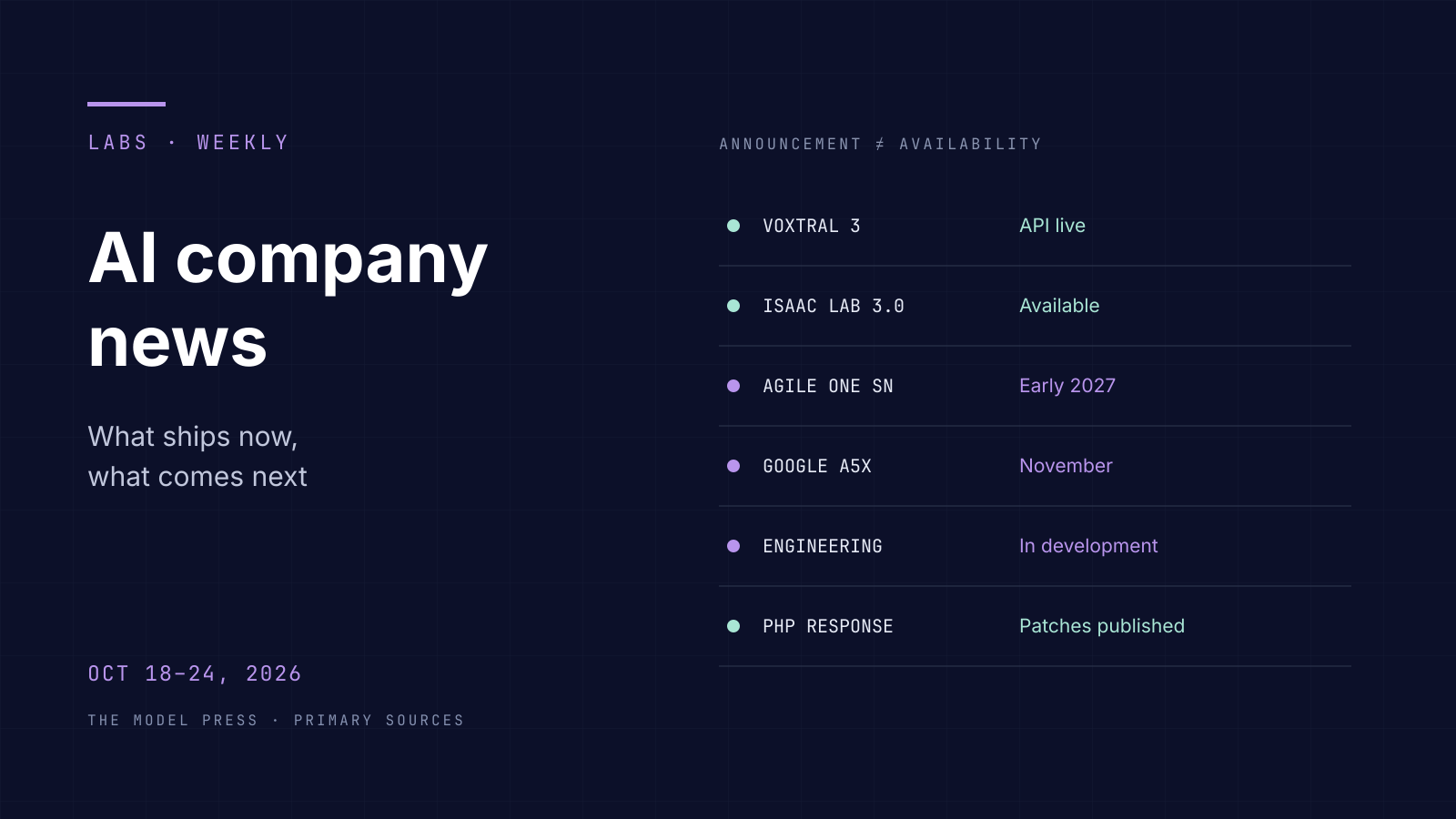
AI company news for October 18–24, 2026 shows why a release date needs an availability check. Mistral put a new voice stack on its API, while NVIDIA released robot-learning software alongside a humanoid planned for 2027. Cloud capacity and engineering benchmarks came with later milestones. OpenAI described the coordination needed to turn vulnerability discoveries into deployed fixes.
The review window is October 18, 2026, 00:00 UTC through October 24, 2026, 23:59 UTC. The five selected developments were announced on October 20–21. They were not covered in the narrative of Friday’s AI news this week.
On this page
Mistral released a voice stack built around connected tasks
Mistral’s Voxtral 3 announcement, dated October 20 in its official news index, combines speech recognition, speech generation and a voice-agent SDK. The SDK uses LiveKit to connect listening, a reasoning model, tool calls and spoken replies in a streaming pipeline.
The distinction between those components matters. Mistral describes transcription across more than 50 languages, while its speech-generation model supports more than 35 languages and over 50 dialects. Those figures describe different parts of the stack. They should not be collapsed into one language-coverage promise for every voice workflow.
Mistral says the products are available through its API, with European, US and global endpoints. Running the full stack on an organization’s own infrastructure requires contacting the company. Its latency and quality comparisons remain vendor evaluations; a released API does not establish reliability on a particular organization’s calls, terminology or connected business systems.
Engineering benchmarks are still development work
On October 21, Mistral and NVIDIA announced further work on AI for engineering. The planned workflows combine Mistral models with NVIDIA’s accelerated-computing libraries and physics tools, with Omniverse integration for 3D scenes and simulation-ready assets.
The companies also intend to develop public benchmarks and open datasets for physics models and engineering agents. Their stated evaluation scope includes technical correctness, multistep tool use, execution time and computational cost in computer-aided engineering and electronic design automation.
That is a useful specification for future evidence, but the announcement does not release the proposed benchmark suite. An engineering team assessing these systems still needs results on its own constraints and simulation workload. The partnership’s ambition should remain separate from a measured improvement in a production design process. For the broader distinction, see how a benchmark’s scope limits its conclusions.
Isaac software is available before the new reference humanoid
NVIDIA’s October 21 Isaac platform expansion puts several release stages in the same announcement. Isaac Lab 3.0 is generally available as an open-source robot-learning framework. NVIDIA also describes an Isaac OS runtime, simulation assets and reference workflows for data generation and training.
Agile Robots’ Agile ONE SN reference humanoid has a different timetable: early 2027. It combines an Agile ONE S body with Jetson Thor compute and Isaac GR00T, while integration with NVIDIA’s Halos safety stack is planned. A software release therefore does not establish that the complete robot platform is already purchasable or deployed.
Data access is another boundary. NVIDIA says the full Human 1M Dataset is available to Cosmos Coalition partners, so an “open platform” description should not imply identical access to every component. Our Isaac and Agile ONE SN report separates those stages; the humanoid-versus-industrial-robot guide explains the deployment questions beyond body shape.
Google Cloud’s A5X announcement points to November
NVIDIA’s October 21 Google Cloud A5X post uses “general availability” in its headline, but the body says that availability is coming the following month. For this review window, November remains a planned milestone.
The instances combine Vera Rubin NVL72 systems with networking and liquid cooling for training, inference and reinforcement-learning workloads. NVIDIA names Ineffable Intelligence as the first customer with access. Early customer access and a general cloud launch are distinct stages, even when both appear in the same release.
The post also describes a plan to scale Rubin-based infrastructure to as many as 960,000 GPUs across multiple sites. That is planned capacity, not a count of machines already operating. Our A5X report covers the announcement in detail. The purchasing question is when a particular configuration and location can actually be provisioned, not simply whether a future fleet target has been announced.
OpenAI described the work between finding a flaw and protecting users
OpenAI’s October 21 Patch the Planet account describes a maintainer-led response to critical PHP vulnerabilities. OpenAI says Calif identified a flaw using GPT-5.6 Sol and Wiz independently reported both vulnerabilities. PHP maintainers led the fixes and releases, with research and infrastructure partners helping prepare protections.
The account also proposes a coordination framework informed by that response. It covers validating a finding, preparing fixes and downstream protections, involving relevant government partners, and supporting deployment after public disclosure. It does not make OpenAI the maintainer of PHP or establish an industry-wide disclosure standard.
The practical limit is deployment. A discovered vulnerability, an upstream patch and a protected installation are separate outcomes. OpenAI’s account supports the need for coordinated defensive work; it does not show that every affected operator has installed a fix. Operators should use the maintainers’ and their providers’ guidance for their own systems.
What readers can take from the five announcements
The available products and the announced programs need different follow-up questions. Voxtral’s API and Isaac Lab can be evaluated now, subject to their documented access and deployment conditions. The engineering benchmarks, Agile ONE SN and A5X’s broad availability need later evidence that the promised milestone occurred.
The PHP response illustrates a related problem after release: publishing a fix is only one step toward its use. Across the five developments, a capability claim becomes more useful when the announcement identifies who can access it, which component is ready and what still depends on another party.