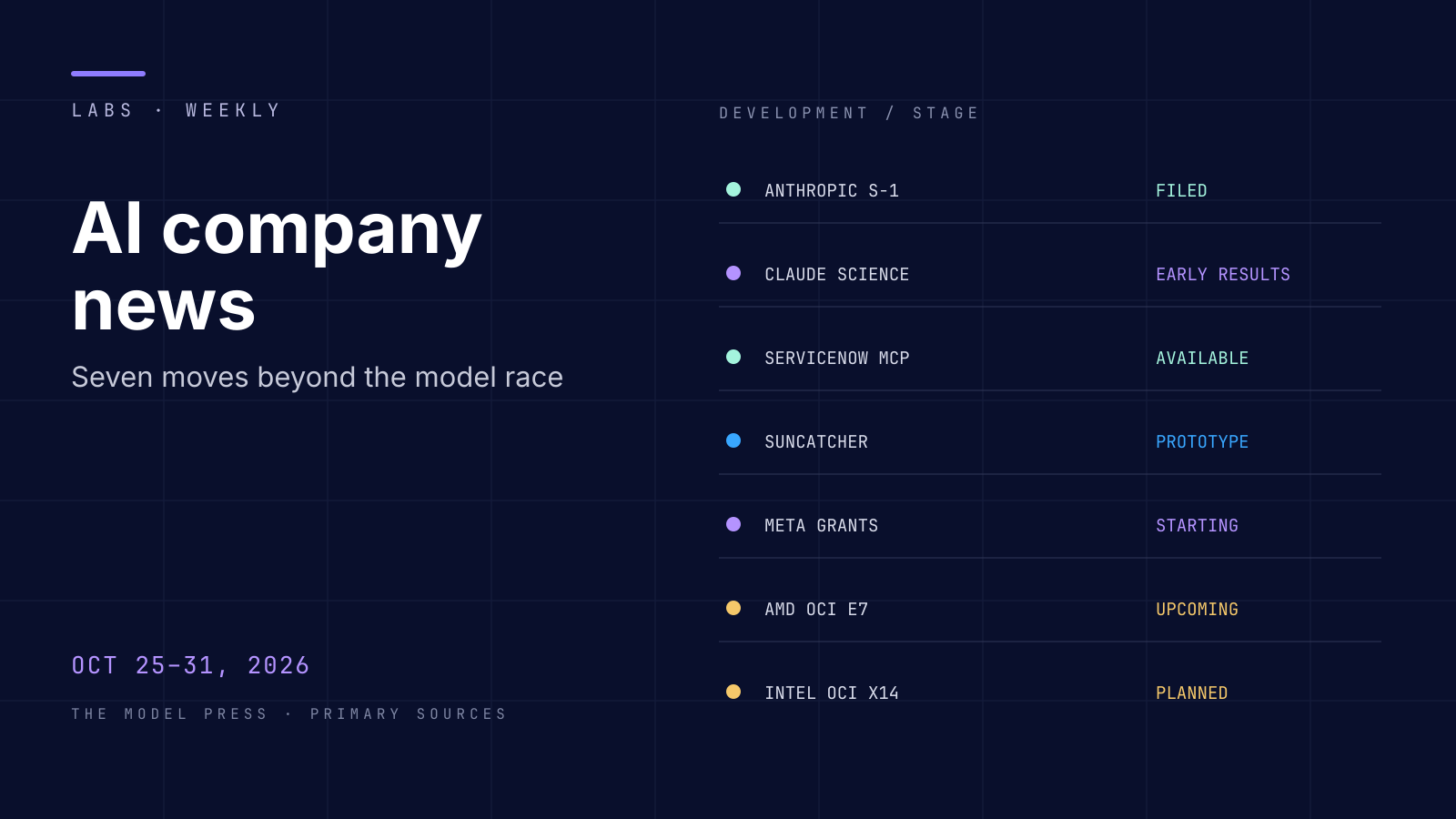
AI-company news for the seven completed UTC days from October 25, 2026, 00:00 UTC through October 31, 2026, 23:59 UTC was less about another race to the top of a model table than about the machinery around AI. Anthropic moved toward the public market while publishing early life-science work. OpenAI connected its models to ServiceNow workflows. Google ran a prototype TPU in orbit. Meta funded university projects, and AMD and Intel described future Oracle Cloud infrastructure.
The selection below is distinct from Friday’s AI news review, which covered GPT-6.1 Terra, Gemini 4 Carbon, Genie 4, Mistral Large 4 weights, Intelligence Index v5 and Meta’s new racks. Company LinkedIn pages were scanned as leads; only claims that could be checked in dated first-party announcements or filings were used.
On this page
Anthropic filed an S-1, but the offering is not yet effective
On October 26, Anthropic said it had filed a Form S-1 registration statement with the US Securities and Exchange Commission for a proposed initial public offering. The company’s announcement and the filed S-1 say it intends to list Class A shares on Nasdaq under ANT. The filing left the number of shares and price range blank, and it had not yet become effective.
The practical consequence is disclosure, not a completed listing. A filed S-1 can expose more detail about a company’s economics, risks and governance, but it does not set a trading date or guarantee that the offering will proceed on the announced timetable. The same filing also supplied infrastructure details used in our data-center news review; those details should not be confused with the legal status of the proposed offering.
Anthropic published early drug-development results and its limits
Anthropic’s October 27 life-sciences update described research partnerships with six organizations and internal drug-discovery programs. The company reported several early case studies: Generate Biomedicines tested a Claude-assisted genetic design that it said was about 70% shorter than the standard version; Divergence Labs generated roughly 35,000 antibody designs before laboratory screening; and BigHat Biosciences made and tested about 1,010 variants over roughly ten weeks.
These are experiments at different stages, not evidence that an AI-designed medicine has completed clinical development. Anthropic’s post mixes computational work, laboratory measurements, document review and proposed company-building workflows. It also links partner technical reports, which makes the work more inspectable than a broad productivity claim. The next evidence will come from replication, further preclinical testing, regulatory review and, where relevant, clinical trials.
OpenAI and ServiceNow separated what is live from what is planned
OpenAI and ServiceNow expanded their partnership on October 28. The ServiceNow MCP plugin was available in OpenAI’s marketplace on the announcement date. The companies also described a ChatGPT integration for ServiceNow records and actions, Codex inside ServiceNow’s AI Workflow Factory, a joint security product and a voice workflow.
Most of that roadmap has later milestones. OpenAI said enhanced MCP capabilities were expected by the end of 2026, security early access in January 2027 and general availability in the second quarter of 2027. The voice feature was expected in the first quarter of 2027, while Codex in AI Workflow Factory was expected during 2027. For buyers, the meaningful distinction is between the plugin that can be evaluated now and the workflow, security and development features that remain previews or plans.
Google’s Suncatcher prototype returned an AI response from orbit
Google said on October 30 that its Project Suncatcher prototype satellite returned its first AI response. During a ground-station pass near Svalbard, the team sent a prompt to a Gemma 4 model running on a data-center-class TPU aboard the satellite and received the generated response. Google described this as a “Hello World” milestone after powering up the host and TPU trays and running early machine-learning tests.
This is a hardware-and-communications demonstration, not an operational orbital data center. It shows that the prototype could power the accelerator, run a model and return output during a pass. It does not establish sustained training, commercial availability, the economics of launch and replacement, or the thermal and networking performance of a larger constellation. Those remain the hard questions for space-based compute.
Meta put $2 million behind five university research programs
Meta announced on October 28 that it would provide $2 million in grants and access to its models across Caltech, Ohio State, Louisiana State, Indiana University and UTHealth Houston. The projects include monitoring infant tracheostomy tubes, adapting conversational systems for people with dementia and investigating earlier prediction of a form of heart failure.
The announcement describes research support and planned studies rather than validated clinical tools. Meta said a proof of concept had been published for the tracheostomy-monitoring project, while the other examples were framed as work under development. The value of the program will depend on study design, external validation, privacy controls and whether successful prototypes survive the route into clinical or scientific practice.
AMD’s Oracle update was about the CPU and network around AI
AMD’s October 27 Oracle Cloud announcement put 6th Gen EPYC processors in upcoming OCI Compute E7 instances and AMD Pensando data-processing units beneath Oracle Acceleron converged network adapters. AMD said the instances would support agent orchestration, concurrent agent sandboxes, retrieval services, caches and ordinary application tiers around AI models.
The announcement is useful because it shifts attention from the accelerator alone. Production agents also need CPU capacity, memory, data movement, storage and security. AMD and Oracle described the E7 instances as upcoming and included a future-product disclaimer, so the statement is a roadmap, not proof that customers could provision the named configuration on October 27. Our training-versus-inference guide explains why the surrounding system matters to both workloads.
Intel and Oracle planned a separate multigeneration CPU path
Also on October 27, Intel and Oracle announced plans for a multiyear collaboration spanning current and future Xeon processors. The companies said planned OCI X14 offerings would use Intel’s next-generation Diamond Rapids server processor, with expanded matrix formats for inference and APX instructions intended to reduce instruction overhead in optimized applications.
Again, the date marks an announcement rather than availability. Intel and Oracle repeatedly used “planned,” “intended” and “expected,” and the release carried a future-product disclaimer. Read beside AMD’s announcement, the practical signal is that Oracle is preparing more than one CPU and networking path for agentic workloads. Customers still need final instance specifications, regions, prices and measured performance before comparing them.
The week’s common thread was deployment structure
Across these seven developments, the important changes happened at different layers. Anthropic’s filing affects corporate financing and disclosure. Its drug work and Meta’s grants create research programs whose outcomes are still uncertain. OpenAI’s ServiceNow work connects models to governed business actions. Google’s satellite remains a prototype. AMD and Intel described future cloud foundations rather than generally available instances.
That mix rewards precise stage labels. A filing is not a listing. A lab result is not a medicine. A partnership is not a finished integration. A successful orbital response is not a scaled data center. Hardware on a roadmap is not capacity a customer can rent today. The announcements matter, but their practical value depends on the next dated milestone.