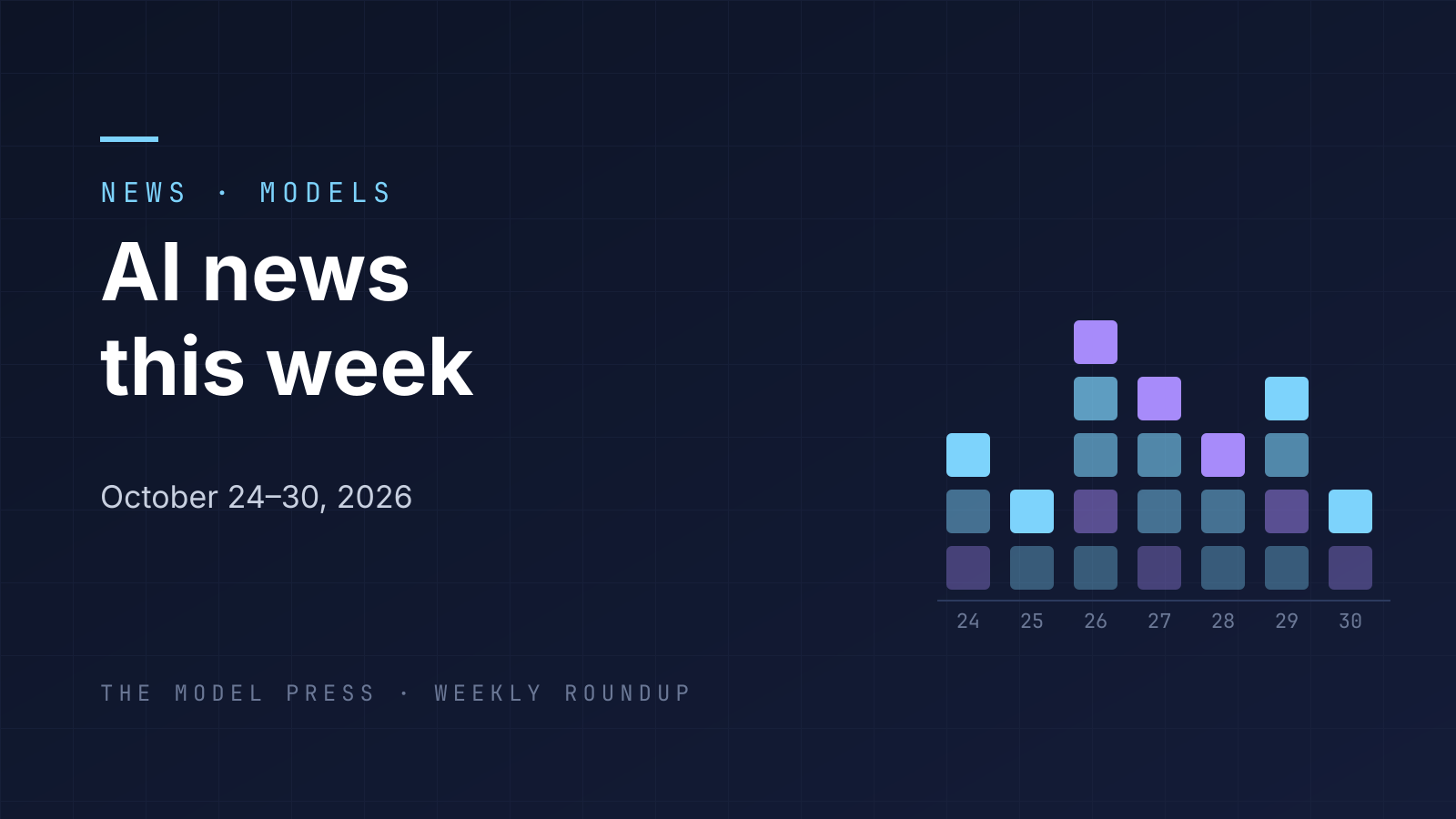
AI news this week, October 24–30, 2026, was dense on the model side. OpenAI released GPT-6.1 Terra on October 26, Google DeepMind previewed the Genie 4 world model on October 27 and announced Gemini 4 Carbon on October 28, and Mistral published the weights of Mistral Large 4 on October 29.
Artificial Analysis rebuilt its Intelligence Index around mostly private tests, Meta lined up more NVIDIA and AMD hardware, and Anthropic’s IPO filing put a figure on its SpaceX compute contracts. Each item below carries its event date and a link to the company’s or maintainer’s own announcement.
On this page
The week at a glance
| Event date | Development | Section | Source or our report |
|---|---|---|---|
| Oct 26 | OpenAI releases GPT-6.1 Terra in ChatGPT Work, Codex and the API | Models | OpenAI |
| Oct 26 | Anthropic’s S-1 discloses up to $120.5 billion of SpaceX compute through 2029 | Labs | Weekly |
| Oct 26 | NVIDIA and Meta expand their partnership; Meta to deploy more Vera Rubin | Chips | NVIDIA |
| Oct 26 | GXO and Agility take Digit humanoids to two more warehouses | Robotics | Report |
| Oct 27 | Artificial Analysis Intelligence Index v5 | Benchmarks | Report |
| Oct 27 | AMD Helios racks installed and in testing at Meta | Chips | Report |
| Oct 27 | Google DeepMind previews Genie 4 to trusted testers | Models | Google DeepMind |
| Oct 27 | Oracle AI World: Vera Rubin generally available on OCI, Google TPUs on OCI from 2027 | Events | Weekly |
| Oct 28 | Google announces Gemini 4 Carbon, cyber defenders first | Models | |
| Oct 29 | Mistral releases the weights of Mistral Large 4 | Models | Mistral |
| Oct 29 | OpenAI updates GPT-6 Luna and publishes a system-card addendum | Models | Report |
| Oct 29 | Intel reports third-quarter 2026 results | Chips | Intel |
Models: Terra, Genie 4, Carbon and open Large 4 weights
GPT-6.1 Terra (October 26). OpenAI introduced GPT-6.1 Terra as a fast model for visual reasoning, computer use and writing, and the successor to GPT-5.6 Terra. It went live the same day for Plus, Pro, Enterprise and Edu users in ChatGPT Work and Codex, and in the API as gpt-6.1-terra; OpenAI’s model page lists a 1,050,000-token context window, text and image input and a June 1, 2026 knowledge cutoff. AWS made it generally available on Amazon Bedrock on the same date. OpenAI reports 50.3% on Terminal-Bench 4.0 at maximum reasoning effort, against 21.5% for GPT-5.6 Terra, and still recommends GPT-6.1 Sol and GPT-6 Astra for the hardest coding work. It also says Terra meets the Critical threshold in cybersecurity under its Preparedness Framework and carries the protections built for GPT-6 Astra. All of these scores are OpenAI’s own.
Genie 4 (October 27). Google DeepMind announced Genie 4, a world model that generates interactive scenes in real time, with natively generated audio including dialogue, and with Gemini 3.8 Flash acting as a planning agent that watches the frames and keeps the simulation on track. It is a research preview for trusted testers; Google lists wider access in Project Genie and for early-access Gemini API and AI Studio partners as coming soon. DeepMind’s model page is frank about the limits: sessions last a few minutes, object permanence drifts, and real-world places are not reproduced accurately. Generated video and audio carry SynthID watermarks.
Gemini 4 Carbon (October 28). Google announced Gemini 4 Carbon two weeks after Gemini 4 Argon, calling it its strongest model for cybersecurity and long-horizon tasks. Access starts this week with a subset of cyber defenders and widens to trusted partners through Google’s Fairwind Program; developers, businesses and consumers are promised access later, with no date. Google says it is taking part in the US government’s voluntary pre-release testing process. Its own figures put Carbon at 88.2% on SEC-bench Pro, 54.8% on ExploitGym and 71.0% on CWE-bench, and Google says Carbon scores 59 on Artificial Analysis Intelligence Index v5, one point above the 58 that Claude Opus 5.5 posted when v5 launched a day earlier. Our Gemini 4 Argon review covers the model Carbon builds on.
Mistral Large 4 weights (October 29). Three weeks after its public preview on October 6, Mistral released the weights of an improved Mistral Large 4, nicknamed Le Chonk, for download from Hugging Face, alongside access through its API. Mistral says further reinforcement learning since the preview raised its Terminal-Bench 4.0 score by 13 points to 41%, and that it leads open-weight models on Cognition’s FrontierCode 2.0 at 19.7%. Mistral also writes that, after monitoring cybersecurity use of the preview, it sees “a potential for uplift to conduct real attacks” and is modifying the model’s guardrails, with further updates “in the months to come”.
GPT-6 Luna update (October 29). OpenAI shipped a revised GPT-6 Luna in ChatGPT aimed at shorter, less agreeable answers. Its system-card addendum reports gains on some safety tests but higher factual-error rates than the October 7 version on all six factuality measures it lists. Our GPT-6 Luna report goes through the numbers. New releases are logged in AI model updates.
Benchmarks: Intelligence Index v5
On October 27, Artificial Analysis released version 5 of its Intelligence Index: nine evaluations in four equally weighted areas, 60% of the score from private or held-out test sets, and new entries including FrontierCode 2.0 and Terminal-Bench-Science. At launch Claude Opus 5.5 (max) led at 58, ahead of GPT-6 Astra (max) at 57 and GPT-6.1 Sol (max) at 55, and the gap between the best open-weights model and the leader widened to 12 points. Scores are not comparable with v4.3. Our Intelligence Index v5 report has the weights and per-evaluation leaders, and dated scores sit on the LLM leaderboard.
Labs: Anthropic’s filing and Meta’s suppliers
Anthropic filed its S-1 for a proposed Nasdaq listing on October 26. The registration statement says Anthropic agreed to spend up to $120.5 billion on NVIDIA-based GPU capacity from SpaceX.AI LLC over terms running into 2029, with all capacity expected by December 2026, and lists a minimum commitment of $110 billion with Amazon between May 2026 and April 2036. Wednesday’s data center news this week sets out the cancellation terms, and the Memphis site behind the first SpaceX deal is in our xAI Colossus explainer.
One OpenAI story from the previous Friday reached our pages this week: on October 23 the company said its frontier training now runs with no internet access, and our report covers the sandboxes it described.
Chips: Meta’s racks and Intel’s quarter
NVIDIA and Meta announced on October 26 that Meta will expand its deployment of Vera Rubin and Vera CPUs, with Spectrum-X Ethernet and BlueField-4, and that the companies will work together on Meta’s Muse models; NVIDIA also said it will invest $3 billion in Meta’s equity offering. A day later AMD said its first Helios rack-scale systems are installed and being tested at Meta, that Meta will deploy a custom AMD Instinct GPU, and that AMD will put $1 billion into the same offering. AMD gave no rack count or site; our AMD Helios at Meta report has what it did say, and Meta’s own campuses are in the Meta Hyperion explainer.
Intel reported third-quarter revenue of $16.5 billion on October 29, up 21% year on year. Its Data Center and AI group brought in $7.3 billion, up 78%, which CFO David Zinsner called Intel’s strongest data center revenue growth in 15 years. Intel guided fourth-quarter revenue to $15.0 billion to $16.0 billion. Accelerator specifications, including Intel’s, are compared in our AI chips table.
Projects and events: Oracle AI World and a $9 billion deal
At Oracle AI World in Las Vegas on October 27, NVIDIA and Oracle said that Vera Rubin NVL72 racks and Vera CPUs are generally available on Oracle Cloud Infrastructure, with OCI Superclusters to grow to multi-gigawatt scale, and Oracle and Google announced that Google TPUs will be offered on OCI from calendar 2027. The same day NAVER signed a $9 billion agreement with Brookfield for GPUs and data centers serving NAVER Cloud, starting with 55 MW in the first half of 2027. Those deals and the week’s groundbreakings in South Korea and Chennai are in Wednesday’s data center roundup; projects are tracked in AI data centers. For dated conferences next year, see AI conferences 2027.
Robotics: Digit’s repeat order
GXO Logistics and Agility Robotics said on October 26 that Digit will move beyond GXO’s Flowery Branch, Georgia warehouse to sites in Statesville, North Carolina and Lebanon, Tennessee, from early 2027, starting on Digit 4. Neither company gave robot counts. Our GXO and Agility report explains why a repeat order from a live customer matters, and the vision-language-action models explainer covers the kind of model that drives robots like it.
Explainers published this week
- HBM suppliers: SK hynix, Samsung and Micron in the HBM race — October 24
- Intel Gaudi explained: specs and where it stands — October 25
- Huawei Ascend: China’s AI chips explained — October 26
- Vision-language-action models: from instructions to motion — October 26
- xAI Colossus: the Memphis supercomputer explained — October 27
- Meta Hyperion and Prometheus: Meta’s AI data centers explained — October 28
- Microsoft Fairwater AI data centers explained — October 29
- AI inference vs training compute: what’s the difference — October 30
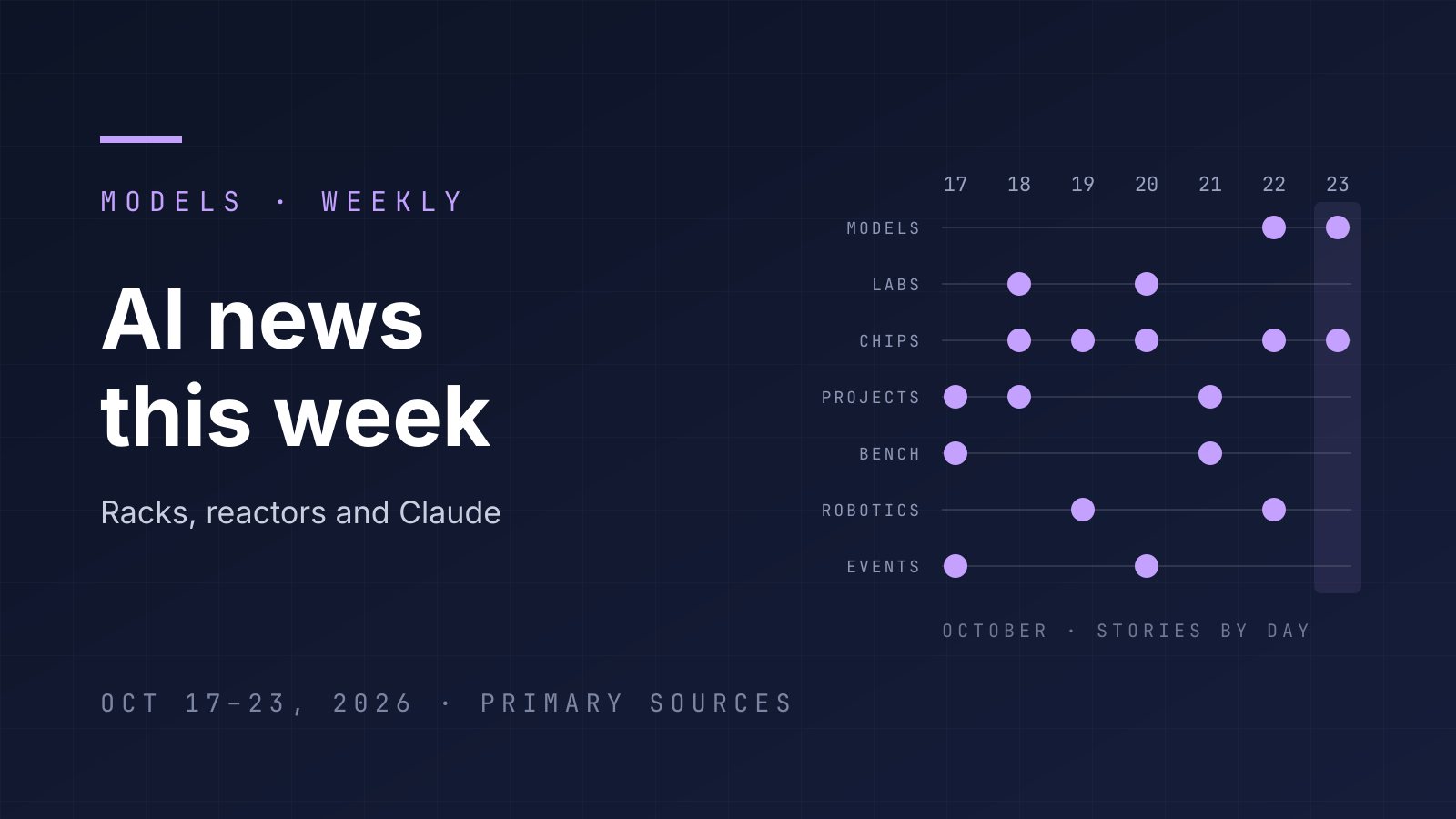
Also published this week: the Firebird Kazakhstan AI factory report (event date October 23) and Sunday’s AI company news for October 18–24. The previous roundup is AI news for October 17–23.