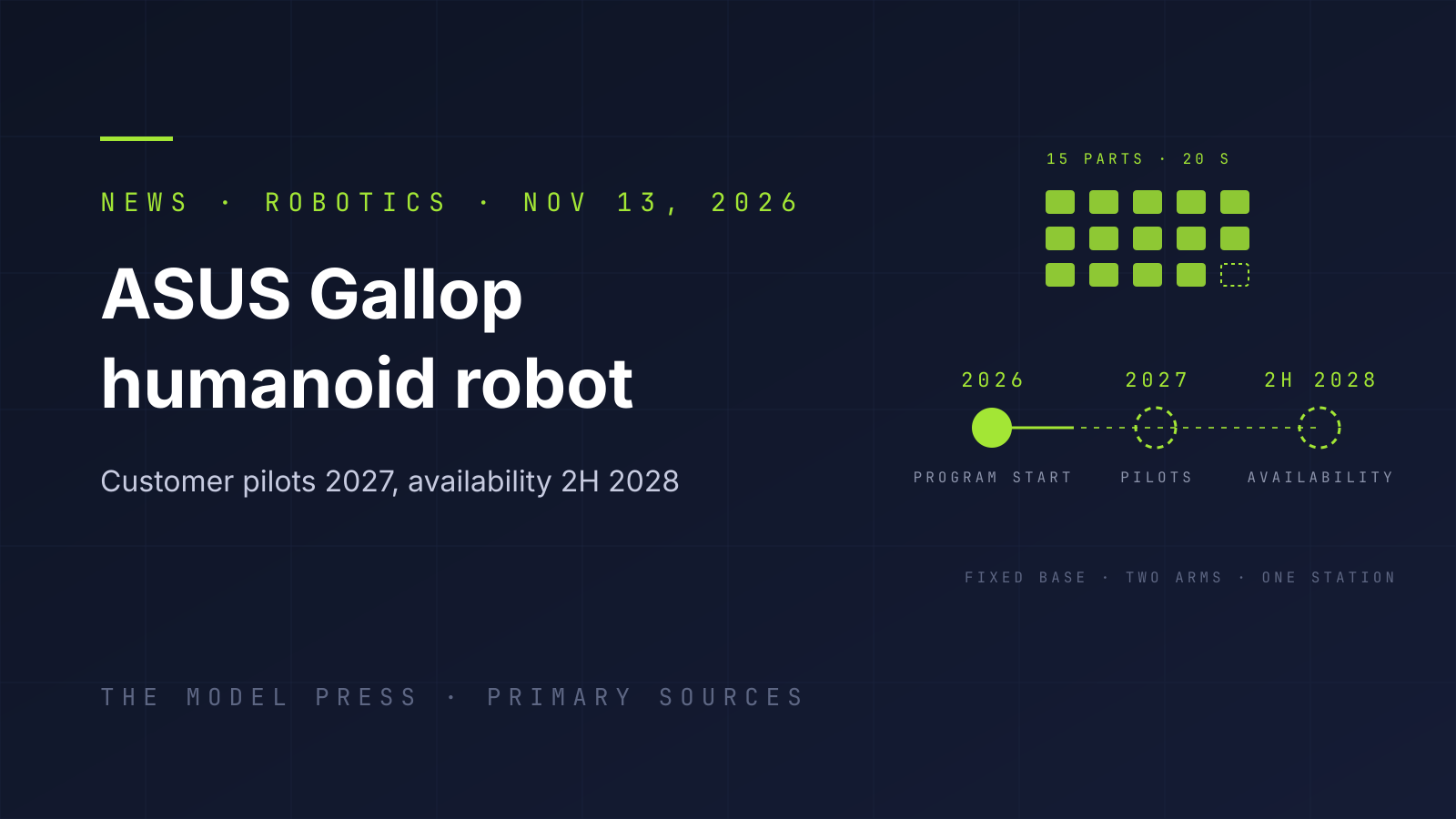
ASUS described its first humanoid robot, Gallop, on November 13, 2026, in a post on the ASUS Pressroom by Dr. Albert Chang. The ASUS humanoid robot is already working at a motherboard-accessory packing station in an ASUS group electronics manufacturing (EMS) factory. Customer pilots are planned for 2027 and market availability is targeted for the second half of 2028.
Gallop is not a walking robot yet. ASUS says it “works from a fixed base with two arms”, with a wheeled version next. The company published no price, payload, weight, battery or degrees-of-freedom figures.
On this page
The first job: 15 parts in 20 seconds
ASUS chose a station it calls hard on purpose. The robot packs 15 small motherboard accessories, many of them in thin, clear bags, and the station takes about 20 seconds per board. ASUS’s target is 99.5% success within those 20 seconds, “the same standard we hold a person to.” The post says the full loop already works: a person shows the task, the robot learns it, and ASUS tests it on the line. It does not say whether Gallop has reached the 99.5% target yet.
What that target means over a shift is our arithmetic, not an ASUS figure. At 20 seconds a board, one station handles 180 boards an hour, or 1,440 in an eight-hour shift with no stops. At 99.5% success, about 7 of those 1,440 boards would still need a retry or a person:
| Assumption or result | Value | Basis |
|---|---|---|
| Cycle time per board | 20 s | ASUS, November 13 |
| Success target | 99.5% | ASUS, November 13 |
| Boards per hour at 20 s | 180 | 3,600 s ÷ 20 s |
| Boards per 8-hour shift, no stops | 1,440 | 180 × 8 (shift length is our assumption) |
| Failed attempts at 99.5% | about 7 per shift | 1,440 × 0.5% |
ASUS’s own test for the project is whether the robot takes on most of the job: “If a person still has to stand beside it the whole time, nobody gains anything.”
How Gallop learns and what runs it
ASUS says it does not build its own large AI model. It starts from “leading open models” and trains them on the station, without naming which ones. Training comes from five sources the post lists: general knowledge from those models; experienced workers wearing head cameras, with their consent; simulation that generates variations of each example; an operator in a VR headset and gloves guiding the robot on the same parts and cameras; and data the robot records once deployed.
The software is split into four layers that talk through fixed interfaces, so ASUS can swap in a newer model without rebuilding the robot:
| Layer | What ASUS says it does |
|---|---|
| Planner | Looks at the scene, understands the job and breaks it into steps |
| Supervisor | A second AI that checks every step and re-plans when something goes wrong |
| Skills | Reaching, grasping and placing |
| Control | Moves the arms and hands precisely and stops instantly if anything is wrong |
All four run on a single Nvidia Jetson AGX Thor computer inside the robot. ASUS does not say which Thor module it uses. On its Jetson Thor page, Nvidia lists the Jetson AGX Thor developer kit and the T5000 module at 2,070 TFLOPS (FP4, sparse), 128 GB of LPDDR5X memory at 273 GB/s and a 40 W to 130 W power range, with a 2,560-core Blackwell GPU; the smaller T4000 is listed at 1,200 TFLOPS and 64 GB. Blackwell is the same GPU architecture as the data-center B200 and GB200 parts in our AI chips table; Jetson Thor is Nvidia’s version of it for robots and other edge machines.
Open robot models of the kind ASUS describes, which turn camera input and instructions into arm and hand motion, are covered in our vision-language-action models explainer and our Nvidia GR00T explainer. ASUS does not say whether Gallop starts from GR00T or another model.
ASUS designs the body and the dexterous hand itself; the hand has a sense of touch, which ASUS says is the hardest part of any humanoid and “still scarce worldwide.” Motors and other standard components come from partners.
Timeline ASUS has given
| Date | Step | Source |
|---|---|---|
| Early 2026 | Gallop program starts | ASUS, November 13 |
| June 2, 2026 | ASUS shows service robots (Kairo, a companion robot) and its Maestro orchestration platform at Computex, no humanoid | ASUS press release |
| November 13, 2026 | Gallop described; fixed-base, two-arm version at an EMS packing station | ASUS, November 13 |
| Next 12 months | In-house dexterous hand fitted; wheeled version | ASUS, November 13 |
| Computex 2027 | Customer demonstrations | ASUS, November 13 |
| 2027 | Customer pilots | ASUS, November 13 |
| Second half of 2028 | Market availability targeted | ASUS, November 13 |
Electronics manufacturing comes first. ASUS says hospitals and service sites could follow because many jobs share the same pick-and-place skills, but gives no dates for those. Gallop comes from the Humanoid Robotics business unit of ASUS’s Physical AI Solutions Business Group.
What the announcement shows, and what it doesn’t
The post is a company account of a robot in its own factory, not an independent test. ASUS gives a target, not a measured success rate, and no figures for uptime, cost or how many Gallop units are running. A fixed two-arm robot at one station is closer to a flexible industrial cell than to the walking humanoids from Agility, Figure or Boston Dynamics; the trade-offs are set out in our humanoid vs industrial robots explainer. Robots that can be bought today, and their prices where makers publish them, are in our humanoid robots for sale explainer, and runtime per charge in our humanoid robot battery life explainer. ASUS has not yet said how Gallop will be powered once it moves onto wheels.
Other humanoid robot news is collected in Humanoid robots news.